

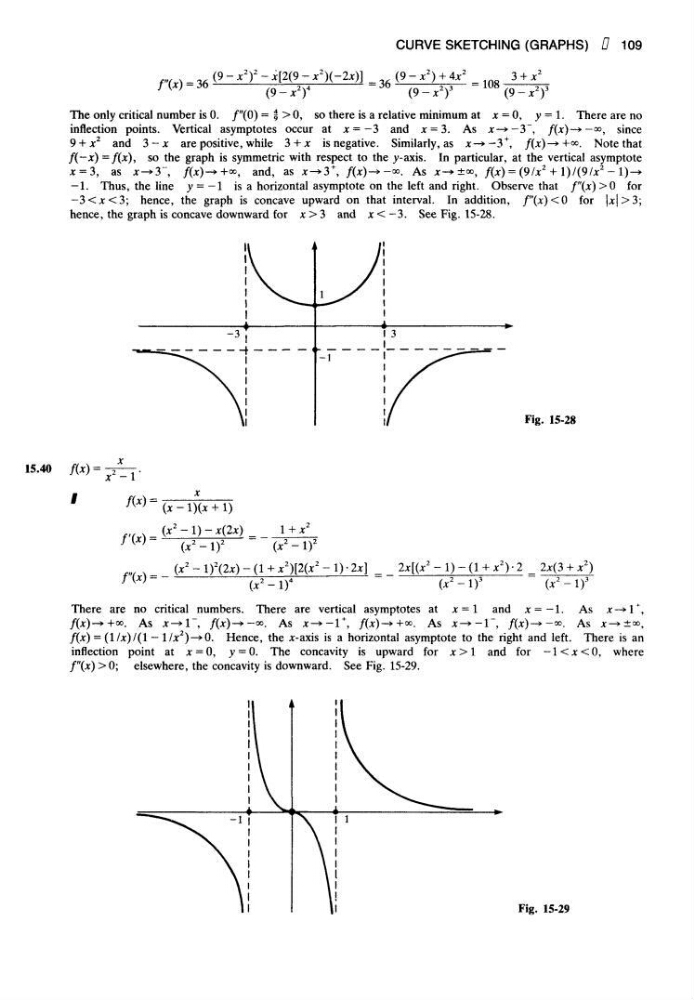
The only critical number is 0. /"(0)=5>0, so there is a relative minimum at AC=O, y = l. There are no
inflection points. Vertical asymptotes occur at x = — 3 and x = 3. As *—>—3~, /(*)—»—°°, since
9 + x
2
and 3 — * are positive, while 3 + x is negative. Similarly, as jc-»-3
+ , /(*)—»+«>. Note that
/(—x) =f(x), so the graph is symmetric with respect to the y-axis. In particular, at the vertical asymptote
x = 3, as x-*3~, /(*)-»+°°, and, as x^>3
+ , /(*)-»-». As ^:->±oo, /(^) = (9/x
2 + l)/(9/x
2 - 1)^
— 1. Thus, the line y = — 1 is a horizontal asym/(—x) =f(x), so the graph is symmetric with respect to the y-axis. In particular, at the vertical asymptoteptote on the left and right. Observe that f"(x) >0 for
-33;
hence, the graph is concave downward for x > 3 and x < -3. See Fig. 15-28.
Fig. 15-28
15.40
Fig. 15-29
CURVE SKETCHING (GRAPHS) D 109
There are no critical numbers. There are vertical asymptotes at x = 1 and x = —\. As x—»1
+ ,
/(*)-»+00. As x—>l~, /(*)-»-°°. As *-»-l
+ , /(*)-»+<». As *-»-!", /(*)-»-=>°. As x—»±°o,
f(x) = (\/x)/(\ — l/x
2 )—*Q. Hence, the x-axis is a horizontal asymptote to the right and left. There is an
inflection point at x = 0, y = 0. The concavity is upward for x>l and for —\
inflection points. Vertical asymptotes occur at x = — 3 and x = 3. As *—>—3~, /(*)—»—°°, since
9 + x
2
and 3 — * are positive, while 3 + x is negative. Similarly, as jc-»-3
+ , /(*)—»+«>. Note that
/(—x) =f(x), so the graph is symmetric with respect to the y-axis. In particular, at the vertical asymptote
x = 3, as x-*3~, /(*)-»+°°, and, as x^>3
+ , /(*)-»-». As ^:->±oo, /(^) = (9/x
2 + l)/(9/x
2 - 1)^
— 1. Thus, the line y = — 1 is a horizontal asym/(—x) =f(x), so the graph is symmetric with respect to the y-axis. In particular, at the vertical asymptoteptote on the left and right. Observe that f"(x) >0 for
-3
hence, the graph is concave downward for x > 3 and x < -3. See Fig. 15-28.
Fig. 15-28
15.40
Fig. 15-29
CURVE SKETCHING (GRAPHS) D 109
There are no critical numbers. There are vertical asymptotes at x = 1 and x = —\. As x—»1
+ ,
/(*)-»+00. As x—>l~, /(*)-»-°°. As *-»-l
+ , /(*)-»+<». As *-»-!", /(*)-»-=>°. As x—»±°o,
f(x) = (\/x)/(\ — l/x
2 )—*Q. Hence, the x-axis is a horizontal asymptote to the right and left. There is an
inflection point at x = 0, y = 0. The concavity is upward for x>l and for —\