

CURVE SKETCHING (GRAPHS) 0 107
In Problems 15.32 to 15.54, sketch the graphs of the given functions.
15.32
f(x) = sin
2 x.
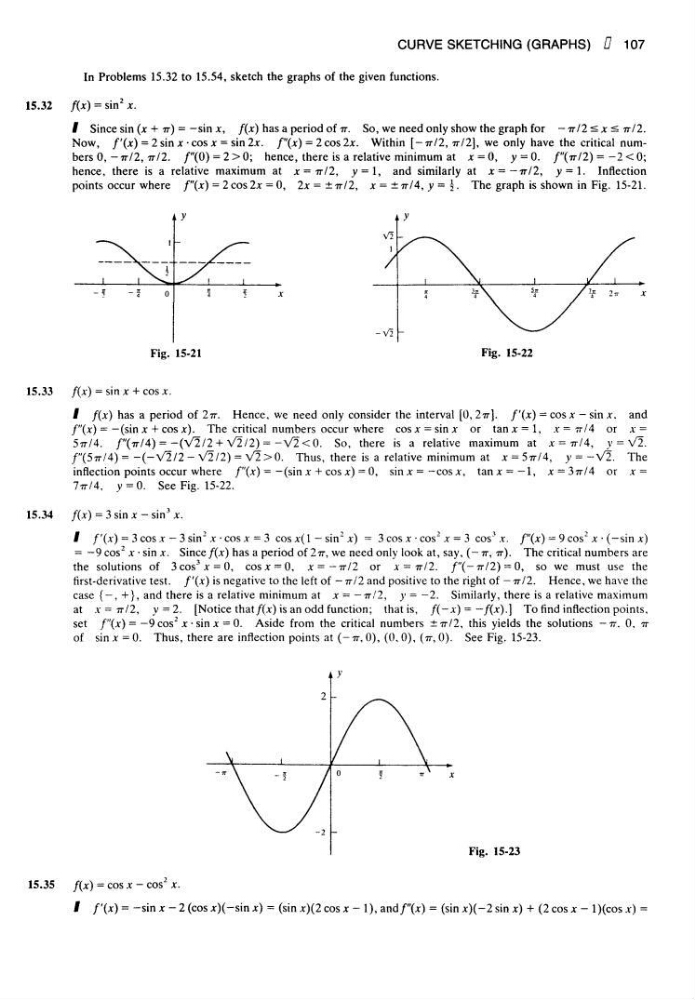
I Since sin (x + 77) — -sin x, f(x) has a period of -n. So, we need only show the graph for -Tr/2-sx s IT 12.
Now, /'(•*) = 2 sin x • cos x = sin 2x. f"(x) = 2cos2x. Within [-77/2, 77/2], we only have the critical numbers 0,-77/2, 77/2. /"(0) = 2>0; hence, there is a relative minimum at x=0, y=0. f"(irl2) = -2<0;
hence, there is a relative maximum at x=-rr/2, y = l, and similarly at x=-ir/2, y = l. Inflection
points occur where f"(x) = 2 cos 2x = 0, 2x = ± ir/2, x = ± ir/4, y = \. The graph is shown in Fig. 15-21.
Fig. 15-21
Fig. 15-22
15.33
f(x) = sinx + COSA.
I f(x) has a period of ITT. Hence, we need only consider the interval [0, 2-rr\. f'(x) = cos x — sin x. and
f"(x) = — (sin x + cos x). The critical numbers occur where cos x = sin* or tanx = l, x = 77/4 or A'=
577/4. f"(ir/4) = -(V2/2 + V2/2) = -V2<0. So, there is a relative maximum at x = 7r/4, y = V2.
/"(57r/4)= -(-V2/2- V2/2) = V2>0. Thus, there is a relative minimum at A = 577/4, y = -V2. The
inflection points occur where f"(x) = -(sin x + cos A:) = 0, sinx =-cos*, tanx = —1, A-= 377/4 or x =
77T/4. y = 0. See Fig. 15-22.
15.34
/(x) = 3 sin x - sin
3 x.
I f'(x) = 3 cos x - 3 sin
2 x • cos A- = 3 cos x( 1 - sin
2 x) = 3 cos * • cos
2 x = 3 cos
3 x. /"(x) = 9 cos
2 x • (-sin x)
= -9 cos
2 x • sin x. Since/(x) has a period of 277, we need only look at, say, (- 77, 77). The critical numbers are
the solutions of 3cos
3 A = 0, COSA- = O, x = --rr/2 or A = 77/2. /"(—77/2) = 0, so we must use the
first-derivative test. f'(x) is negative to the left of - 77/2 and positive to the right of - 77/2. Hence, we have the
case {-, +}, and there is a relative minimum at x = -Tr/2, y = -2. Similarly, there is a relative maximum
at A = 77/2, y = 2. [Notice that /(A) is an odd function; that is, f(-x) =—f(x).} To find inflection points,
set f"(x) = — 9 cos
2 x • sin x = 0. Aside from the critical numbers ±77/2, this yields the solutions -77. 0. 77
of sin A = 0. Thus, there are inflection points at (- 77,0), (0. 0), (77, 0). See Fig. 15-23.
Fig. 15-23
15.35
/(A-) = cos x - cos
2 x.
I f'(x)= -sin A- -2(cosA-)(-sinA-) = (sin x)(2 cos x - l),and/"(A-) = (sin A)(-2sin x) + (2 cos A: - l)(cos x)
In Problems 15.32 to 15.54, sketch the graphs of the given functions.
15.32
f(x) = sin
2 x.
I Since sin (x + 77) — -sin x, f(x) has a period of -n. So, we need only show the graph for -Tr/2-sx s IT 12.
Now, /'(•*) = 2 sin x • cos x = sin 2x. f"(x) = 2cos2x. Within [-77/2, 77/2], we only have the critical numbers 0,-77/2, 77/2. /"(0) = 2>0; hence, there is a relative minimum at x=0, y=0. f"(irl2) = -2<0;
hence, there is a relative maximum at x=-rr/2, y = l, and similarly at x=-ir/2, y = l. Inflection
points occur where f"(x) = 2 cos 2x = 0, 2x = ± ir/2, x = ± ir/4, y = \. The graph is shown in Fig. 15-21.
Fig. 15-21
Fig. 15-22
15.33
f(x) = sinx + COSA.
I f(x) has a period of ITT. Hence, we need only consider the interval [0, 2-rr\. f'(x) = cos x — sin x. and
f"(x) = — (sin x + cos x). The critical numbers occur where cos x = sin* or tanx = l, x = 77/4 or A'=
577/4. f"(ir/4) = -(V2/2 + V2/2) = -V2<0. So, there is a relative maximum at x = 7r/4, y = V2.
/"(57r/4)= -(-V2/2- V2/2) = V2>0. Thus, there is a relative minimum at A = 577/4, y = -V2. The
inflection points occur where f"(x) = -(sin x + cos A:) = 0, sinx =-cos*, tanx = —1, A-= 377/4 or x =
77T/4. y = 0. See Fig. 15-22.
15.34
/(x) = 3 sin x - sin
3 x.
I f'(x) = 3 cos x - 3 sin
2 x • cos A- = 3 cos x( 1 - sin
2 x) = 3 cos * • cos
2 x = 3 cos
3 x. /"(x) = 9 cos
2 x • (-sin x)
= -9 cos
2 x • sin x. Since/(x) has a period of 277, we need only look at, say, (- 77, 77). The critical numbers are
the solutions of 3cos
3 A = 0, COSA- = O, x = --rr/2 or A = 77/2. /"(—77/2) = 0, so we must use the
first-derivative test. f'(x) is negative to the left of - 77/2 and positive to the right of - 77/2. Hence, we have the
case {-, +}, and there is a relative minimum at x = -Tr/2, y = -2. Similarly, there is a relative maximum
at A = 77/2, y = 2. [Notice that /(A) is an odd function; that is, f(-x) =—f(x).} To find inflection points,
set f"(x) = — 9 cos
2 x • sin x = 0. Aside from the critical numbers ±77/2, this yields the solutions -77. 0. 77
of sin A = 0. Thus, there are inflection points at (- 77,0), (0. 0), (77, 0). See Fig. 15-23.
Fig. 15-23
15.35
/(A-) = cos x - cos
2 x.
I f'(x)= -sin A- -2(cosA-)(-sinA-) = (sin x)(2 cos x - l),and/"(A-) = (sin A)(-2sin x) + (2 cos A: - l)(cos x)