

106 D CHAPTER 15
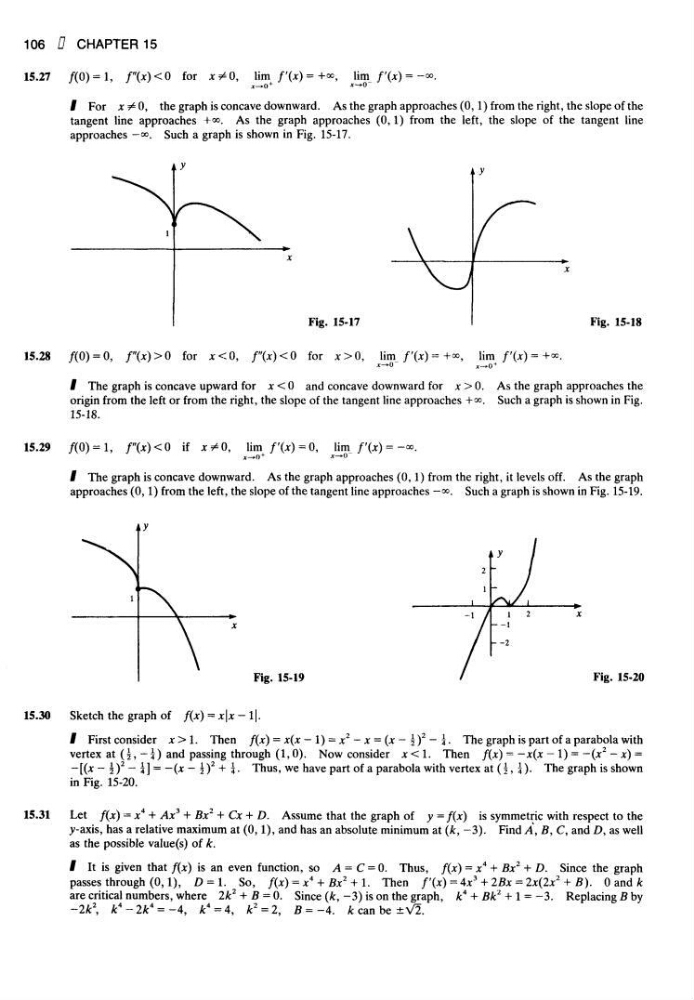
15.27 /(0) = 1, /"W<0 for
I For x ¥= 0, the graph is concave downward. As the graph approaches (0, 1) from the right, the slope of the
tangent line approaches +°°. As the graph approaches (0, 1) from the left, the slope of the tangent line
approaches — ». Such a graph is shown in Fig. 15-17.
Fig. 15-17
Fig. 15-18
15.28 /(0) = 0, /"(*)>0 for x<0, f"(x)<0 for x>0,
I The graph is concave upward for x < 0 and concave downward for x > 0. As the graph approaches the
origin from the left or from the right, the slope of the tangent line approaches +». Such a graph is shown in Fig.
15-18.
I The graph is concave downward. As the graph approaches (0, 1) from the right, it levels off. As the graph
approaches (0, 1) from the left, the slope of the tangent line approaches — °o. Such a graph is shown in Fig. 15-19.
Fig. 15-19
Fig. 15-20
15.30
Sketch the graph of f(x) = x\x-l\.
I First consider x>l. Then f(x) = x(x — 1) = x
2 - x = (x - j)
2 — j. The graph is part of a parabola with
vertex at (J, — |) and passing through (1,0). Now consider *<1. Then f(x) = — x(x — 1) = — (x
2 — x) =
-[(x - j)
2 — 3 ] = —(x— j )
2 + ?. Thus, we have part of a parabola with vertex at ( \, \ ). The graph is shown
in Fig. 15-20.
15.31
Let f(x) = x
4 + Ax
3 + Bx
2 + Cx + D. Assume that the graph of y = f(x) is symmetric with respect to the
y-axis, has a relative maximum at (0,1), and has an absolute minimum at (k, -3). Find A, B, C, and D, as well
as the possible value(s) of k.
I It is given that f(x) is an even function, so A = C = 0. Thus, f(x) = x
4 + Bx
2 + D. Since the graph
passes through (0,1), D = 1. So, f(x) = x
4 + Bx
2 + 1. Then /'(*) = 4x
3 +2Bx = 2x(2x
2 + B). 0 and A:
are critical numbers, where 2k
2 + B = 0. Since (fc,-3) is on the graph, k* + Bk
2 + l = -3. Replacing B by
-2k
2 , A:
4 -2Jfc
4 = -4, A:
4 = 4, k
2 = 2, B = -4. k can be ±V2.
15.29 /(0) = 1, f"(x)<0 if x 7^0,
15.27 /(0) = 1, /"W<0 for
I For x ¥= 0, the graph is concave downward. As the graph approaches (0, 1) from the right, the slope of the
tangent line approaches +°°. As the graph approaches (0, 1) from the left, the slope of the tangent line
approaches — ». Such a graph is shown in Fig. 15-17.
Fig. 15-17
Fig. 15-18
15.28 /(0) = 0, /"(*)>0 for x<0, f"(x)<0 for x>0,
I The graph is concave upward for x < 0 and concave downward for x > 0. As the graph approaches the
origin from the left or from the right, the slope of the tangent line approaches +». Such a graph is shown in Fig.
15-18.
I The graph is concave downward. As the graph approaches (0, 1) from the right, it levels off. As the graph
approaches (0, 1) from the left, the slope of the tangent line approaches — °o. Such a graph is shown in Fig. 15-19.
Fig. 15-19
Fig. 15-20
15.30
Sketch the graph of f(x) = x\x-l\.
I First consider x>l. Then f(x) = x(x — 1) = x
2 - x = (x - j)
2 — j. The graph is part of a parabola with
vertex at (J, — |) and passing through (1,0). Now consider *<1. Then f(x) = — x(x — 1) = — (x
2 — x) =
-[(x - j)
2 — 3 ] = —(x— j )
2 + ?. Thus, we have part of a parabola with vertex at ( \, \ ). The graph is shown
in Fig. 15-20.
15.31
Let f(x) = x
4 + Ax
3 + Bx
2 + Cx + D. Assume that the graph of y = f(x) is symmetric with respect to the
y-axis, has a relative maximum at (0,1), and has an absolute minimum at (k, -3). Find A, B, C, and D, as well
as the possible value(s) of k.
I It is given that f(x) is an even function, so A = C = 0. Thus, f(x) = x
4 + Bx
2 + D. Since the graph
passes through (0,1), D = 1. So, f(x) = x
4 + Bx
2 + 1. Then /'(*) = 4x
3 +2Bx = 2x(2x
2 + B). 0 and A:
are critical numbers, where 2k
2 + B = 0. Since (fc,-3) is on the graph, k* + Bk
2 + l = -3. Replacing B by
-2k
2 , A:
4 -2Jfc
4 = -4, A:
4 = 4, k
2 = 2, B = -4. k can be ±V2.
15.29 /(0) = 1, f"(x)<0 if x 7^0,