

Part II: The Answers
572
Answers
901–1,001
962.
12 8
7
6
5
4
3
2
1
2 3
7 12
12
512
1 3
1 4
1 6
1 12
1 12
x
x
x
x
x
x
x
x
x
+
+
+
+
+
+
+
+
−
/
/
ln
+ C
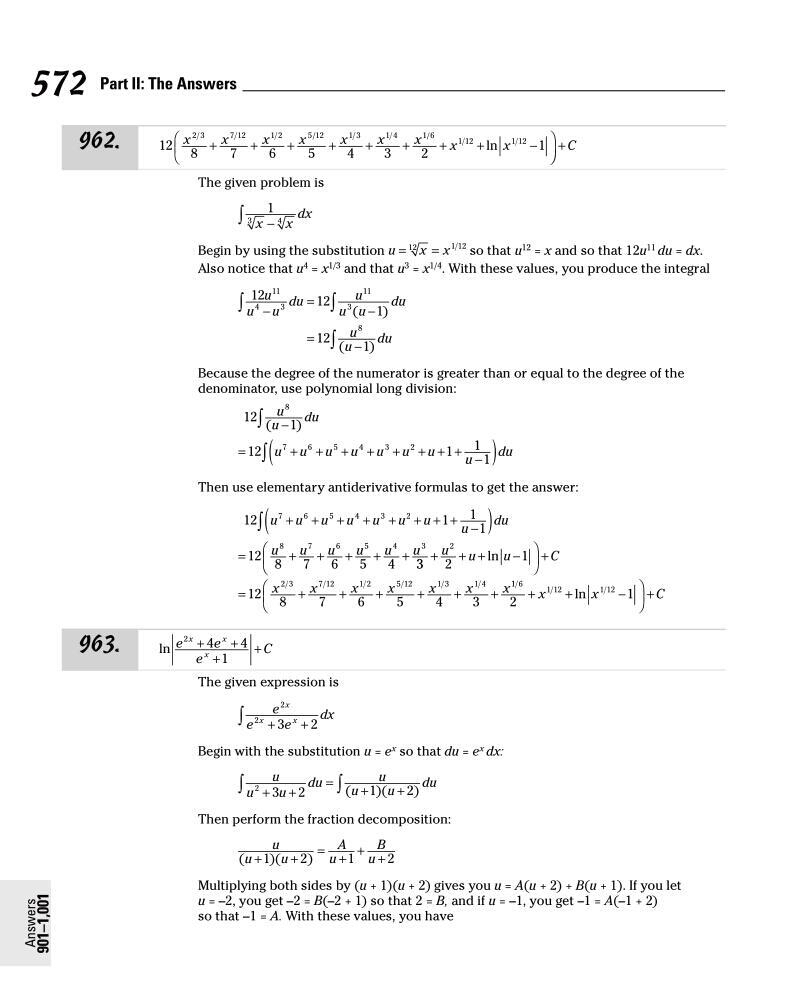
The given problem is
1
3
4
x
x
dx
−
∫
Begin by using the substitution u
x x
=
=
12
1 12 so that u
12
= x and so that 12u
11
du = dx.
Also notice that u
4
= x
1/3
and that u
3
= x
1/4
. With these values, you produce the integral
12
12
1
12
1
11
4
3
11
3
8
u
u u
du
u
u u
du
u
u
du
−
=
−
=
−
∫
∫
∫
(
)
(
)
Because the degree of the numerator is greater than or equal to the degree of the
denominator, use polynomial long division:
12
1
12
1
1
1
8
7
6
5
4
3
2
u
u
du
u u u u u u u
u
du
(
)
−
=
+ + + + + + + + − )
(
∫
∫
Then use elementary antiderivative formulas to get the answer:
12
1
1
1
12 8
7
6
5
4
7
6
5
4
3
2
8
7
6
5
4
3
u u u u u u u
u
du
u
u
u
u
u
u
+ + + + + + + + − )
(
=
+
+
+
+
+
∫
3 3
2
1
12 8
7
6
5
4
3
2
2 3
7 12
12
512
1 3
1 4
+
+ +
−
+
=
+
+
+
+
+
+
u u
u
C
x
x
x
x
x
x
x
ln
1 1 6
1 12
1 12
2
1
+
+
−
+
x
x
C
ln
963.
ln e
e
e
C
x
x
x
2
4
4
1
+
+
+
+
The given expression is
e
e
e
dx
x
x
x
2
2
3
2
+
+
∫
Begin with the substitution u = e
x
so that du = e
x
dx:
u
u
u
du
u
u
u
du
2
3 2
1
2
+ +
=
+
+
∫
∫ ( )( )
Then perform the fraction decomposition:
u
u
u
A
u
B
u
(
)(
)
+
+
= +
+ +
1
2
1
2
Multiplying both sides by (u + 1)(u + 2) gives you u = A(u + 2) + B(u + 1). If you let
u = –2, you get –2 = B(–2 + 1) so that 2 = B, and if u = –1, you get –1 = A(–1 + 2)
so that –1 = A. With these values, you have
572
Answers
901–1,001
962.
12 8
7
6
5
4
3
2
1
2 3
7 12
12
512
1 3
1 4
1 6
1 12
1 12
x
x
x
x
x
x
x
x
x
+
+
+
+
+
+
+
+
−
/
/
ln
+ C
The given problem is
1
3
4
x
x
dx
−
∫
Begin by using the substitution u
x x
=
=
12
1 12 so that u
12
= x and so that 12u
11
du = dx.
Also notice that u
4
= x
1/3
and that u
3
= x
1/4
. With these values, you produce the integral
12
12
1
12
1
11
4
3
11
3
8
u
u u
du
u
u u
du
u
u
du
−
=
−
=
−
∫
∫
∫
(
)
(
)
Because the degree of the numerator is greater than or equal to the degree of the
denominator, use polynomial long division:
12
1
12
1
1
1
8
7
6
5
4
3
2
u
u
du
u u u u u u u
u
du
(
)
−
=
+ + + + + + + + − )
(
∫
∫
Then use elementary antiderivative formulas to get the answer:
12
1
1
1
12 8
7
6
5
4
7
6
5
4
3
2
8
7
6
5
4
3
u u u u u u u
u
du
u
u
u
u
u
u
+ + + + + + + + − )
(
=
+
+
+
+
+
∫
3 3
2
1
12 8
7
6
5
4
3
2
2 3
7 12
12
512
1 3
1 4
+
+ +
−
+
=
+
+
+
+
+
+
u u
u
C
x
x
x
x
x
x
x
ln
1 1 6
1 12
1 12
2
1
+
+
−
+
x
x
C
ln
963.
ln e
e
e
C
x
x
x
2
4
4
1
+
+
+
+
The given expression is
e
e
e
dx
x
x
x
2
2
3
2
+
+
∫
Begin with the substitution u = e
x
so that du = e
x
dx:
u
u
u
du
u
u
u
du
2
3 2
1
2
+ +
=
+
+
∫
∫ ( )( )
Then perform the fraction decomposition:
u
u
u
A
u
B
u
(
)(
)
+
+
= +
+ +
1
2
1
2
Multiplying both sides by (u + 1)(u + 2) gives you u = A(u + 2) + B(u + 1). If you let
u = –2, you get –2 = B(–2 + 1) so that 2 = B, and if u = –1, you get –1 = A(–1 + 2)
so that –1 = A. With these values, you have