

Answers and Explanations 571
Answers
901–1,001
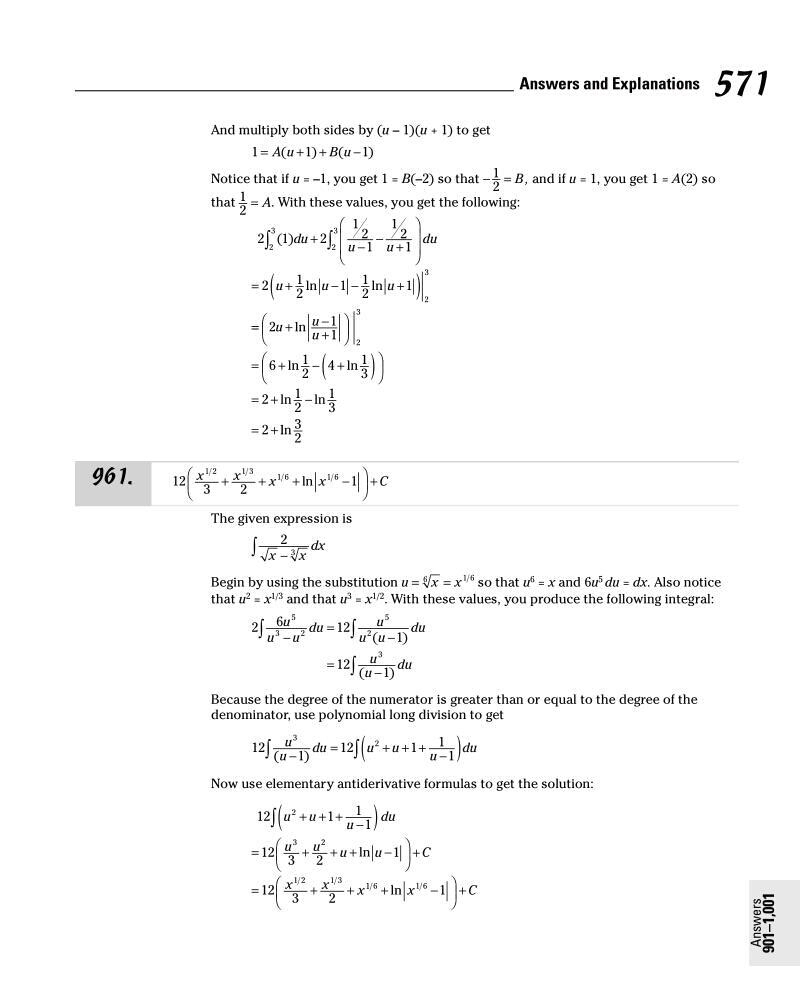
And multiply both sides by (u – 1)(u + 1) to get
1
1
1
=
+ +
−
A u
B u
(
)
(
)
Notice that if u = –1, you get 1 = B(–2) so that − =
1
2
B , and if u = 1, you get 1 = A(2) so
that 1
2
= A. With these values, you get the following:
2 1
2
1 2
1
1 2
1
2
1
2
1 1
2
1
2
3
2
3
2
3
( )
ln
ln
du
u
u
du
u
u
u
∫
∫
+
−
− +
=
+
− −
+ )
(
= =
+
−
+
= +
− +
( )
= +
−
= +
2
1
1
6
1
2
4
1
3
2
1
2
1
3
2
2
3
u
u
u
ln
ln
ln
ln
ln
l ln 3
2
961.
12 3
2
1
1 2
1 3
1 6
1 6
x
x
x
x
C
+
+
+
−
+
ln
The given expression is
2
3
x
x
dx
−
∫
Begin by using the substitution u
x x
=
=
6
1 6 so that u
6
= x and 6u
5
du = dx. Also notice
that u
2
= x
1/3
and that u
3
= x
1/2
. With these values, you produce the following integral:
2 6
12
1
12
1
5
3
2
5
2
3
u
u u
du
u
u u
du
u
u
du
−
=
−
=
−
∫
∫
∫
(
)
(
)
Because the degree of the numerator is greater than or equal to the degree of the
denominator, use polynomial long division to get
12
1
12
1
1
1
3
2
u
u
du
u u
u
du
(
)
−
=
+ + + −
(
)
∫
∫
Now use elementary antiderivative formulas to get the solution:
12
1
1
1
12 3
2
1
12 3
2
2
3
2
1 2
1 3
u u
u
du
u
u u
u
C
x
x
x
+ + + −
(
)
=
+
+ +
−
+
=
+
+
∫
ln
1 1 6
1 6
1
+
−
+
ln x
C
Answers
901–1,001
And multiply both sides by (u – 1)(u + 1) to get
1
1
1
=
+ +
−
A u
B u
(
)
(
)
Notice that if u = –1, you get 1 = B(–2) so that − =
1
2
B , and if u = 1, you get 1 = A(2) so
that 1
2
= A. With these values, you get the following:
2 1
2
1 2
1
1 2
1
2
1
2
1 1
2
1
2
3
2
3
2
3
( )
ln
ln
du
u
u
du
u
u
u
∫
∫
+
−
− +
=
+
− −
+ )
(
= =
+
−
+
= +
− +
( )
= +
−
= +
2
1
1
6
1
2
4
1
3
2
1
2
1
3
2
2
3
u
u
u
ln
ln
ln
ln
ln
l ln 3
2
961.
12 3
2
1
1 2
1 3
1 6
1 6
x
x
x
x
C
+
+
+
−
+
ln
The given expression is
2
3
x
x
dx
−
∫
Begin by using the substitution u
x x
=
=
6
1 6 so that u
6
= x and 6u
5
du = dx. Also notice
that u
2
= x
1/3
and that u
3
= x
1/2
. With these values, you produce the following integral:
2 6
12
1
12
1
5
3
2
5
2
3
u
u u
du
u
u u
du
u
u
du
−
=
−
=
−
∫
∫
∫
(
)
(
)
Because the degree of the numerator is greater than or equal to the degree of the
denominator, use polynomial long division to get
12
1
12
1
1
1
3
2
u
u
du
u u
u
du
(
)
−
=
+ + + −
(
)
∫
∫
Now use elementary antiderivative formulas to get the solution:
12
1
1
1
12 3
2
1
12 3
2
2
3
2
1 2
1 3
u u
u
du
u
u u
u
C
x
x
x
+ + + −
(
)
=
+
+ +
−
+
=
+
+
∫
ln
1 1 6
1 6
1
+
−
+
ln x
C