

Answers and Explanations 559
Answers
901–1,001
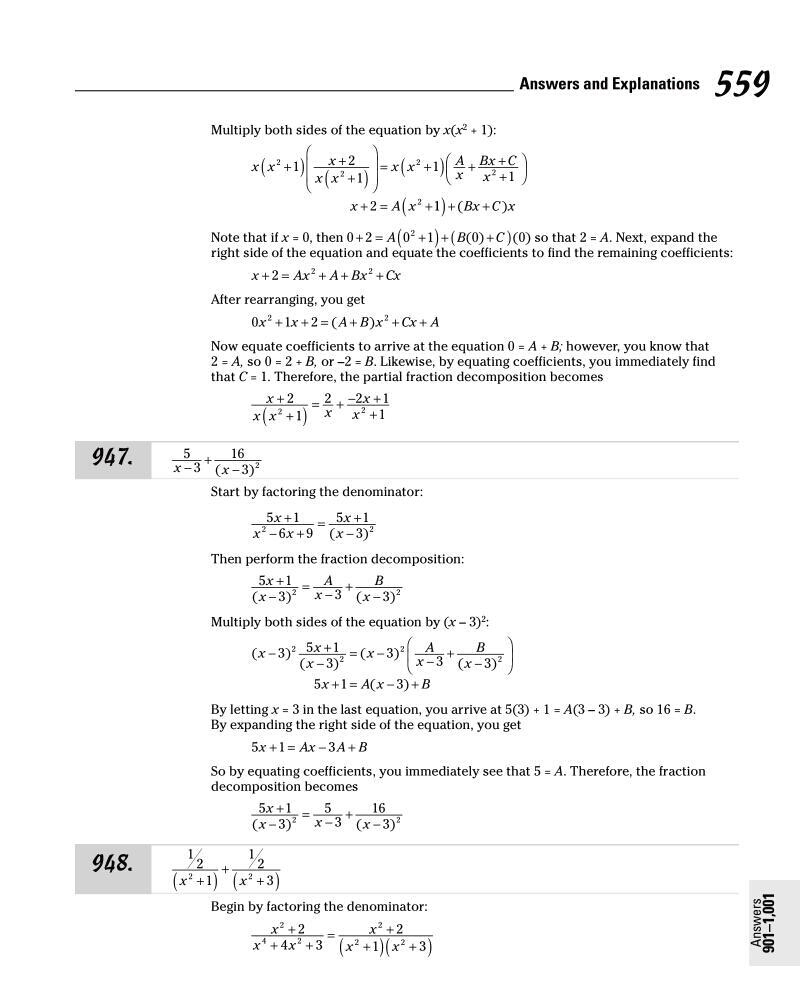
Multiply both sides of the equation by x(x
2
+ 1):
x x
x
x x
x x
A
x
Bx C
x
x
A x
2
2
2
2
2
1
2
1
1
1
2
+
(
)
+
+
(
)
=
+
(
) + +
+
+ =
+ 1 1
(
) + +
(
)
Bx C x
Note that if x = 0, then 0 2
0 1
0
0
2
+ =
+
( ) +
+
(
)
A
B
C
( )
( ) so that 2 = A. Next, expand the
right side of the equation and equate the coefficients to find the remaining coefficients:
x
Ax
A Bx Cx
+ =
+ +
+
2
2
2
After rearranging, you get
0
1
2
2
2
x
x
A B x Cx A
+ + =
+
+
+
(
)
Now equate coefficients to arrive at the equation 0 = A + B; however, you know that
2 = A, so 0 = 2 + B, or –2 = B. Likewise, by equating coefficients, you immediately find
that C = 1. Therefore, the partial fraction decomposition becomes
x
x x
x
x
x
+
+
(
)
= + − +
+
2
1
2
2
1
1
2
2
947.
5
3
16
3
2
x
x
−
+
−
(
)
Start by factoring the denominator:
5 1
6
9
5 1
3
2
2
x
x
x
x
x
+
−
+
=
+
−
(
)
Then perform the fraction decomposition:
5 1
3
3
3
2
2
x
x
A
x
B
x
+
−
= −
+
−
(
)
(
)
Multiply both sides of the equation by (x – 3)
2
:
(
) (
)
(
)
(
)
(
)
x
x
x
x
A
x
B
x
x
A x
B
−
+
−
=
−
−
+
−
+ =
− +
3
5 1
3
3
3
3
5 1
3
2
2
2
2
By letting x = 3 in the last equation, you arrive at 5(3) + 1 = A(3 – 3) + B, so 16 = B.
By expanding the right side of the equation, you get
5
1
3
x
Ax
A B
+ =
−
+
So by equating coefficients, you immediately see that 5 = A. Therefore, the fraction
decomposition becomes
5 1
3
5
3
16
3
2
2
x
x
x
x
+
−
= −
+
−
(
)
(
)
948.
1 2
1
1 2
3
2
2
x
x
+
(
)
+
+
(
)
Begin by factoring the denominator:
x
x
x
x
x
x
2
4
2
2
2
2
2
4
3
2
1
3
+
+
+
=
+
+
(
) +
(
)
Answers
901–1,001
Multiply both sides of the equation by x(x
2
+ 1):
x x
x
x x
x x
A
x
Bx C
x
x
A x
2
2
2
2
2
1
2
1
1
1
2
+
(
)
+
+
(
)
=
+
(
) + +
+
+ =
+ 1 1
(
) + +
(
)
Bx C x
Note that if x = 0, then 0 2
0 1
0
0
2
+ =
+
( ) +
+
(
)
A
B
C
( )
( ) so that 2 = A. Next, expand the
right side of the equation and equate the coefficients to find the remaining coefficients:
x
Ax
A Bx Cx
+ =
+ +
+
2
2
2
After rearranging, you get
0
1
2
2
2
x
x
A B x Cx A
+ + =
+
+
+
(
)
Now equate coefficients to arrive at the equation 0 = A + B; however, you know that
2 = A, so 0 = 2 + B, or –2 = B. Likewise, by equating coefficients, you immediately find
that C = 1. Therefore, the partial fraction decomposition becomes
x
x x
x
x
x
+
+
(
)
= + − +
+
2
1
2
2
1
1
2
2
947.
5
3
16
3
2
x
x
−
+
−
(
)
Start by factoring the denominator:
5 1
6
9
5 1
3
2
2
x
x
x
x
x
+
−
+
=
+
−
(
)
Then perform the fraction decomposition:
5 1
3
3
3
2
2
x
x
A
x
B
x
+
−
= −
+
−
(
)
(
)
Multiply both sides of the equation by (x – 3)
2
:
(
) (
)
(
)
(
)
(
)
x
x
x
x
A
x
B
x
x
A x
B
−
+
−
=
−
−
+
−
+ =
− +
3
5 1
3
3
3
3
5 1
3
2
2
2
2
By letting x = 3 in the last equation, you arrive at 5(3) + 1 = A(3 – 3) + B, so 16 = B.
By expanding the right side of the equation, you get
5
1
3
x
Ax
A B
+ =
−
+
So by equating coefficients, you immediately see that 5 = A. Therefore, the fraction
decomposition becomes
5 1
3
5
3
16
3
2
2
x
x
x
x
+
−
= −
+
−
(
)
(
)
948.
1 2
1
1 2
3
2
2
x
x
+
(
)
+
+
(
)
Begin by factoring the denominator:
x
x
x
x
x
x
2
4
2
2
2
2
2
4
3
2
1
3
+
+
+
=
+
+
(
) +
(
)