

Part II: The Answers
558
Answers
901–1,001
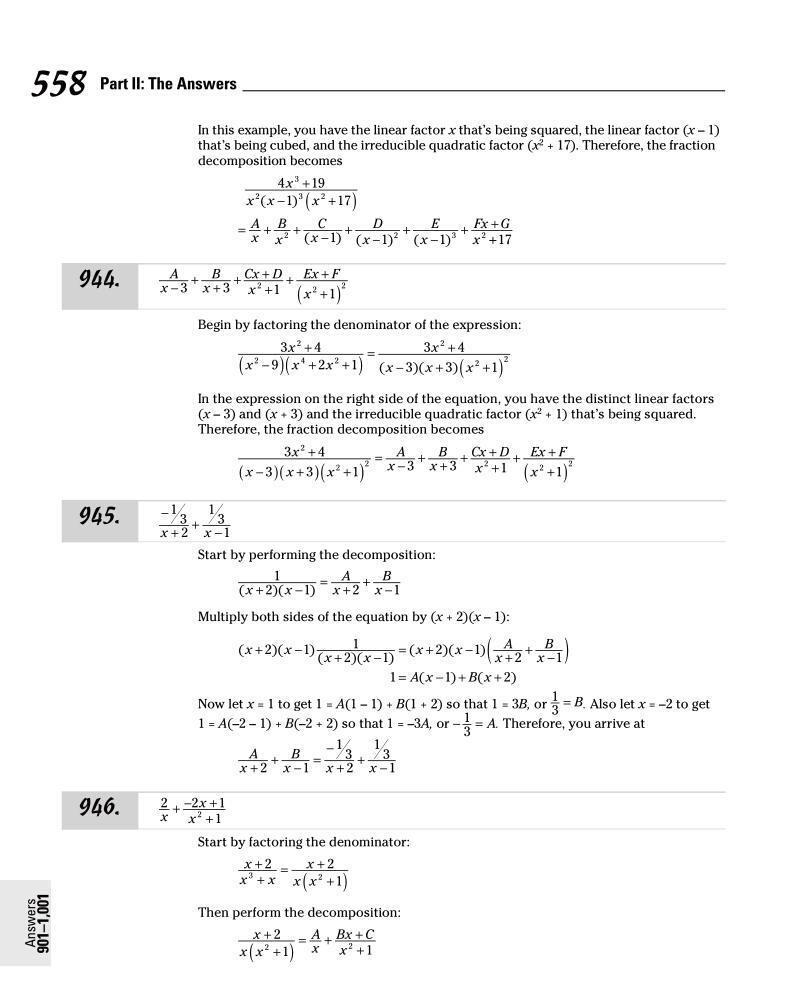
In this example, you have the linear factor x that’s being squared, the linear factor (x – 1)
that’s being cubed, and the irreducible quadratic factor (x
2
+ 17). Therefore, the fraction
decomposition becomes
4
19
1
1 7
1
1
1
3
2
3
2
2
2
3
2
x
x x
x
A
x
B
x
C
x
D
x
E
x
Fx G
x
+
−
+
(
)
= +
+
−
+
−
+
−
+
+
(
)
(
) (
)
(
)
+ + 17
944.
A
x
B
x
Cx D
x
Ex F
x
−
+ +
+
+
+
+
+
+
(
)
3
3
1
1
2
2
2
Begin by factoring the denominator of the expression:
3
4
9
2
1
3
4
3
3
1
2
2
4
2
2
2
2
x
x
x
x
x
x
x
x
+
−
(
) + +
(
)
=
+
−
+
+
(
)
(
)(
)
In the expression on the right side of the equation, you have the distinct linear factors
(x – 3) and (x + 3) and the irreducible quadratic factor (x
2
+ 1) that’s being squared.
Therefore, the fraction decomposition becomes
3
4
3
3
1
3
3
1
1
2
2
2
2
2
2
x
x
x
x
A
x
B
x
Cx D
x
Ex F
x
+
−
(
) +
(
) +
(
)
= −
+ +
+
+
+
+
+
+
(
)
945.
−
+
+ −
1 3
2
1 3
1
x
x
Start by performing the decomposition:
1
2
1
2
1
(
)(
)
x
x
A
x
B
x
+
−
= +
+ −
Multiply both sides of the equation by (x + 2)(x – 1):
(
)(
) (
)(
)
(
)(
)
(
)
(
)
x
x
x
x
x
x
A
x
B
x
A x
B x
+
−
+
−
=
+
−
+
+ −
(
)
=
− +
+
2
1
1
2
1
2
1
2
1
1
1
2
Now let x = 1 to get 1 = A(1 – 1) + B(1 + 2) so that 1 = 3B, or
1
3
= B . Also let x = –2 to get
1 = A(–2 – 1) + B(–2 + 2) so that 1 = –3A, or − =
1
3
A. Therefore, you arrive at
A
x
B
x
x
x
+
+ −
=
−
+
+ −
2
1
1 3
2
1 3
1
946.
2
2
1
1
2
x
x
x
+ − +
+
Start by factoring the denominator:
x
x
x
x
x x
+
+
=
+
+
(
)
2
2
1
3
2
Then perform the decomposition:
x
x x
A
x
Bx C
x
+
+
(
)
= +
+
+
2
1
1
2
2
558
Answers
901–1,001
In this example, you have the linear factor x that’s being squared, the linear factor (x – 1)
that’s being cubed, and the irreducible quadratic factor (x
2
+ 17). Therefore, the fraction
decomposition becomes
4
19
1
1 7
1
1
1
3
2
3
2
2
2
3
2
x
x x
x
A
x
B
x
C
x
D
x
E
x
Fx G
x
+
−
+
(
)
= +
+
−
+
−
+
−
+
+
(
)
(
) (
)
(
)
+ + 17
944.
A
x
B
x
Cx D
x
Ex F
x
−
+ +
+
+
+
+
+
+
(
)
3
3
1
1
2
2
2
Begin by factoring the denominator of the expression:
3
4
9
2
1
3
4
3
3
1
2
2
4
2
2
2
2
x
x
x
x
x
x
x
x
+
−
(
) + +
(
)
=
+
−
+
+
(
)
(
)(
)
In the expression on the right side of the equation, you have the distinct linear factors
(x – 3) and (x + 3) and the irreducible quadratic factor (x
2
+ 1) that’s being squared.
Therefore, the fraction decomposition becomes
3
4
3
3
1
3
3
1
1
2
2
2
2
2
2
x
x
x
x
A
x
B
x
Cx D
x
Ex F
x
+
−
(
) +
(
) +
(
)
= −
+ +
+
+
+
+
+
+
(
)
945.
−
+
+ −
1 3
2
1 3
1
x
x
Start by performing the decomposition:
1
2
1
2
1
(
)(
)
x
x
A
x
B
x
+
−
= +
+ −
Multiply both sides of the equation by (x + 2)(x – 1):
(
)(
) (
)(
)
(
)(
)
(
)
(
)
x
x
x
x
x
x
A
x
B
x
A x
B x
+
−
+
−
=
+
−
+
+ −
(
)
=
− +
+
2
1
1
2
1
2
1
2
1
1
1
2
Now let x = 1 to get 1 = A(1 – 1) + B(1 + 2) so that 1 = 3B, or
1
3
= B . Also let x = –2 to get
1 = A(–2 – 1) + B(–2 + 2) so that 1 = –3A, or − =
1
3
A. Therefore, you arrive at
A
x
B
x
x
x
+
+ −
=
−
+
+ −
2
1
1 3
2
1 3
1
946.
2
2
1
1
2
x
x
x
+ − +
+
Start by factoring the denominator:
x
x
x
x
x x
+
+
=
+
+
(
)
2
2
1
3
2
Then perform the decomposition:
x
x x
A
x
Bx C
x
+
+
(
)
= +
+
+
2
1
1
2
2