

Part II: The Answers
520
Answers
801–900
876.
1
2
1
2
2
2
2
x
x
x C
sin
c os
+
+
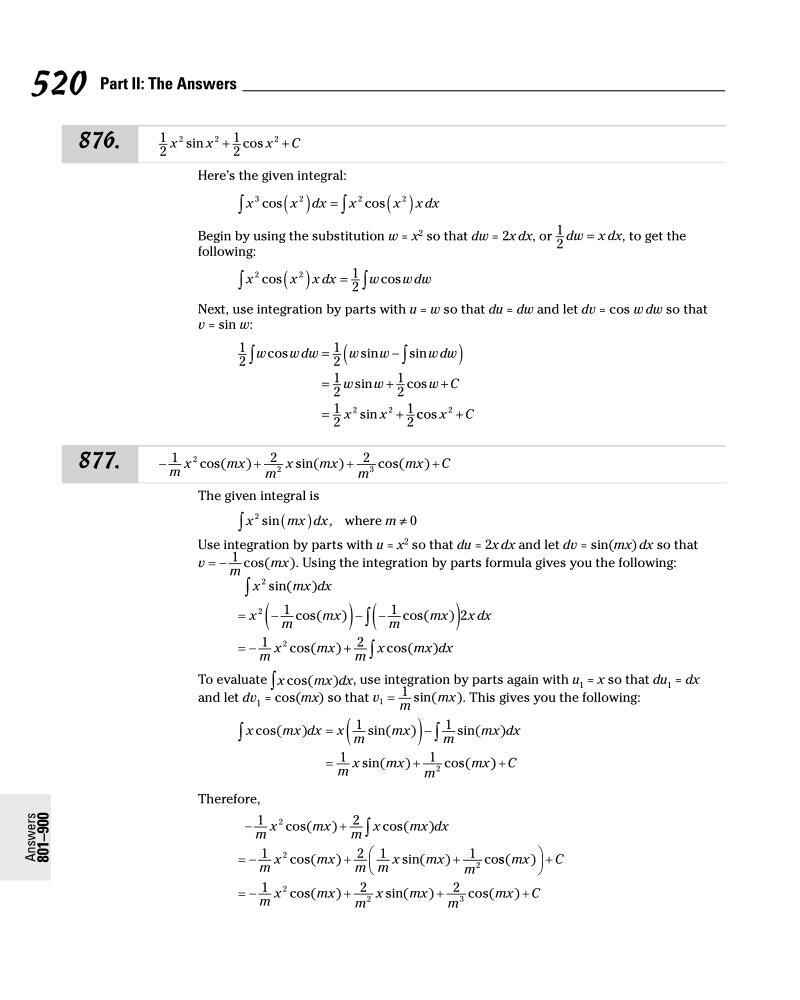
Here’s the given integral:
x
x dx
x
x x dx
3
2
2
2
cos
c os
( ) =
( )
∫
∫
Begin by using the substitution w = x
2
so that dw = 2x
dx, or 1
2
dw x dx
=
, to get the
following:
x
x x dx
w
w dw
2
2
1
2
cos
c os
( ) =
∫
∫
Next, use integration by parts with u = w so that du = dw and let dv = cos w
dw so that
v = sin w:
1
2
1
2
1
2
1
2
1
2
1
2
2
2
w
wdw
w
w
w dw
w
w
w C
x
x
cos
s in
sin
sin
cos
sin
∫
∫
=
−
(
)
=
+
+
=
+ c cos x C
2
+
877.
−
+
+
+
1
2
2
2
3
2
m
x
mx
m
x
mx
m
mx C
cos(
)
sin(
)
cos(
)
The given integral is
x
mx dx
m
2
0
sin ( )
≠
∫
, where
Use integration by parts with u = x
2
so that du = 2x
dx and let dv = sin(mx)
dx so that
v
m
mx
= − 1 cos(
). Using the integration by parts formula gives you the following:
x
mx dx
x
m
mx
m
mx
x dx
m
x
mx
2
2
2
1
1
2
1
sin(
)
cos(
)
c os(
)
cos(
)
∫
∫
=
−
(
) − −
(
)
= −
+ + ∫
2
m
x
mx dx
cos(
)
To evaluate x
mx dx
cos(
)
∫
, use integration by parts again with u 1 = x so that du 1 = dx
and let dv 1 = cos(mx) so that v
m
mx
1
1
= sin(
). This gives you the following:
x
mx dx x m
mx
m
mx dx
m
x
mx
m
mx
cos(
)
s in(
)
sin(
)
sin(
)
cos(
∫
∫
= (
) −
=
+
1
1
1
1
2
) ) + C
Therefore,
−
+
= −
+
+
∫
1
2
1
2 1
1
2
2
2
m
x
mx
m
x
mx dx
m
x
mx
m m
x
mx
m
cos(
)
c os(
)
cos(
)
s in(
)
cos s(
)
cos(
)
s in(
)
cos(
)
mx
C
m
x
mx
m
x
mx
m
mx C
+
= −
+
+
+
1
2
2
2
3
2
520
Answers
801–900
876.
1
2
1
2
2
2
2
x
x
x C
sin
c os
+
+
Here’s the given integral:
x
x dx
x
x x dx
3
2
2
2
cos
c os
( ) =
( )
∫
∫
Begin by using the substitution w = x
2
so that dw = 2x
dx, or 1
2
dw x dx
=
, to get the
following:
x
x x dx
w
w dw
2
2
1
2
cos
c os
( ) =
∫
∫
Next, use integration by parts with u = w so that du = dw and let dv = cos w
dw so that
v = sin w:
1
2
1
2
1
2
1
2
1
2
1
2
2
2
w
wdw
w
w
w dw
w
w
w C
x
x
cos
s in
sin
sin
cos
sin
∫
∫
=
−
(
)
=
+
+
=
+ c cos x C
2
+
877.
−
+
+
+
1
2
2
2
3
2
m
x
mx
m
x
mx
m
mx C
cos(
)
sin(
)
cos(
)
The given integral is
x
mx dx
m
2
0
sin ( )
≠
∫
, where
Use integration by parts with u = x
2
so that du = 2x
dx and let dv = sin(mx)
dx so that
v
m
mx
= − 1 cos(
). Using the integration by parts formula gives you the following:
x
mx dx
x
m
mx
m
mx
x dx
m
x
mx
2
2
2
1
1
2
1
sin(
)
cos(
)
c os(
)
cos(
)
∫
∫
=
−
(
) − −
(
)
= −
+ + ∫
2
m
x
mx dx
cos(
)
To evaluate x
mx dx
cos(
)
∫
, use integration by parts again with u 1 = x so that du 1 = dx
and let dv 1 = cos(mx) so that v
m
mx
1
1
= sin(
). This gives you the following:
x
mx dx x m
mx
m
mx dx
m
x
mx
m
mx
cos(
)
s in(
)
sin(
)
sin(
)
cos(
∫
∫
= (
) −
=
+
1
1
1
1
2
) ) + C
Therefore,
−
+
= −
+
+
∫
1
2
1
2 1
1
2
2
2
m
x
mx
m
x
mx dx
m
x
mx
m m
x
mx
m
cos(
)
c os(
)
cos(
)
s in(
)
cos s(
)
cos(
)
s in(
)
cos(
)
mx
C
m
x
mx
m
x
mx
m
mx C
+
= −
+
+
+
1
2
2
2
3
2