

Part II: The Answers
450
Answers
701–800
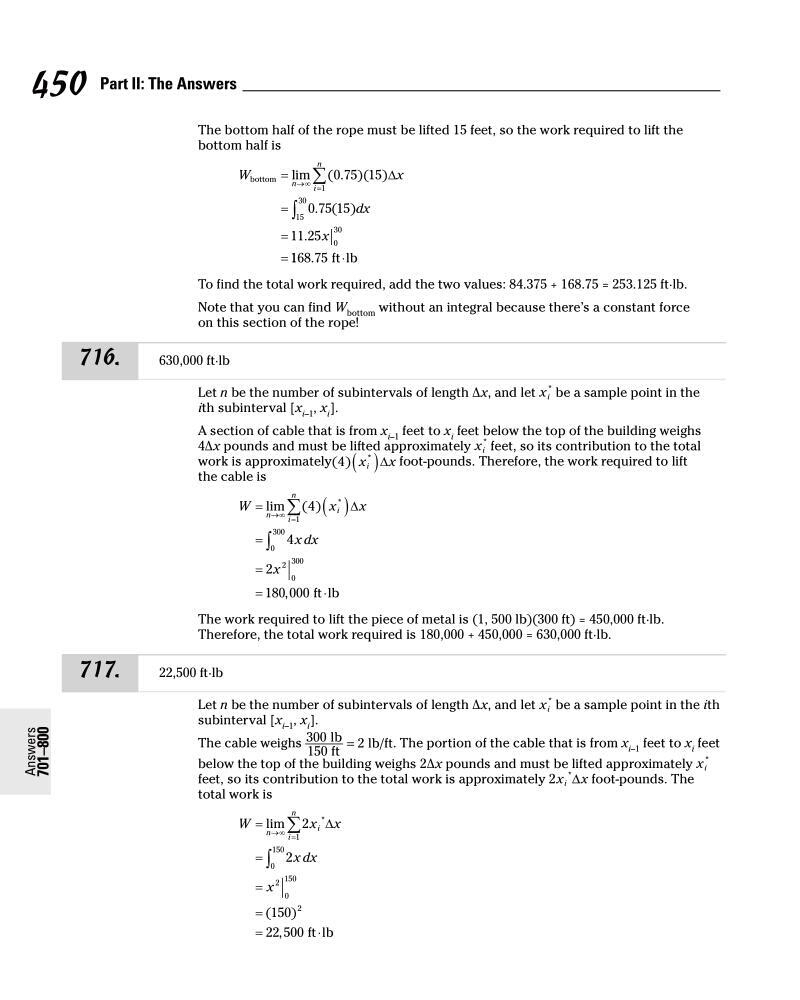
The bottom half of the rope must be lifted 15 feet, so the work required to lift the
bottom half is
x
W
dx
x
n
i
n
bottom =
=
=
=
→∞ =
∑
∫
lim ( . )( )
. ( )
.
0 75 15
0 75 15
11 25
1
15
30
0
30
∆
1 168 75
. ft lb
⋅
To find the total work required, add the two values: 84.375 + 168.75 = 253.125 ft·lb.
Note that you can find W bottom without an integral because there’s a constant force
on this section of the rope!
716.
630,000 ft·lb
Let n be the number of subintervals of length Δ x, and let x i
* be a sample point in the
ith subinterval [x i–1 , x i ].
A section of cable that is from x i–1 feet to x i feet below the top of the building weighs
4Δ x pounds and must be lifted approximately x i
* feet, so its contribution to the total
work is approximately( )
*
4 x
x
i
( ) ∆ foot-pounds. Therefore, the work required to lift
the cable is
W
x
x
x dx
x
n
i
i
n
=
( )
=
=
=
⋅
→∞ =
∑
∫
lim ( )
,
*
4
4
2
180 000
1
0
300
2
0
300
∆
ft lb
The work required to lift the piece of metal is (1, 500 lb)(300 ft) = 450,000 ft·lb.
Therefore, the total work required is 180,000 + 450,000 = 630,000 ft·lb.
717.
22,500 ft·lb
Let n be the number of subintervals of length Δ x, and let x i
* be a sample point in the ith
subinterval [x i–1 , x i ].
The cable weighs 300
150
2
lb
ft
lb/ft
=
. The portion of the cable that is from x i–1 feet to x i feet
below the top of the building weighs 2Δ x pounds and must be lifted approximately x i
*
feet, so its contribution to the total work is approximately 2x x
i
*
∆ foot-pounds. The
total work is
W
x x
x dx
x
n
i
i
n
=
=
=
=
=
⋅
→∞ =
∑
∫
lim
(
)
,
*
2
2
150
22 500
1
0
150
2
0
150
2
∆
ft lb
450
Answers
701–800
The bottom half of the rope must be lifted 15 feet, so the work required to lift the
bottom half is
x
W
dx
x
n
i
n
bottom =
=
=
=
→∞ =
∑
∫
lim ( . )( )
. ( )
.
0 75 15
0 75 15
11 25
1
15
30
0
30
∆
1 168 75
. ft lb
⋅
To find the total work required, add the two values: 84.375 + 168.75 = 253.125 ft·lb.
Note that you can find W bottom without an integral because there’s a constant force
on this section of the rope!
716.
630,000 ft·lb
Let n be the number of subintervals of length Δ x, and let x i
* be a sample point in the
ith subinterval [x i–1 , x i ].
A section of cable that is from x i–1 feet to x i feet below the top of the building weighs
4Δ x pounds and must be lifted approximately x i
* feet, so its contribution to the total
work is approximately( )
*
4 x
x
i
( ) ∆ foot-pounds. Therefore, the work required to lift
the cable is
W
x
x
x dx
x
n
i
i
n
=
( )
=
=
=
⋅
→∞ =
∑
∫
lim ( )
,
*
4
4
2
180 000
1
0
300
2
0
300
∆
ft lb
The work required to lift the piece of metal is (1, 500 lb)(300 ft) = 450,000 ft·lb.
Therefore, the total work required is 180,000 + 450,000 = 630,000 ft·lb.
717.
22,500 ft·lb
Let n be the number of subintervals of length Δ x, and let x i
* be a sample point in the ith
subinterval [x i–1 , x i ].
The cable weighs 300
150
2
lb
ft
lb/ft
=
. The portion of the cable that is from x i–1 feet to x i feet
below the top of the building weighs 2Δ x pounds and must be lifted approximately x i
*
feet, so its contribution to the total work is approximately 2x x
i
*
∆ foot-pounds. The
total work is
W
x x
x dx
x
n
i
i
n
=
=
=
=
=
⋅
→∞ =
∑
∫
lim
(
)
,
*
2
2
150
22 500
1
0
150
2
0
150
2
∆
ft lb