

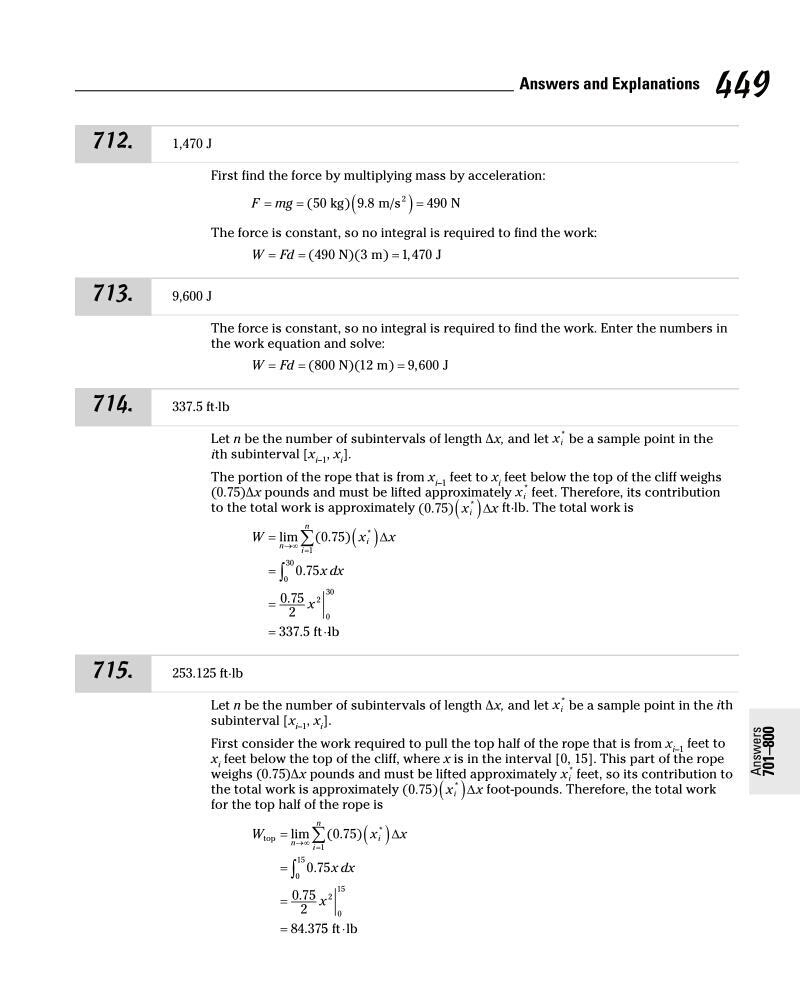
449
Answers
701–800
Answers and Explanations
712.
1,470 J
First find the force by multiplying mass by acceleration:
F mg
=
=
(
) =
(
) .
50
9 8
490
2
kg
m/s
N
The force is constant, so no integral is required to find the work:
W Fd
=
=
=
(
)(
) ,
490
3
1 470
N
m
J
713.
9,600 J
The force is constant, so no integral is required to find the work. Enter the numbers in
the work equation and solve:
W Fd
=
=
=
(
)(
)
,
800
12
9600
N
m
J
714.
337.5 ft·lb
Let n be the number of subintervals of length Δ x, and let x i
* be a sample point in the
ith subinterval [x i–1 , x i ].
The portion of the rope that is from x i–1 feet to x i feet below the top of the cliff weighs
(0.75)Δ x pounds and must be lifted approximately x i
* feet. Therefore, its contribution
to the total work is approximately ( . )
*
0 75 x
x
i
( ) ∆ ft·lb. The total work is
W
x
x
x dx
x
n
i
i
n
=
( )
=
=
=
→∞ =
∑
∫
lim ( . )
.
.
.
*
0 75
0 75
0 75
2
337 5
1
0
30
2
0
30
∆
ft ⋅⋅ lb
715.
253.125 ft·lb
Let n be the number of subintervals of length Δ x, and let x i
* be a sample point in the ith
subinterval [x i–1 , x i ].
First consider the work required to pull the top half of the rope that is from x i–1 feet to
x i feet below the top of the cliff, where x is in the interval [0, 15]. This part of the rope
weighs (0.75)Δ x pounds and must be lifted approximately x i
* feet, so its contribution to
the total work is approximately ( . )
*
0 75 x
x
i
( ) ∆ foot-pounds. Therefore, the total work
for the top half of the rope is
W
x
x
x dx
x
n
i
i
n
top =
( )
=
=
=
→∞ =
∑
∫
lim ( . )
.
.
.
*
0 75
0 75
0 75
2
84 37
1
0
15
2
0
15
∆
5 5 ft lb
⋅
Answers
701–800
Answers and Explanations
712.
1,470 J
First find the force by multiplying mass by acceleration:
F mg
=
=
(
) =
(
) .
50
9 8
490
2
kg
m/s
N
The force is constant, so no integral is required to find the work:
W Fd
=
=
=
(
)(
) ,
490
3
1 470
N
m
J
713.
9,600 J
The force is constant, so no integral is required to find the work. Enter the numbers in
the work equation and solve:
W Fd
=
=
=
(
)(
)
,
800
12
9600
N
m
J
714.
337.5 ft·lb
Let n be the number of subintervals of length Δ x, and let x i
* be a sample point in the
ith subinterval [x i–1 , x i ].
The portion of the rope that is from x i–1 feet to x i feet below the top of the cliff weighs
(0.75)Δ x pounds and must be lifted approximately x i
* feet. Therefore, its contribution
to the total work is approximately ( . )
*
0 75 x
x
i
( ) ∆ ft·lb. The total work is
W
x
x
x dx
x
n
i
i
n
=
( )
=
=
=
→∞ =
∑
∫
lim ( . )
.
.
.
*
0 75
0 75
0 75
2
337 5
1
0
30
2
0
30
∆
ft ⋅⋅ lb
715.
253.125 ft·lb
Let n be the number of subintervals of length Δ x, and let x i
* be a sample point in the ith
subinterval [x i–1 , x i ].
First consider the work required to pull the top half of the rope that is from x i–1 feet to
x i feet below the top of the cliff, where x is in the interval [0, 15]. This part of the rope
weighs (0.75)Δ x pounds and must be lifted approximately x i
* feet, so its contribution to
the total work is approximately ( . )
*
0 75 x
x
i
( ) ∆ foot-pounds. Therefore, the total work
for the top half of the rope is
W
x
x
x dx
x
n
i
i
n
top =
( )
=
=
=
→∞ =
∑
∫
lim ( . )
.
.
.
*
0 75
0 75
0 75
2
84 37
1
0
15
2
0
15
∆
5 5 ft lb
⋅