

429
Answers
601–700
Answers and Explanations
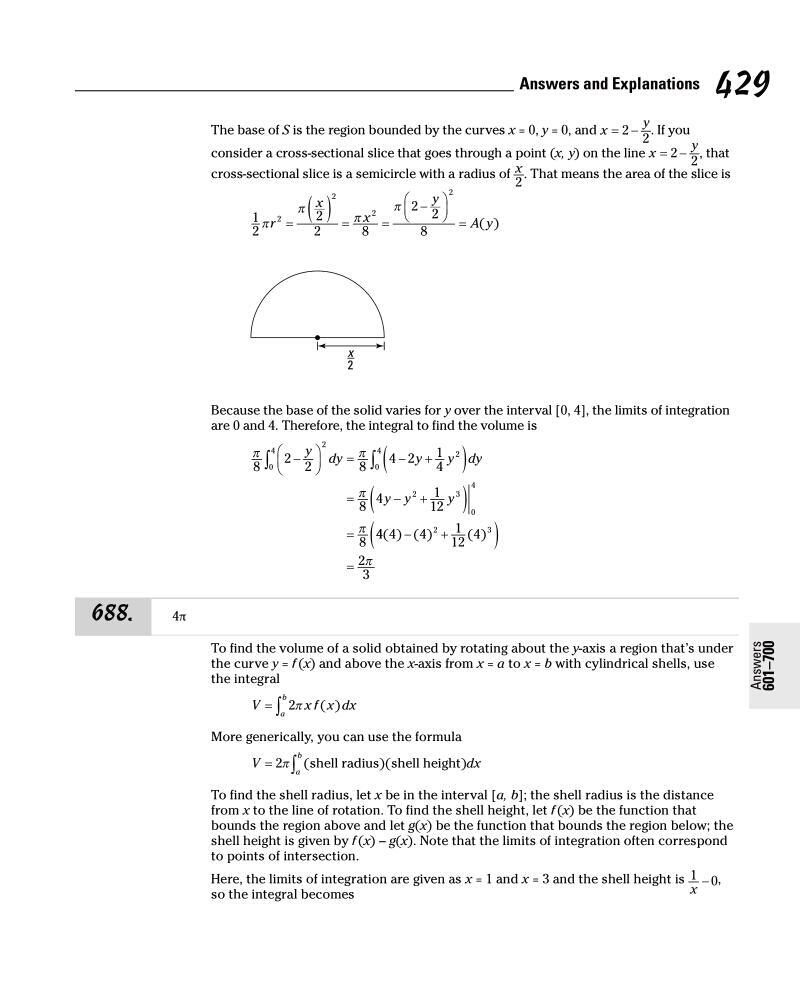
The base of S is the region bounded by the curves x = 0, y = 0, and x
y
= −
2 2
. If you
consider a cross-sectional slice that goes through a point (x, y) on the line x
y
= −
2 2
, that
cross-sectional slice is a semicircle with a radius of x
2
. That means the area of the slice is
1
2
2
2
8
2 2
8
2
2
2
2
π
π
π
π
r
x
x
y
A y
=
( ) = =
−
= ( )
Because the base of the solid varies for y over the interval [0, 4], the limits of integration
are 0 and 4. Therefore, the integral to find the volume is
π
π
π
π
8
2 2
8
4 2
1
4
8
4
1
12
8
2
0
4
2
0
4
2
3
0
4
−
=
− +
(
)
=
− +
(
)
=
∫
∫
y dy
y
y dy
y y
y
4 4 4
4
1
12
4
2
3
2
3
( ) ( )
( )
−
+
(
)
= π
688.
4π
To find the volume of a solid obtained by rotating about the y-axis a region that’s under
the curve y = f
(x) and above the x-axis from x = a to x = b with cylindrical shells, use
the integral
V
xf x dx
a
b
= ∫ 2π ( )
More generically, you can use the formula
d
V
x
a
b
= ∫
2π (
) (
)
shell radius shell height
To find the shell radius, let x be in the interval [a, b]; the shell radius is the distance
from x to the line of rotation. To find the shell height, let f
(x) be the function that
bounds the region above and let g(x) be the function that bounds the region below; the
shell height is given by f
(x) – g(x). Note that the limits of integration often correspond
to points of intersection.
Here, the limits of integration are given as x = 1 and x = 3 and the shell height is 1 0
x
− ,
so the integral becomes
Answers
601–700
Answers and Explanations
The base of S is the region bounded by the curves x = 0, y = 0, and x
y
= −
2 2
. If you
consider a cross-sectional slice that goes through a point (x, y) on the line x
y
= −
2 2
, that
cross-sectional slice is a semicircle with a radius of x
2
. That means the area of the slice is
1
2
2
2
8
2 2
8
2
2
2
2
π
π
π
π
r
x
x
y
A y
=
( ) = =
−
= ( )
Because the base of the solid varies for y over the interval [0, 4], the limits of integration
are 0 and 4. Therefore, the integral to find the volume is
π
π
π
π
8
2 2
8
4 2
1
4
8
4
1
12
8
2
0
4
2
0
4
2
3
0
4
−
=
− +
(
)
=
− +
(
)
=
∫
∫
y dy
y
y dy
y y
y
4 4 4
4
1
12
4
2
3
2
3
( ) ( )
( )
−
+
(
)
= π
688.
4π
To find the volume of a solid obtained by rotating about the y-axis a region that’s under
the curve y = f
(x) and above the x-axis from x = a to x = b with cylindrical shells, use
the integral
V
xf x dx
a
b
= ∫ 2π ( )
More generically, you can use the formula
d
V
x
a
b
= ∫
2π (
) (
)
shell radius shell height
To find the shell radius, let x be in the interval [a, b]; the shell radius is the distance
from x to the line of rotation. To find the shell height, let f
(x) be the function that
bounds the region above and let g(x) be the function that bounds the region below; the
shell height is given by f
(x) – g(x). Note that the limits of integration often correspond
to points of intersection.
Here, the limits of integration are given as x = 1 and x = 3 and the shell height is 1 0
x
− ,
so the integral becomes