

Part II: The Answers
428
Answers
601–700
If you consider a cross-sectional slice that goes through a point (x, y) on the ellipse,
where y > 0, then the hypotenuse of the right triangle has length 2y. If l is a leg of the
isosceles right triangle, then by the Pythagorean theorem, l
2
+ l
2
= (2y)
2
so that l
2
= 2y
2
.
Solving the elliptical boundary function for y
2
gives you y
x
2
2
1
9
36 4
=
−
(
) . Therefore,
the area of the triangle is
1
2
1
2
1
2
1
2
2
1
9
36 4
2
2
2
bh
l l
l
y
x
=
=
= ( ) =
−
(
)
( )( )
Because the base of the solid varies for x over the interval [–3, 3], the limits of integration are –3 and 3. Therefore, the integral to find the volume is
1
9
36 4
2 1
9
36 4
2
9
36
4
3
2
9
36
3
3
2
0
3
2
3
0
3
−
∫
∫
−
(
) =
−
(
)
=
−
=
x dx
x dx
x
x
(3 3
4 3
3
16
3
)
( )
−
=
Note that because y = 36 – 4x
2
is an even function, the lower limit of integration was
changed to zero and the resulting integral was multiplied by 2 to make the integral a
bit easier to compute.
687.
2
3
π
Recall the definition of volume: Let S be a solid that lies between y = c and y = d. If A(y)
is the cross-sectional area of S in the plane P y that goes through y and is perpendicular
to the y-axis, where A is a continuous function, then the volume of S is
V
A y dx
c
d
= ∫ ( )
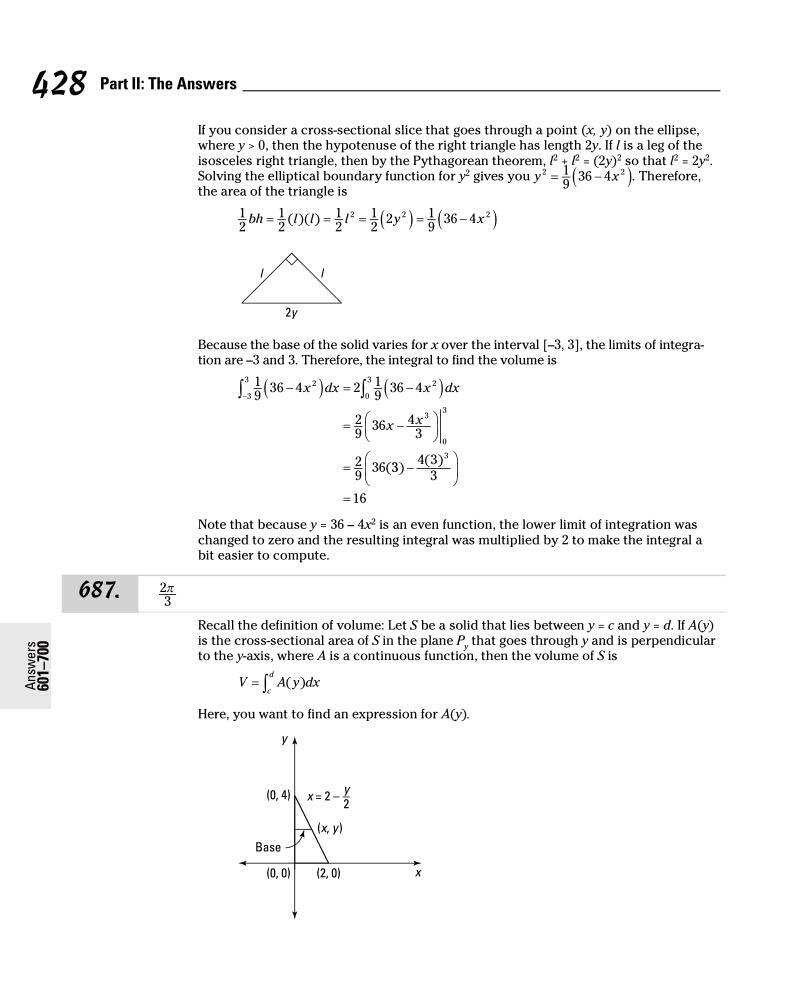
Here, you want to find an expression for A(y).
428
Answers
601–700
If you consider a cross-sectional slice that goes through a point (x, y) on the ellipse,
where y > 0, then the hypotenuse of the right triangle has length 2y. If l is a leg of the
isosceles right triangle, then by the Pythagorean theorem, l
2
+ l
2
= (2y)
2
so that l
2
= 2y
2
.
Solving the elliptical boundary function for y
2
gives you y
x
2
2
1
9
36 4
=
−
(
) . Therefore,
the area of the triangle is
1
2
1
2
1
2
1
2
2
1
9
36 4
2
2
2
bh
l l
l
y
x
=
=
= ( ) =
−
(
)
( )( )
Because the base of the solid varies for x over the interval [–3, 3], the limits of integration are –3 and 3. Therefore, the integral to find the volume is
1
9
36 4
2 1
9
36 4
2
9
36
4
3
2
9
36
3
3
2
0
3
2
3
0
3
−
∫
∫
−
(
) =
−
(
)
=
−
=
x dx
x dx
x
x
(3 3
4 3
3
16
3
)
( )
−
=
Note that because y = 36 – 4x
2
is an even function, the lower limit of integration was
changed to zero and the resulting integral was multiplied by 2 to make the integral a
bit easier to compute.
687.
2
3
π
Recall the definition of volume: Let S be a solid that lies between y = c and y = d. If A(y)
is the cross-sectional area of S in the plane P y that goes through y and is perpendicular
to the y-axis, where A is a continuous function, then the volume of S is
V
A y dx
c
d
= ∫ ( )
Here, you want to find an expression for A(y).