

399
Answers
601–700
Answers and Explanations
652.
4
3
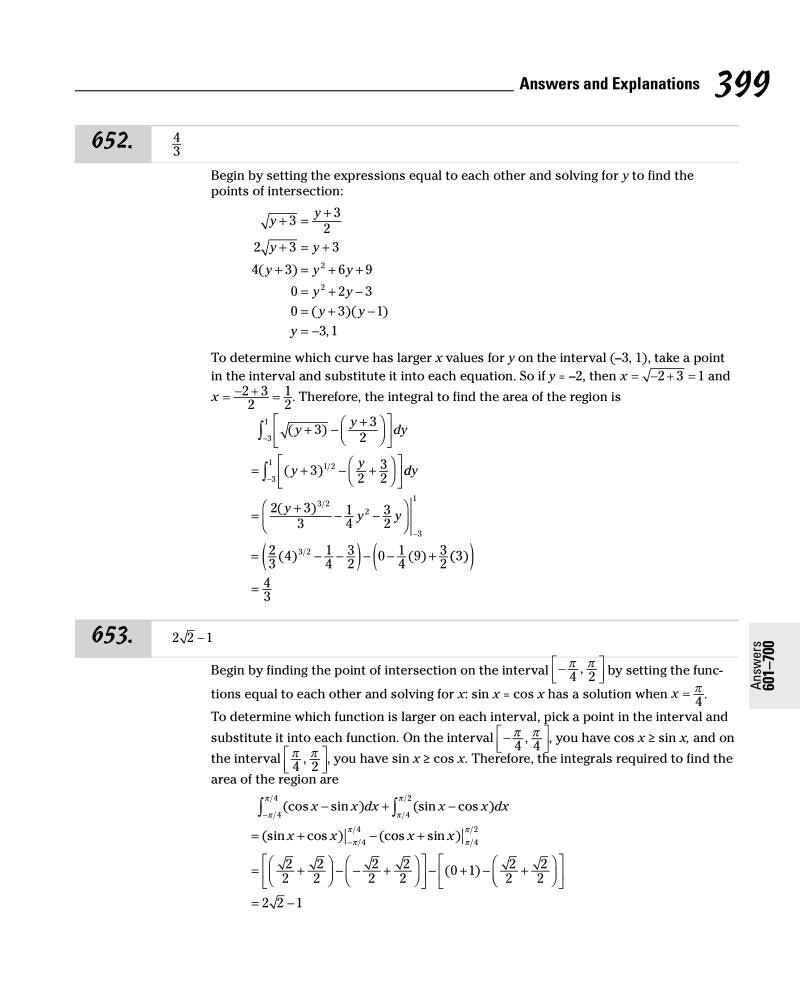
Begin by setting the expressions equal to each other and solving for y to find the
points of intersection:
y
y
y
y
y
y
y
y
y
y
y
y
+ =
+
+ = +
+ =
+
+
=
+
−
=
+
−
= −
3
3
2
2
3
3
4
3
6
9
0
2
3
0
3
1
3 1
2
2
(
)
(
)(
)
,
To determine which curve has larger x values for y on the interval (–3, 1), take a point
in the interval and substitute it into each equation. So if y = –2, then x = − + =
2 3 1 and
x = − + =
2 3
2
1
2
. Therefore, the integral to find the area of the region is
(
)
(
)
y
y
dy
y
y
+ −
+
=
+
−
+
−
−
∫
∫
3
3
2
3
2
3
2
3
1
1 2
3
1
d dy
y
y
y
=
+
−
−
=
− −
(
) − − +
−
2
3
3
1
4
3
2
2
3
4
1
4
3
2
0 1
4
9 3
2
3 2
2
3
1
3 2
(
)
( )
( )
( ( )
3
4
3
(
)
=
653.
2 2 1
−
Begin by finding the point of intersection on the interval −
π π
4 2
,
by setting the functions equal to each other and solving for x: sin x = cos x has a solution when x = π
4
.
To determine which function is larger on each interval, pick a point in the interval and
substitute it into each function. On the interval −
π π
4 4
,
, you have cos x ≥ sin x, and on
the interval π π
4 2
,
, you have sin x ≥ cos x. Therefore, the integrals required to find the
area of the region are
(cos
sin )
(sin
cos )
(sin
cos )
(c
x
x dx
x
x dx
x
x
−
+
−
=
+
−
−
−
∫
∫
π
π
π
π
π
π
4
4
4
2
4
4
o os
sin )
(
)
x
x
+
=
+
− −
+
−
+ −
+
π
π
4
2
2
2
2
2
2
2
2
2
0 1
2
2
2
2
=
−
2 2 1
Answers
601–700
Answers and Explanations
652.
4
3
Begin by setting the expressions equal to each other and solving for y to find the
points of intersection:
y
y
y
y
y
y
y
y
y
y
y
y
+ =
+
+ = +
+ =
+
+
=
+
−
=
+
−
= −
3
3
2
2
3
3
4
3
6
9
0
2
3
0
3
1
3 1
2
2
(
)
(
)(
)
,
To determine which curve has larger x values for y on the interval (–3, 1), take a point
in the interval and substitute it into each equation. So if y = –2, then x = − + =
2 3 1 and
x = − + =
2 3
2
1
2
. Therefore, the integral to find the area of the region is
(
)
(
)
y
y
dy
y
y
+ −
+
=
+
−
+
−
−
∫
∫
3
3
2
3
2
3
2
3
1
1 2
3
1
d dy
y
y
y
=
+
−
−
=
− −
(
) − − +
−
2
3
3
1
4
3
2
2
3
4
1
4
3
2
0 1
4
9 3
2
3 2
2
3
1
3 2
(
)
( )
( )
( ( )
3
4
3
(
)
=
653.
2 2 1
−
Begin by finding the point of intersection on the interval −
π π
4 2
,
by setting the functions equal to each other and solving for x: sin x = cos x has a solution when x = π
4
.
To determine which function is larger on each interval, pick a point in the interval and
substitute it into each function. On the interval −
π π
4 4
,
, you have cos x ≥ sin x, and on
the interval π π
4 2
,
, you have sin x ≥ cos x. Therefore, the integrals required to find the
area of the region are
(cos
sin )
(sin
cos )
(sin
cos )
(c
x
x dx
x
x dx
x
x
−
+
−
=
+
−
−
−
∫
∫
π
π
π
π
π
π
4
4
4
2
4
4
o os
sin )
(
)
x
x
+
=
+
− −
+
−
+ −
+
π
π
4
2
2
2
2
2
2
2
2
2
0 1
2
2
2
2
=
−
2 2 1