

395
Answers
601–700
Answers and Explanations
646.
72
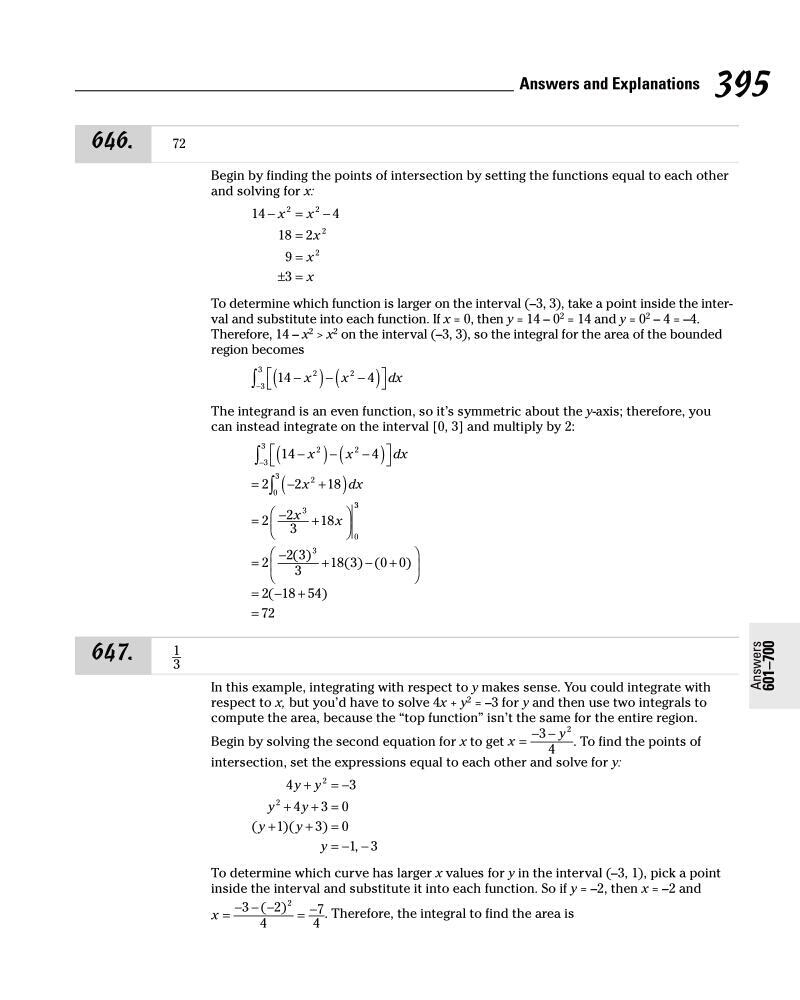
Begin by finding the points of intersection by setting the functions equal to each other
and solving for x:
14
4
18 2
9
3
2
2
2
2
−
=
−
=
=
± =
x
x
x
x
x
To determine which function is larger on the interval (–3, 3), take a point inside the interval and substitute into each function. If x = 0, then y = 14 – 0
2
= 14 and y = 0
2
– 4 = –4.
Therefore, 14 – x
2
> x
2
on the interval (–3, 3), so the integral for the area of the bounded
region becomes
14
4
2
2
3
3
−
(
) − −
(
)
−
∫
x
x
dx
The integrand is an even function, so it’s symmetric about the y-axis; therefore, you
can instead integrate on the interval [0, 3] and multiply by 2:
14
4
2
2
18
2 2
3
18
2
2
3
3
2
0
3
3
0
−
(
) − −
(
)
=
−
+
(
)
=
−
+
−
∫
∫
x
x
dx
x
d x
x
x
3 3
3
2
2 3
3
18 3
0 0
2 18 54
72
=
−
+
− +
= − +
=
( )
( ) (
)
(
)
647.
1
3
In this example, integrating with respect to y makes sense. You could integrate with
respect to x, but you’d have to solve 4x + y
2
= –3 for y and then use two integrals to
compute the area, because the “top function” isn’t the same for the entire region.
Begin by solving the second equation for x to get x
y
=
− −
3
4
2
. To find the points of
intersection, set the expressions equal to each other and solve for y:
4
3
4
3 0
1
3 0
1 3
2
2
y y
y
y
y
y
y
+
= −
+
+ =
+
+ =
= − −
(
)(
)
,
To determine which curve has larger x values for y in the interval (–3, 1), pick a point
inside the interval and substitute it into each function. So if y = –2, then x = –2 and
x =
− − −
= −
3
2
4
7
4
2
( )
. Therefore, the integral to find the area is
Answers
601–700
Answers and Explanations
646.
72
Begin by finding the points of intersection by setting the functions equal to each other
and solving for x:
14
4
18 2
9
3
2
2
2
2
−
=
−
=
=
± =
x
x
x
x
x
To determine which function is larger on the interval (–3, 3), take a point inside the interval and substitute into each function. If x = 0, then y = 14 – 0
2
= 14 and y = 0
2
– 4 = –4.
Therefore, 14 – x
2
> x
2
on the interval (–3, 3), so the integral for the area of the bounded
region becomes
14
4
2
2
3
3
−
(
) − −
(
)
−
∫
x
x
dx
The integrand is an even function, so it’s symmetric about the y-axis; therefore, you
can instead integrate on the interval [0, 3] and multiply by 2:
14
4
2
2
18
2 2
3
18
2
2
3
3
2
0
3
3
0
−
(
) − −
(
)
=
−
+
(
)
=
−
+
−
∫
∫
x
x
dx
x
d x
x
x
3 3
3
2
2 3
3
18 3
0 0
2 18 54
72
=
−
+
− +
= − +
=
( )
( ) (
)
(
)
647.
1
3
In this example, integrating with respect to y makes sense. You could integrate with
respect to x, but you’d have to solve 4x + y
2
= –3 for y and then use two integrals to
compute the area, because the “top function” isn’t the same for the entire region.
Begin by solving the second equation for x to get x
y
=
− −
3
4
2
. To find the points of
intersection, set the expressions equal to each other and solve for y:
4
3
4
3 0
1
3 0
1 3
2
2
y y
y
y
y
y
y
+
= −
+
+ =
+
+ =
= − −
(
)(
)
,
To determine which curve has larger x values for y in the interval (–3, 1), pick a point
inside the interval and substitute it into each function. So if y = –2, then x = –2 and
x =
− − −
= −
3
2
4
7
4
2
( )
. Therefore, the integral to find the area is