

Part II: The Answers
388
Answers
601–700
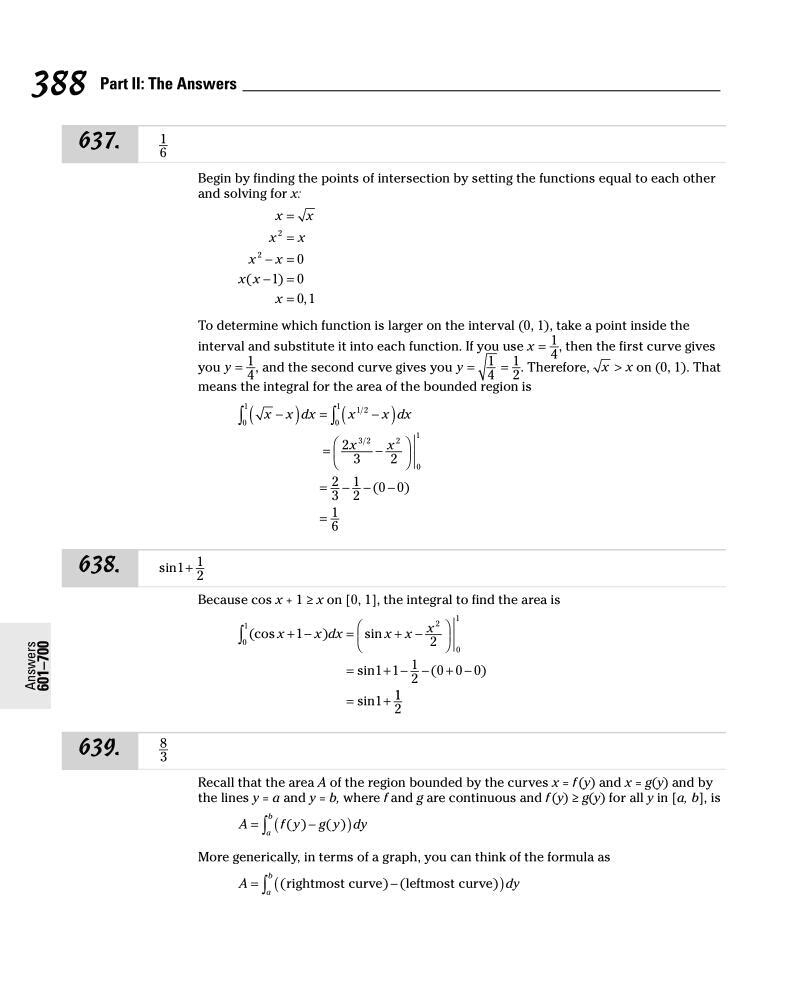
Begin by finding the points of intersection by setting the functions equal to each other
and solving for x:
x
x
x
x
x x
x x
x
=
=
− =
− =
=
2
2
0
1 0
0 1
(
)
,
To determine which function is larger on the interval (0, 1), take a point inside the
interval and substitute it into each function. If you use x = 1
4
, then the first curve gives
you y = 1
4
, and the second curve gives you y =
=
1
4
1
2
. Therefore, x x
> on (0, 1). That
means the integral for the area of the bounded region is
x x dx
x
x dx
x
x
−
(
) =
−
(
)
=
−
= − − −
=
∫
∫
0
1
1 2
0
1
3 2
2
0
1
2
3
2
2
3
1
2
0 0
1
6
(
)
638.
sin1 1
2
+
Because cos x + 1 ≥ x on [0, 1], the integral to find the area is
(cos
)
sin
sin
(
)
sin
x
x dx
x x x
+ −
=
+ −
=
+ − − + −
=
+
∫
1
2
1 1 1
2
0 0 0
1
0
1
2
0
1
1 1
2
639.
8
3
Recall that the area A of the region bounded by the curves x = f
(y) and x = g(y) and by
the lines y = a and y = b, where f and g are continuous and f
(y) ≥ g(y) for all y in [a, b], is
A
f y g y dy
a
b
=
−
(
)
∫ ( ) ( )
More generically, in terms of a graph, you can think of the formula as
d
A
y
a
b
−
=
)
(
∫ (
)(
)
rightmost curve
leftmost curve
637.
1
6
388
Answers
601–700
Begin by finding the points of intersection by setting the functions equal to each other
and solving for x:
x
x
x
x
x x
x x
x
=
=
− =
− =
=
2
2
0
1 0
0 1
(
)
,
To determine which function is larger on the interval (0, 1), take a point inside the
interval and substitute it into each function. If you use x = 1
4
, then the first curve gives
you y = 1
4
, and the second curve gives you y =
=
1
4
1
2
. Therefore, x x
> on (0, 1). That
means the integral for the area of the bounded region is
x x dx
x
x dx
x
x
−
(
) =
−
(
)
=
−
= − − −
=
∫
∫
0
1
1 2
0
1
3 2
2
0
1
2
3
2
2
3
1
2
0 0
1
6
(
)
638.
sin1 1
2
+
Because cos x + 1 ≥ x on [0, 1], the integral to find the area is
(cos
)
sin
sin
(
)
sin
x
x dx
x x x
+ −
=
+ −
=
+ − − + −
=
+
∫
1
2
1 1 1
2
0 0 0
1
0
1
2
0
1
1 1
2
639.
8
3
Recall that the area A of the region bounded by the curves x = f
(y) and x = g(y) and by
the lines y = a and y = b, where f and g are continuous and f
(y) ≥ g(y) for all y in [a, b], is
A
f y g y dy
a
b
=
−
(
)
∫ ( ) ( )
More generically, in terms of a graph, you can think of the formula as
d
A
y
a
b
−
=
)
(
∫ (
)(
)
rightmost curve
leftmost curve
637.
1
6