

361
Answers
501–600
Answers and Explanations
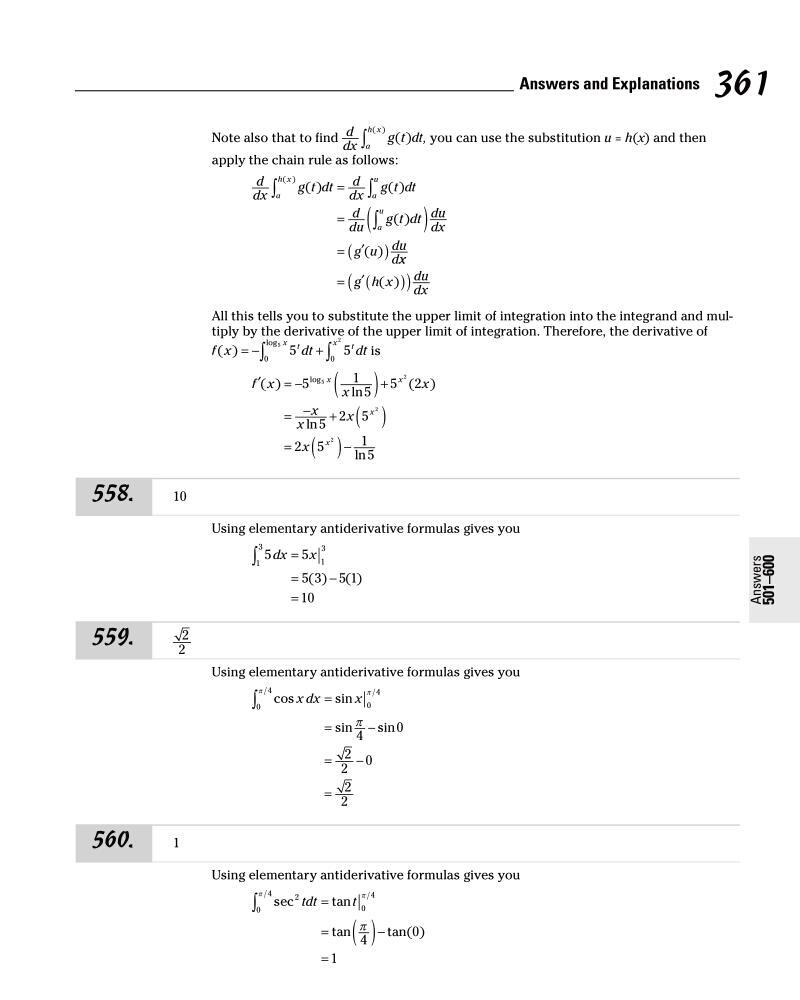
Note also that to find d
dx
g t dt
a
h x
( )
( )
∫
, you can use the substitution u = h(x) and then
apply the chain rule as follows:
d
dx
g t dt
d
dx
g t dt
d
du
g t dt du
dx
g u du
d
a
h x
a
u
a
u
( )
( )
( )
( )
( )
∫
∫
∫
=
=
(
)
= ′
(
) x x
g h x
du
dx
= ′ (
)
(
)
( )
All this tells you to substitute the upper limit of integration into the integrand and multiply by the derivative of the upper limit of integration. Therefore, the derivative of
f x
dt
dt
t
x
t
x
( )
log
= −
+
∫
∫
5
5
0
0
5
2
is
′
= −
( ) +
= − + ( )
=
( ) −
f x
x
x
x
x
x
x
x
x
x
x
( )
ln
( )
ln
ln
log
5
1
5
5 2
5
2 5
2 5
1
5
5
2
2
2
558.
10
Using elementary antiderivative formulas gives you
5
5
5 3 5 1
10
1
3
1
3
dx
x
∫
=
=
−
=
( ) ( )
559.
2
2
Using elementary antiderivative formulas gives you
cos
s in
sin
sin
x dx
x
0
4
0
4
4
0
2
2
0
2
2
π
π
π
∫
=
=
−
=
−
=
560.
1
Using elementary antiderivative formulas gives you
sec
t an
tan
tan( )
2
0
4
0
4
4
0
1
tdt
t
π
π
π
∫
=
=
( ) −
=
Answers
501–600
Answers and Explanations
Note also that to find d
dx
g t dt
a
h x
( )
( )
∫
, you can use the substitution u = h(x) and then
apply the chain rule as follows:
d
dx
g t dt
d
dx
g t dt
d
du
g t dt du
dx
g u du
d
a
h x
a
u
a
u
( )
( )
( )
( )
( )
∫
∫
∫
=
=
(
)
= ′
(
) x x
g h x
du
dx
= ′ (
)
(
)
( )
All this tells you to substitute the upper limit of integration into the integrand and multiply by the derivative of the upper limit of integration. Therefore, the derivative of
f x
dt
dt
t
x
t
x
( )
log
= −
+
∫
∫
5
5
0
0
5
2
is
′
= −
( ) +
= − + ( )
=
( ) −
f x
x
x
x
x
x
x
x
x
x
x
( )
ln
( )
ln
ln
log
5
1
5
5 2
5
2 5
2 5
1
5
5
2
2
2
558.
10
Using elementary antiderivative formulas gives you
5
5
5 3 5 1
10
1
3
1
3
dx
x
∫
=
=
−
=
( ) ( )
559.
2
2
Using elementary antiderivative formulas gives you
cos
s in
sin
sin
x dx
x
0
4
0
4
4
0
2
2
0
2
2
π
π
π
∫
=
=
−
=
−
=
560.
1
Using elementary antiderivative formulas gives you
sec
t an
tan
tan( )
2
0
4
0
4
4
0
1
tdt
t
π
π
π
∫
=
=
( ) −
=