

Part II: The Answers
304
Answers
401–500
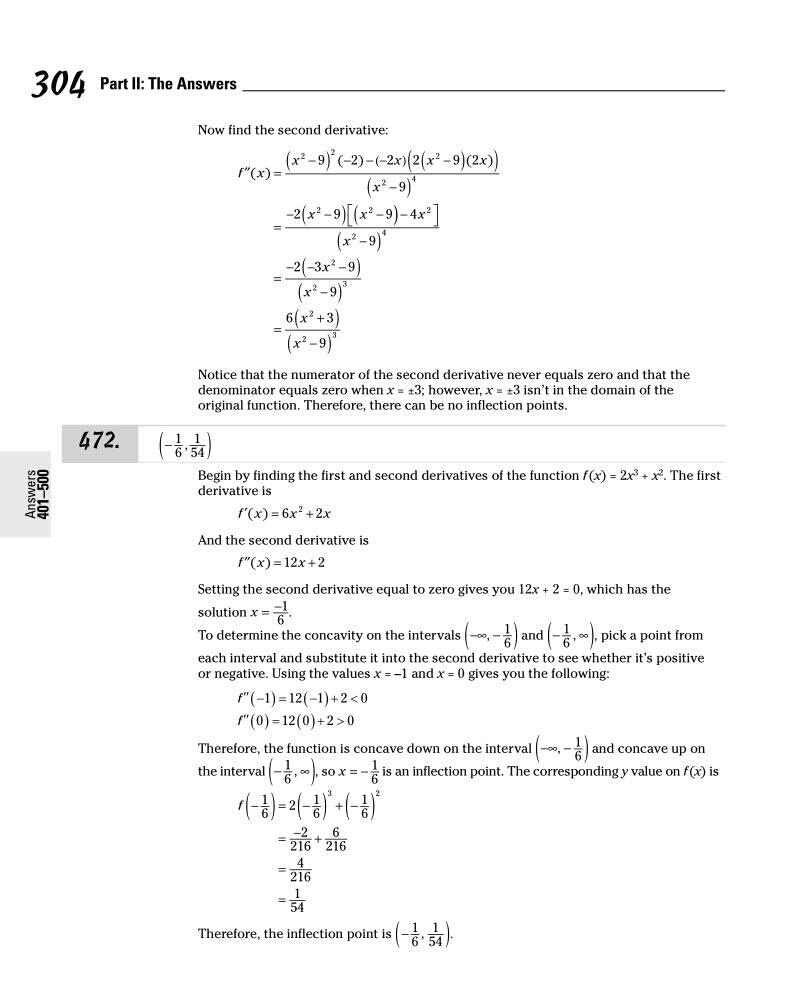
Now find the second derivative:
′′
(
)
(
)
(
)
(
)
(
) (
f x
x
x
x
x
x
x
x
( )
( )
( )
=
−
− − (− )
−
−
=
−
−
−
2
2
2
2
4
2
2
9
2
2 2
9 2
9
2
9
9 ) )
(
)
(
)
(
)
(
)
(
)
−
−
=
− −
−
−
=
+
−
4
9
2 3
9
9
6
3
9
2
2
4
2
2
3
2
2
3
x
x
x
x
x
x
Notice that the numerator of the second derivative never equals zero and that the
denominator equals zero when x = ±3; however, x = ±3 isn’t in the domain of the
original function. Therefore, there can be no inflection points.
472.
− 1
6
1
54
,
( )
Begin by finding the first and second derivatives of the function f
(x) = 2x
3
+ x
2
. The first
derivative is
′
f x
x
x
( ) =
+
6
2
2
And the second derivative is
′′
f x
x
( ) =
+
12
2
Setting the second derivative equal to zero gives you 12x + 2 = 0, which has the
solution x = −1
6
.
To determine the concavity on the intervals −∞ −
, 1
6
( ) and − ∞
1
6
,
( ) , pick a point from
each interval and substitute it into the second derivative to see whether it’s positive
or negative. Using the values x = –1 and x = 0 gives you the following:
′′ −
( )= −
( )+ <
′′ ( ) = ( )+ >
f
f
1 12 1 2 0
0 12 0 2 0
Therefore, the function is concave down on the interval −∞ −
, 1
6
( ) and concave up on
the interval − ∞
1
6
,
( ) , so x = − 1
6
is an inflection point. The corresponding y value on f
(x) is
f −
= −
+ −
= − +
=
=
1
6
2 1
6
1
6
2
216
6
216
4
216
1
54
3
2
( ) ( ) ( )
Therefore, the inflection point is −
(
)
1
6
1
54
,
.
304
Answers
401–500
Now find the second derivative:
′′
(
)
(
)
(
)
(
)
(
) (
f x
x
x
x
x
x
x
x
( )
( )
( )
=
−
− − (− )
−
−
=
−
−
−
2
2
2
2
4
2
2
9
2
2 2
9 2
9
2
9
9 ) )
(
)
(
)
(
)
(
)
(
)
−
−
=
− −
−
−
=
+
−
4
9
2 3
9
9
6
3
9
2
2
4
2
2
3
2
2
3
x
x
x
x
x
x
Notice that the numerator of the second derivative never equals zero and that the
denominator equals zero when x = ±3; however, x = ±3 isn’t in the domain of the
original function. Therefore, there can be no inflection points.
472.
− 1
6
1
54
,
( )
Begin by finding the first and second derivatives of the function f
(x) = 2x
3
+ x
2
. The first
derivative is
′
f x
x
x
( ) =
+
6
2
2
And the second derivative is
′′
f x
x
( ) =
+
12
2
Setting the second derivative equal to zero gives you 12x + 2 = 0, which has the
solution x = −1
6
.
To determine the concavity on the intervals −∞ −
, 1
6
( ) and − ∞
1
6
,
( ) , pick a point from
each interval and substitute it into the second derivative to see whether it’s positive
or negative. Using the values x = –1 and x = 0 gives you the following:
′′ −
( )= −
( )+ <
′′ ( ) = ( )+ >
f
f
1 12 1 2 0
0 12 0 2 0
Therefore, the function is concave down on the interval −∞ −
, 1
6
( ) and concave up on
the interval − ∞
1
6
,
( ) , so x = − 1
6
is an inflection point. The corresponding y value on f
(x) is
f −
= −
+ −
= − +
=
=
1
6
2 1
6
1
6
2
216
6
216
4
216
1
54
3
2
( ) ( ) ( )
Therefore, the inflection point is −
(
)
1
6
1
54
,
.