

Answers and Explanations 303
Answers
401–500
′′
(
)
f x
x
x
x
x
x
x
( )
cos
sin( )
sin( )
cos
( sin cos )
c
= −
+
()
=
−
=
−
2
2
2
2
4
2
2
4 2
2 o os
cos ( sin
)
x
x
x
=
−
2
4
1
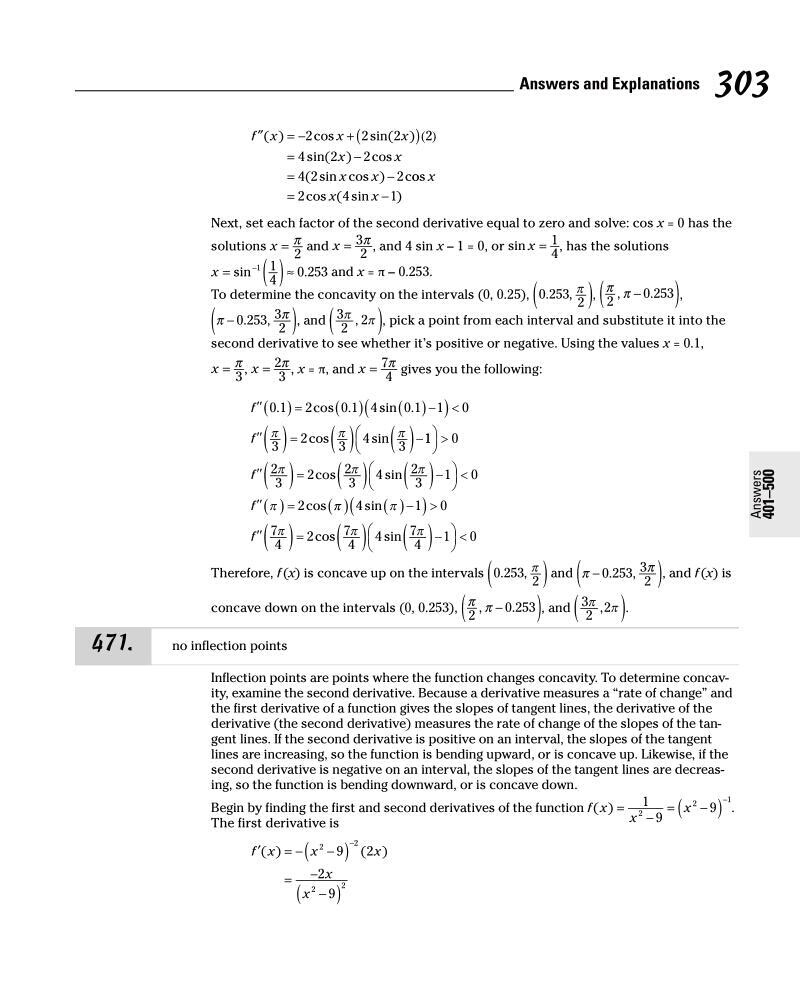
Next, set each factor of the second derivative equal to zero and solve: cos x = 0 has the
solutions x = π
2
and x = 3
2
π , and 4 sin x – 1 = 0, or sin x = 1
4
, has the solutions
x =
≈
−
sin
.
1 1
4
0 253
( ) and x = π – 0.253.
To determine the concavity on the intervals (0, 0.25), 0 253 2
.
, π
(
) ,
π π
2
0 253
,
.
−
(
) ,
π
π
− 0 253 3
2
.
,
(
) , and 3
2
2
π π
,
( ) , pick a point from each interval and substitute it into the
second derivative to see whether it’s positive or negative. Using the values x = 0.1,
x = π
3
, x = 2
3
π , x = π, and x = 7
4
π gives you the following:
′′ ( )=
( )
( )−
(
) <
′′ ( ) = ( ) ( ) −
f
f
0 1 2
01 4
0 1 1 0
3
2
3
4
3
.
cos .
sin .
cos
sin
π
π
π 1 1 0
2
3
2
2
3
4
2
3
1 0
2
>
′′ ( ) = ( ) ( ) −
<
′′ ( ) =
f
f
π
π
π
π
cos
s in
cos π π
π
π
π
( )
( )−
(
) >
′′ ( ) = ( ) ( ) −
<
4
1 0
7
4
2
7
4
4
7
4
1 0
sin
cos
s in
π
f
Therefore, f
(x) is concave up on the intervals 0 253 2
.
, π
(
) and π
π
− 0 253 3
2
.
,
(
) , and f
(x) is
concave down on the intervals (0, 0.253), π π
2
0 253
,
.
−
(
) , and 3
2
2
π π
,
( ) .
471.
no inflection points
Inflection points are points where the function changes concavity. To determine concavity, examine the second derivative. Because a derivative measures a “rate of change” and
the first derivative of a function gives the slopes of tangent lines, the derivative of the
derivative (the second derivative) measures the rate of change of the slopes of the tangent lines. If the second derivative is positive on an interval, the slopes of the tangent
lines are increasing, so the function is bending upward, or is concave up. Likewise, if the
second derivative is negative on an interval, the slopes of the tangent lines are decreasing, so the function is bending downward, or is concave down.
Begin by finding the first and second derivatives of the function f x
x
x
( ) =
−
=
−
−
1
9
9
2
2
1
(
) .
The first derivative is
′
(
)
(
)
f x
x
x
x
x
( )
( )
= −
−
= −
−
−
2
2
2
2
9
2
2
9
Answers
401–500
′′
(
)
f x
x
x
x
x
x
x
( )
cos
sin( )
sin( )
cos
( sin cos )
c
= −
+
()
=
−
=
−
2
2
2
2
4
2
2
4 2
2 o os
cos ( sin
)
x
x
x
=
−
2
4
1
Next, set each factor of the second derivative equal to zero and solve: cos x = 0 has the
solutions x = π
2
and x = 3
2
π , and 4 sin x – 1 = 0, or sin x = 1
4
, has the solutions
x =
≈
−
sin
.
1 1
4
0 253
( ) and x = π – 0.253.
To determine the concavity on the intervals (0, 0.25), 0 253 2
.
, π
(
) ,
π π
2
0 253
,
.
−
(
) ,
π
π
− 0 253 3
2
.
,
(
) , and 3
2
2
π π
,
( ) , pick a point from each interval and substitute it into the
second derivative to see whether it’s positive or negative. Using the values x = 0.1,
x = π
3
, x = 2
3
π , x = π, and x = 7
4
π gives you the following:
′′ ( )=
( )
( )−
(
) <
′′ ( ) = ( ) ( ) −
f
f
0 1 2
01 4
0 1 1 0
3
2
3
4
3
.
cos .
sin .
cos
sin
π
π
π 1 1 0
2
3
2
2
3
4
2
3
1 0
2
>
′′ ( ) = ( ) ( ) −
<
′′ ( ) =
f
f
π
π
π
π
cos
s in
cos π π
π
π
π
( )
( )−
(
) >
′′ ( ) = ( ) ( ) −
<
4
1 0
7
4
2
7
4
4
7
4
1 0
sin
cos
s in
π
f
Therefore, f
(x) is concave up on the intervals 0 253 2
.
, π
(
) and π
π
− 0 253 3
2
.
,
(
) , and f
(x) is
concave down on the intervals (0, 0.253), π π
2
0 253
,
.
−
(
) , and 3
2
2
π π
,
( ) .
471.
no inflection points
Inflection points are points where the function changes concavity. To determine concavity, examine the second derivative. Because a derivative measures a “rate of change” and
the first derivative of a function gives the slopes of tangent lines, the derivative of the
derivative (the second derivative) measures the rate of change of the slopes of the tangent lines. If the second derivative is positive on an interval, the slopes of the tangent
lines are increasing, so the function is bending upward, or is concave up. Likewise, if the
second derivative is negative on an interval, the slopes of the tangent lines are decreasing, so the function is bending downward, or is concave down.
Begin by finding the first and second derivatives of the function f x
x
x
( ) =
−
=
−
−
1
9
9
2
2
1
(
) .
The first derivative is
′
(
)
(
)
f x
x
x
x
x
( )
( )
= −
−
= −
−
−
2
2
2
2
9
2
2
9