

Part II: The Answers
286
Answers
401–500
A
bh
dA
dt
db
dt
h b dh
dt
=
=
+
1
2
1
2
1
1
( ) ( )
Note that you have to use the product rule to find the derivative of the right side of the
equation.
Substitute in the given information, db
dt
= 2 centimeters per minute, h = 32 centimeters,
b = 20 centimeters, and dh
dt
= 4 centimeters per minute:
dA
dt
=
+
=
1
2
2 32 20 4
72
( )( )
( )
[
]
cm /min
2
439.
13.56 km/h
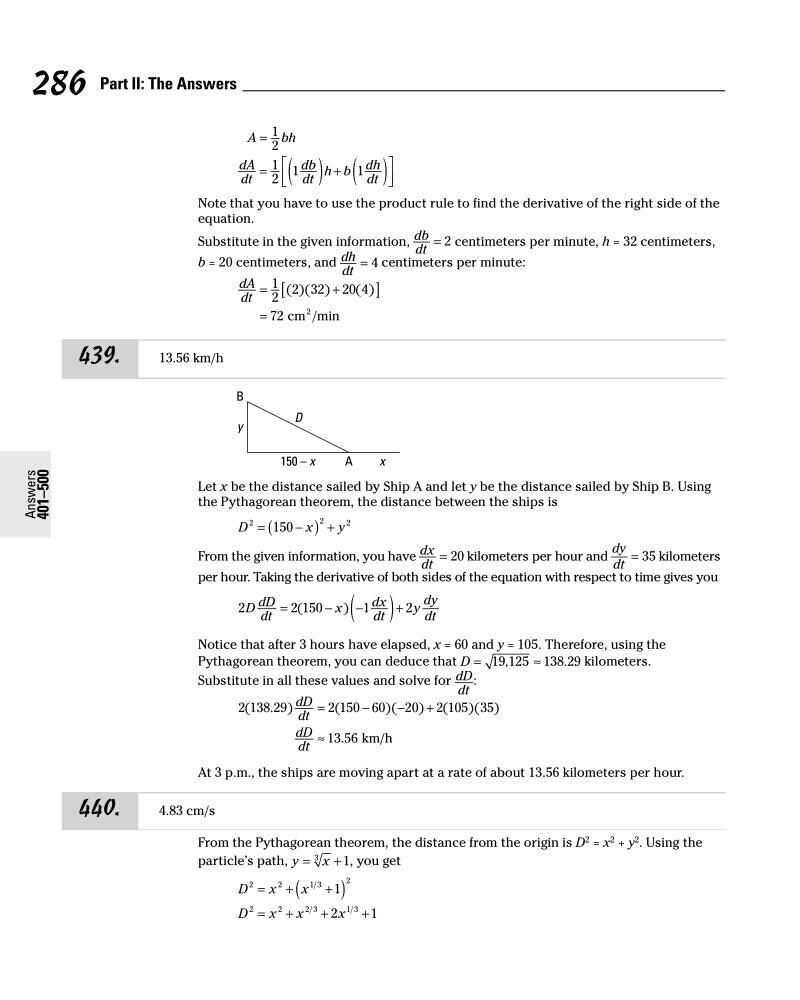
Let x be the distance sailed by Ship A and let y be the distance sailed by Ship B. Using
the Pythagorean theorem, the distance between the ships is
D
x
y
2
2
2
150
=
−
+
(
)
From the given information, you have dx
dt
= 20 kilometers per hour and
dy
dt
= 35 kilometers
per hour. Taking the derivative of both sides of the equation with respect to time gives you
2
2150
1
2
D dD
dt
x
dx
dt
y
dy
dt
=
−
−
+
(
) ( )
Notice that after 3 hours have elapsed, x = 60 and y = 105. Therefore, using the
Pythagorean theorem, you can deduce that D =
≈
19 125 138 29
,
. kilometers.
Substitute in all these values and solve for dD
dt
:
2 138 29
2 150 60 20 2 105 35
13 56
(
. )
(
)(
) (
)( )
.
dD
dt
dD
dt
=
−
−
+
≈
km/h
At 3 p.m., the ships are moving apart at a rate of about 13.56 kilometers per hour.
440.
4.83 cm/s
From the Pythagorean theorem, the distance from the origin is D
2
= x
2
+ y
2
. Using the
particle’s path, y
x
=
+
3
1, you get
D
x
x
D
x
x
x
2
2
1 3
2
2
2
2 3
1 3
1
2
1
=
+
+
=
+
+
+
(
)
286
Answers
401–500
A
bh
dA
dt
db
dt
h b dh
dt
=
=
+
1
2
1
2
1
1
( ) ( )
Note that you have to use the product rule to find the derivative of the right side of the
equation.
Substitute in the given information, db
dt
= 2 centimeters per minute, h = 32 centimeters,
b = 20 centimeters, and dh
dt
= 4 centimeters per minute:
dA
dt
=
+
=
1
2
2 32 20 4
72
( )( )
( )
[
]
cm /min
2
439.
13.56 km/h
Let x be the distance sailed by Ship A and let y be the distance sailed by Ship B. Using
the Pythagorean theorem, the distance between the ships is
D
x
y
2
2
2
150
=
−
+
(
)
From the given information, you have dx
dt
= 20 kilometers per hour and
dy
dt
= 35 kilometers
per hour. Taking the derivative of both sides of the equation with respect to time gives you
2
2150
1
2
D dD
dt
x
dx
dt
y
dy
dt
=
−
−
+
(
) ( )
Notice that after 3 hours have elapsed, x = 60 and y = 105. Therefore, using the
Pythagorean theorem, you can deduce that D =
≈
19 125 138 29
,
. kilometers.
Substitute in all these values and solve for dD
dt
:
2 138 29
2 150 60 20 2 105 35
13 56
(
. )
(
)(
) (
)( )
.
dD
dt
dD
dt
=
−
−
+
≈
km/h
At 3 p.m., the ships are moving apart at a rate of about 13.56 kilometers per hour.
440.
4.83 cm/s
From the Pythagorean theorem, the distance from the origin is D
2
= x
2
+ y
2
. Using the
particle’s path, y
x
=
+
3
1, you get
D
x
x
D
x
x
x
2
2
1 3
2
2
2
2 3
1 3
1
2
1
=
+
+
=
+
+
+
(
)