

Answers and Explanations 285
Answers
401–500
dA
dt
=
= ( )
≈
24
6
0 12
24
3
2
0 12
2 49
2
cos ( . )
( . )
.
π
(
)
m /s
When the angle between the sides is π
6
, the area is increasing at a rate of about 2.49
square meters per second.
437.
3
4
rad/s
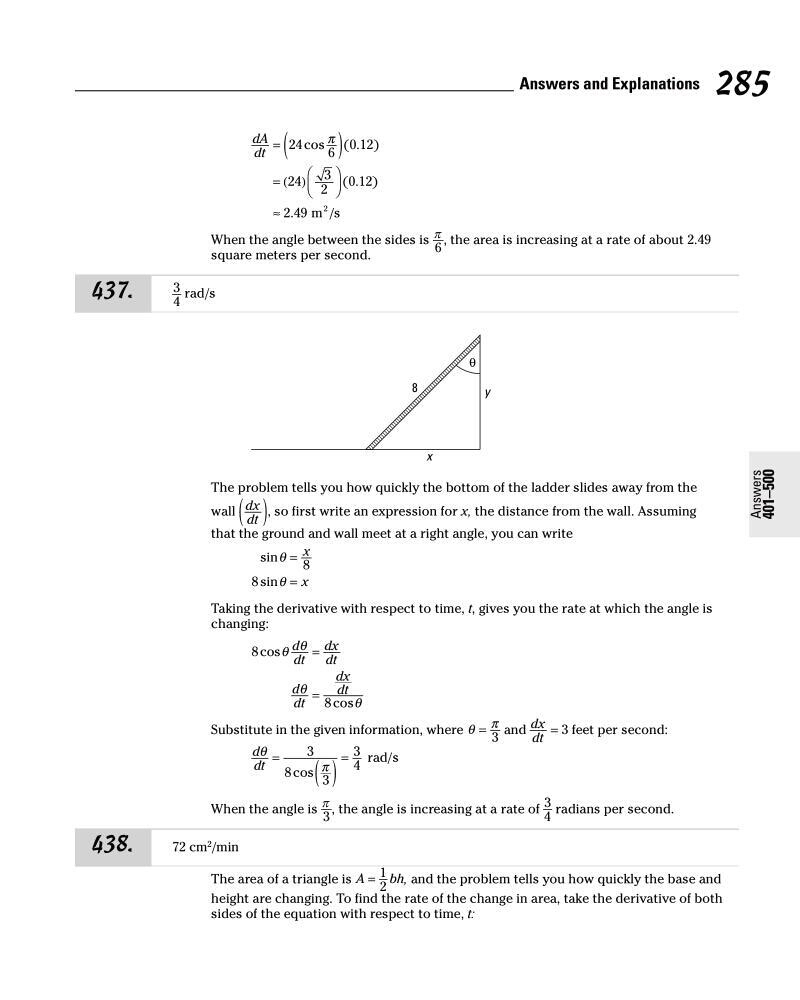
The problem tells you how quickly the bottom of the ladder slides away from the
wall dx
dt
( ) , so first write an expression for x, the distance from the wall. Assuming
that the ground and wall meet at a right angle, you can write
sin
sin
θ
θ
=
=
x
x
8
8
Taking the derivative with respect to time, t, gives you the rate at which the angle is
changing:
8
8
cos
cos
θ θ
θ
θ
d
dt
dx
dt
d
dt
dx
dt
=
=
Substitute in the given information, where θ π
= 3
and dx
dt
= 3 feet per second:
d
dt
θ
π
=
=
3
8
3
3
4
cos ( )
rad/s
When the angle is π
3
, the angle is increasing at a rate of 3
4
radians per second.
438.
72 cm
2
/min
The area of a triangle is A
bh
= 1
2
, and the problem tells you how quickly the base and
height are changing. To find the rate of the change in area, take the derivative of both
sides of the equation with respect to time, t:
Answers
401–500
dA
dt
=
= ( )
≈
24
6
0 12
24
3
2
0 12
2 49
2
cos ( . )
( . )
.
π
(
)
m /s
When the angle between the sides is π
6
, the area is increasing at a rate of about 2.49
square meters per second.
437.
3
4
rad/s
The problem tells you how quickly the bottom of the ladder slides away from the
wall dx
dt
( ) , so first write an expression for x, the distance from the wall. Assuming
that the ground and wall meet at a right angle, you can write
sin
sin
θ
θ
=
=
x
x
8
8
Taking the derivative with respect to time, t, gives you the rate at which the angle is
changing:
8
8
cos
cos
θ θ
θ
θ
d
dt
dx
dt
d
dt
dx
dt
=
=
Substitute in the given information, where θ π
= 3
and dx
dt
= 3 feet per second:
d
dt
θ
π
=
=
3
8
3
3
4
cos ( )
rad/s
When the angle is π
3
, the angle is increasing at a rate of 3
4
radians per second.
438.
72 cm
2
/min
The area of a triangle is A
bh
= 1
2
, and the problem tells you how quickly the base and
height are changing. To find the rate of the change in area, take the derivative of both
sides of the equation with respect to time, t: