

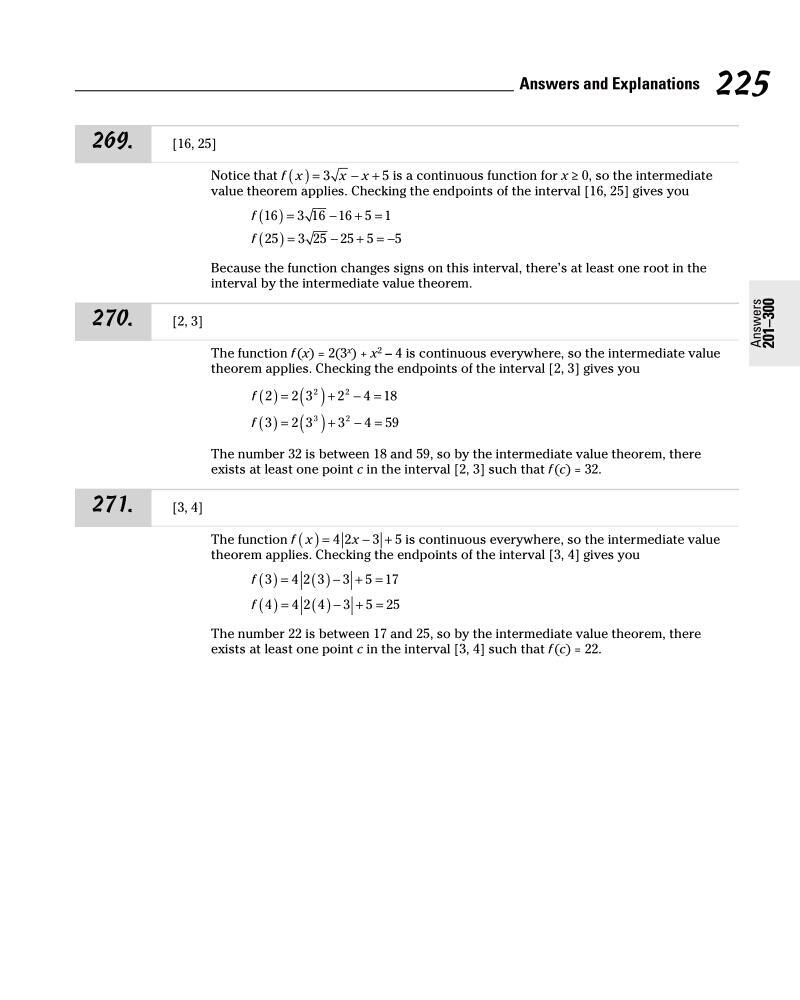
Answers and Explanations 225
Answers
201–300
269.
[16, 25]
Notice that f x
x x
( ) =
− +
3
5 is a continuous function for x ≥ 0, so the intermediate
value theorem applies. Checking the endpoints of the interval [16, 25] gives you
f
f
16
3 16 16 5 1
25 3 25 25 5
5
( )=
− + =
( )=
− + = −
Because the function changes signs on this interval, there’s at least one root in the
interval by the intermediate value theorem.
270.
[2, 3]
The function f
(x) = 2(3
x
) + x
2
– 4 is continuous everywhere, so the intermediate value
theorem applies. Checking the endpoints of the interval [2, 3] gives you
f
f
2 2 3
2 4 18
3 2 3
3 4 59
2
2
3
2
( ) = ( ) + − =
( ) = ( ) + − =
The number 32 is between 18 and 59, so by the intermediate value theorem, there
exists at least one point c in the interval [2, 3] such that f
(c) = 32.
271.
[3, 4]
The function f x
x
( ) =
− +
4 2
3 5 is continuous everywhere, so the intermediate value
theorem applies. Checking the endpoints of the interval [3, 4] gives you
f
f
3
4 2 3 3 5 17
4
4 2 4 3 5 25
( ) = ( )− + =
( ) = ( )− + =
The number 22 is between 17 and 25, so by the intermediate value theorem, there
exists at least one point c in the interval [3, 4] such that f
(c) = 22.
Answers
201–300
269.
[16, 25]
Notice that f x
x x
( ) =
− +
3
5 is a continuous function for x ≥ 0, so the intermediate
value theorem applies. Checking the endpoints of the interval [16, 25] gives you
f
f
16
3 16 16 5 1
25 3 25 25 5
5
( )=
− + =
( )=
− + = −
Because the function changes signs on this interval, there’s at least one root in the
interval by the intermediate value theorem.
270.
[2, 3]
The function f
(x) = 2(3
x
) + x
2
– 4 is continuous everywhere, so the intermediate value
theorem applies. Checking the endpoints of the interval [2, 3] gives you
f
f
2 2 3
2 4 18
3 2 3
3 4 59
2
2
3
2
( ) = ( ) + − =
( ) = ( ) + − =
The number 32 is between 18 and 59, so by the intermediate value theorem, there
exists at least one point c in the interval [2, 3] such that f
(c) = 32.
271.
[3, 4]
The function f x
x
( ) =
− +
4 2
3 5 is continuous everywhere, so the intermediate value
theorem applies. Checking the endpoints of the interval [3, 4] gives you
f
f
3
4 2 3 3 5 17
4
4 2 4 3 5 25
( ) = ( )− + =
( ) = ( )− + =
The number 22 is between 17 and 25, so by the intermediate value theorem, there
exists at least one point c in the interval [3, 4] such that f
(c) = 22.