

Part II: The Answers
224
Answers
201–300
The left-hand limit at x = 4 is given by lim
x
x
c
c
c
→
−
+
(
) = ( ) + = +
4
2
2
2
2
2
4
1 6
, and the
right-hand limit is given by lim
x
cx
c
→
+
+
(
)= +
4
12 4 12. Also note that f
c
4 16
2
( ) = + .
The left-hand limit must equal the right-hand limit, so set them equal to each other:
16
4 12
4 4 0
2
0
2
2
2
+ =
+
− + =
−
(
) =
c
c
c
c
c
Therefore, c – 2 = 0, which gives you the solution c = 2.
268.
[1, 2]
Recall the intermediate value theorem: Suppose that f is continuous on the closed
interval [a, b], and let N be any number between f
(a) and f
(b), where f
(a) ≠ f
(b). Then
a number c exists in (a, b) such that f
(c) = N.
Notice that f x
x
( ) = −
2
3
2
is a polynomial that’s continuous everywhere, so the intermediate value theorem applies. Checking the endpoints of the interval [1, 2] gives you
f
f
1 1 3
2
1
2
2 2
3
2
4 3
2
5
2
2
2
( ) = − = −
( ) = − = − =
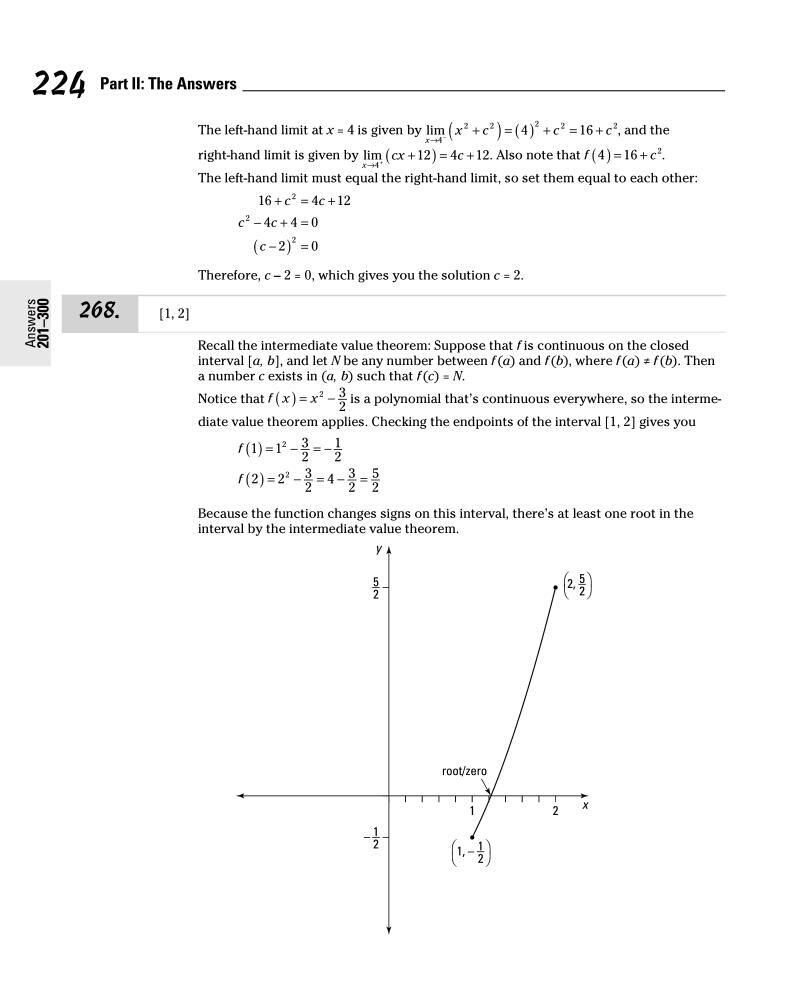
Because the function changes signs on this interval, there’s at least one root in the
interval by the intermediate value theorem.
224
Answers
201–300
The left-hand limit at x = 4 is given by lim
x
x
c
c
c
→
−
+
(
) = ( ) + = +
4
2
2
2
2
2
4
1 6
, and the
right-hand limit is given by lim
x
cx
c
→
+
+
(
)= +
4
12 4 12. Also note that f
c
4 16
2
( ) = + .
The left-hand limit must equal the right-hand limit, so set them equal to each other:
16
4 12
4 4 0
2
0
2
2
2
+ =
+
− + =
−
(
) =
c
c
c
c
c
Therefore, c – 2 = 0, which gives you the solution c = 2.
268.
[1, 2]
Recall the intermediate value theorem: Suppose that f is continuous on the closed
interval [a, b], and let N be any number between f
(a) and f
(b), where f
(a) ≠ f
(b). Then
a number c exists in (a, b) such that f
(c) = N.
Notice that f x
x
( ) = −
2
3
2
is a polynomial that’s continuous everywhere, so the intermediate value theorem applies. Checking the endpoints of the interval [1, 2] gives you
f
f
1 1 3
2
1
2
2 2
3
2
4 3
2
5
2
2
2
( ) = − = −
( ) = − = − =
Because the function changes signs on this interval, there’s at least one root in the
interval by the intermediate value theorem.