

Part II: The Answers
222
262.
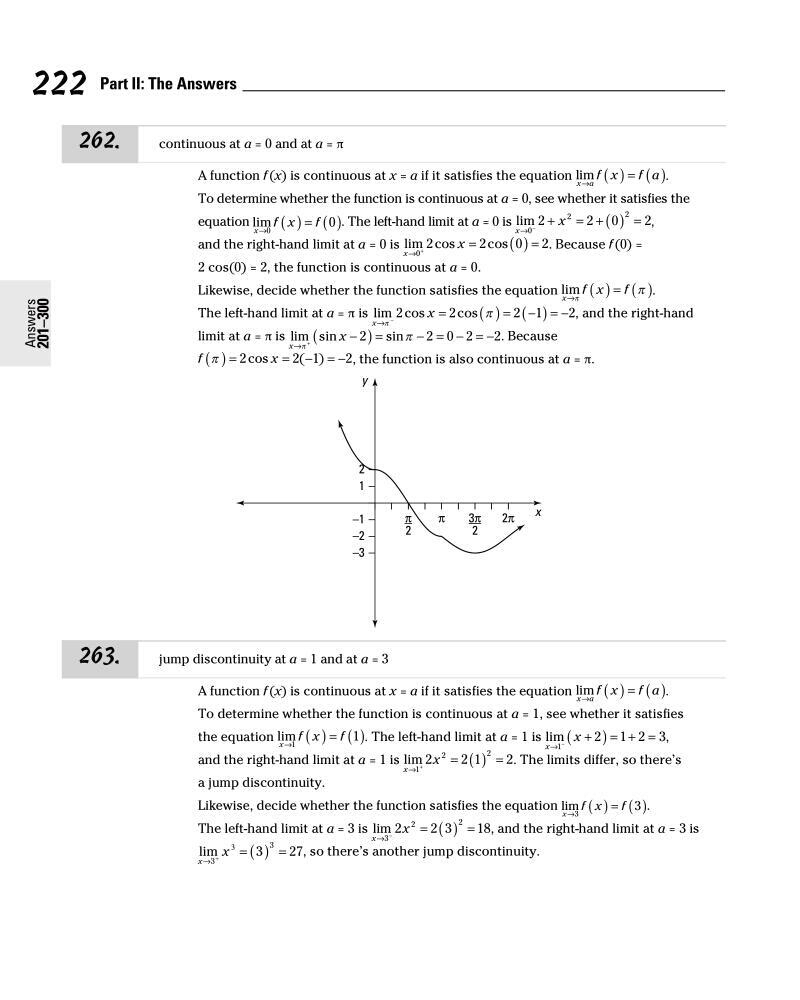
continuous at a = 0 and at a = π
A function f
(x) is continuous at x = a if it satisfies the equation lim x a
f x
f a
→
( ) = ( ).
To determine whether the function is continuous at a = 0, see whether it satisfies the
equation lim x
f x
f
→
( ) = ( )
0
0 . The left-hand limit at a = 0 is lim
x
x
→
−
+
= + ( ) =
0
2
2
2
2 0
2,
and the right-hand limit at a = 0 is lim cos
cos
x
x
→
+
=
( ) =
0
2
2
0 2. Because f
(0) =
2 cos(0) = 2, the function is continuous at a = 0.
Likewise, decide whether the function satisfies the equation lim x f x
f
→
( ) = ( )
π
π .
The left-hand limit at a = π is lim cos
cos
x
x
→
−
=
( ) = −
( )= −
π
π
2
2
2 1
2, and the right-hand
limit at a = π is lim sin
s in
x
x
→
+
−
(
)=
− = − = −
π
π
2
2 0 2
2. Because
f
x
π
( ) =
= − = −
2
2 1
2
cos
( )
, the function is also continuous at a = π.
263.
jump discontinuity at a = 1 and at a = 3
A function f
(x) is continuous at x = a if it satisfies the equation lim x a f x
f a
→
( ) = ( ).
To determine whether the function is continuous at a = 1, see whether it satisfies
the equation lim x
f x
f
→
( ) = ( )
1
1 . The left-hand limit at a = 1 is lim
x
x
→
−
+
(
)= + =
1
2 1 2 3,
and the right-hand limit at a = 1 is lim
x
x
→
+
= ( ) =
1
2
2
2
2 1
2. The limits differ, so there’s
a jump discontinuity.
Likewise, decide whether the function satisfies the equation lim x f x
f
→
( ) = ( )
3
3 .
The left-hand limit at a = 3 is lim
x
x
→
−
= ( ) =
3
2
2
2
2 3
18, and the right-hand limit at a = 3 is
lim
x
x
→
3
+
= ( ) =
3
3
3
27, so there’s another jump discontinuity.
Answers
201–300
222
262.
continuous at a = 0 and at a = π
A function f
(x) is continuous at x = a if it satisfies the equation lim x a
f x
f a
→
( ) = ( ).
To determine whether the function is continuous at a = 0, see whether it satisfies the
equation lim x
f x
f
→
( ) = ( )
0
0 . The left-hand limit at a = 0 is lim
x
x
→
−
+
= + ( ) =
0
2
2
2
2 0
2,
and the right-hand limit at a = 0 is lim cos
cos
x
x
→
+
=
( ) =
0
2
2
0 2. Because f
(0) =
2 cos(0) = 2, the function is continuous at a = 0.
Likewise, decide whether the function satisfies the equation lim x f x
f
→
( ) = ( )
π
π .
The left-hand limit at a = π is lim cos
cos
x
x
→
−
=
( ) = −
( )= −
π
π
2
2
2 1
2, and the right-hand
limit at a = π is lim sin
s in
x
x
→
+
−
(
)=
− = − = −
π
π
2
2 0 2
2. Because
f
x
π
( ) =
= − = −
2
2 1
2
cos
( )
, the function is also continuous at a = π.
263.
jump discontinuity at a = 1 and at a = 3
A function f
(x) is continuous at x = a if it satisfies the equation lim x a f x
f a
→
( ) = ( ).
To determine whether the function is continuous at a = 1, see whether it satisfies
the equation lim x
f x
f
→
( ) = ( )
1
1 . The left-hand limit at a = 1 is lim
x
x
→
−
+
(
)= + =
1
2 1 2 3,
and the right-hand limit at a = 1 is lim
x
x
→
+
= ( ) =
1
2
2
2
2 1
2. The limits differ, so there’s
a jump discontinuity.
Likewise, decide whether the function satisfies the equation lim x f x
f
→
( ) = ( )
3
3 .
The left-hand limit at a = 3 is lim
x
x
→
−
= ( ) =
3
2
2
2
2 3
18, and the right-hand limit at a = 3 is
lim
x
x
→
3
+
= ( ) =
3
3
3
27, so there’s another jump discontinuity.
Answers
201–300