

Answers and Explanations 221
260.
not continuous, jump discontinuity
A function f
(x) is continuous at x = a if it satisfies the equation lim x a f x
f a
→
( ) = ( ). The lefthand limit at a is
lim
lim
lim
x
x
x
x
x
x
x
→−
→−
→−
−
−
−
+
+
=
+
− +
(
)
=
−
( )
= −
6
6
6
6
6
6
6
1
1
The right-hand limit at a is
lim
lim
lim
x
x
x
x
x
x
x
→−
→−
→−
+
+
+
+
+
=
+
+
(
)
=
( )
=
6
6
6
6
6
6
6
1
1
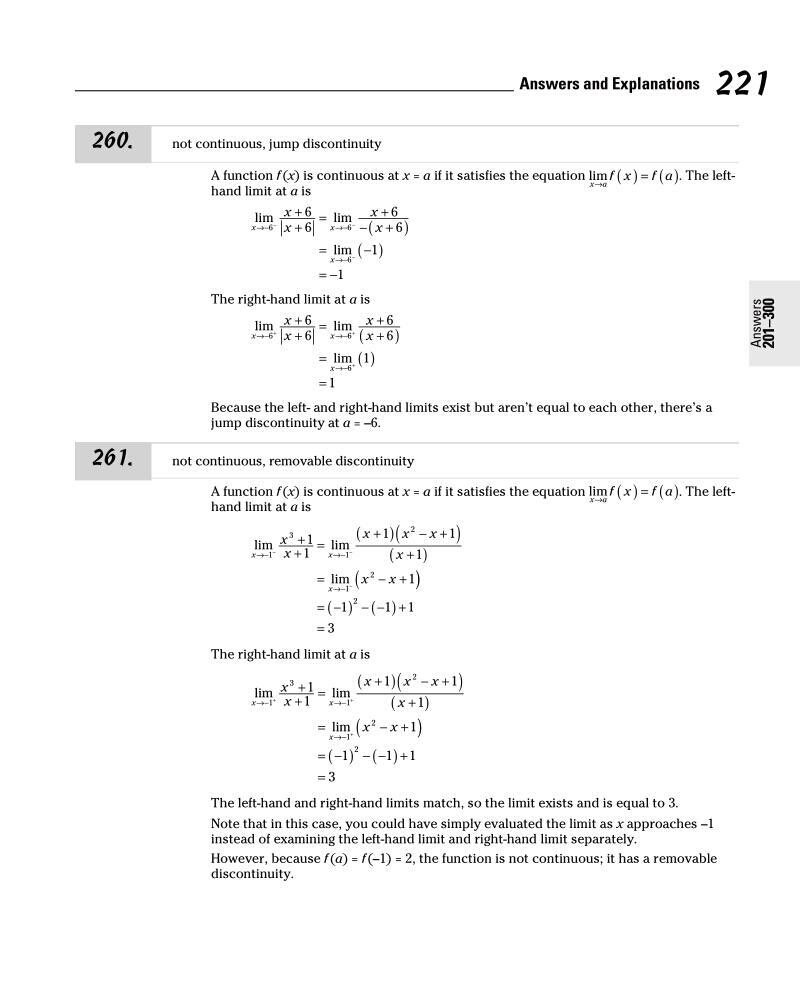
Because the left- and right-hand limits exist but aren’t equal to each other, there’s a
jump discontinuity at a = –6.
261.
not continuous, removable discontinuity
A function f
(x) is continuous at x = a if it satisfies the equation lim x a
f x
f a
→
( ) = ( ). The lefthand limit at a is
lim
lim
lim
x
x
x
x
x
x
x
x
x
x
x
→−
→−
→−
−
−
−
+
+
=
+
(
) − +
(
)
+
(
)
=
− +
(
1
3
1
2
1
2
1
1
1
1
1
1 ) )
= −
( ) − −
( )+
=
1
1 1
3
2
The right-hand limit at a is
lim
lim
lim
x
x
x
x
x
x
x
x
x
x
x
→−
→−
→−
+
+
+
+
+
=
+
(
) − +
(
)
+
(
)
=
− +
(
1
3
1
2
1
2
1
1
1
1
1
1 ) )
= −
( ) − −
( )+
=
1
1 1
3
2
The left-hand and right-hand limits match, so the limit exists and is equal to 3.
Note that in this case, you could have simply evaluated the limit as x approaches –1
instead of examining the left-hand limit and right-hand limit separately.
However, because f
(a) = f
(–1) = 2, the function is not continuous; it has a removable
discontinuity.
Answers
201–300
260.
not continuous, jump discontinuity
A function f
(x) is continuous at x = a if it satisfies the equation lim x a f x
f a
→
( ) = ( ). The lefthand limit at a is
lim
lim
lim
x
x
x
x
x
x
x
→−
→−
→−
−
−
−
+
+
=
+
− +
(
)
=
−
( )
= −
6
6
6
6
6
6
6
1
1
The right-hand limit at a is
lim
lim
lim
x
x
x
x
x
x
x
→−
→−
→−
+
+
+
+
+
=
+
+
(
)
=
( )
=
6
6
6
6
6
6
6
1
1
Because the left- and right-hand limits exist but aren’t equal to each other, there’s a
jump discontinuity at a = –6.
261.
not continuous, removable discontinuity
A function f
(x) is continuous at x = a if it satisfies the equation lim x a
f x
f a
→
( ) = ( ). The lefthand limit at a is
lim
lim
lim
x
x
x
x
x
x
x
x
x
x
x
→−
→−
→−
−
−
−
+
+
=
+
(
) − +
(
)
+
(
)
=
− +
(
1
3
1
2
1
2
1
1
1
1
1
1 ) )
= −
( ) − −
( )+
=
1
1 1
3
2
The right-hand limit at a is
lim
lim
lim
x
x
x
x
x
x
x
x
x
x
x
→−
→−
→−
+
+
+
+
+
=
+
(
) − +
(
)
+
(
)
=
− +
(
1
3
1
2
1
2
1
1
1
1
1
1 ) )
= −
( ) − −
( )+
=
1
1 1
3
2
The left-hand and right-hand limits match, so the limit exists and is equal to 3.
Note that in this case, you could have simply evaluated the limit as x approaches –1
instead of examining the left-hand limit and right-hand limit separately.
However, because f
(a) = f
(–1) = 2, the function is not continuous; it has a removable
discontinuity.
Answers
201–300