

Answers and Explanations 209
237.
–∞
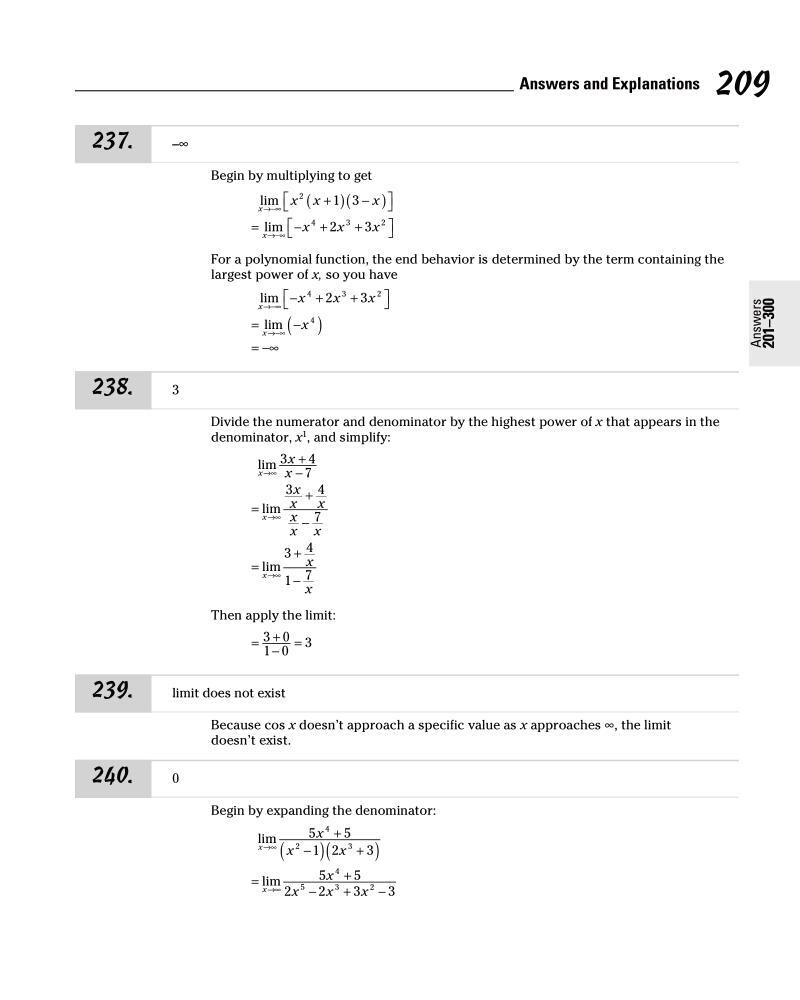
Begin by multiplying to get
lim
lim
x
x
x x
x
x
x
x
→−∞
→−∞
+
(
) −
(
)
=
− +
+
2
4
3
2
1 3
2
3
For a polynomial function, the end behavior is determined by the term containing the
largest power of x, so you have
lim
lim
x
x
x
x
x
x
→−∞
→−∞
− +
+
=
−
( )
= −∞
4
3
2
4
2
3
238.
3
Divide the numerator and denominator by the highest power of x that appears in the
denominator, x
1
, and simplify:
lim
lim
lim
x
x
x
x
x
x
x
x
x
x x
x
x
→∞
→∞
→∞
+
−
=
+
−
=
+
−
3
4
7
3
4
7
3 4
1 7
Then apply the limit:
= +
−
=
3 0
1 0
3
239.
limit does not exist
Because cos x doesn’t approach a specific value as x approaches ∞, the limit
doesn’t exist.
240.
0
Begin by expanding the denominator:
lim
lim
x
x
x
x
x
x
x
x
x
→∞
→∞
+
−
(
) +
(
)
=
+
−
+
−
5
5
1 2
3
5
5
2
2
3
3
4
2
3
4
5
3
2
Answers
201–300
237.
–∞
Begin by multiplying to get
lim
lim
x
x
x x
x
x
x
x
→−∞
→−∞
+
(
) −
(
)
=
− +
+
2
4
3
2
1 3
2
3
For a polynomial function, the end behavior is determined by the term containing the
largest power of x, so you have
lim
lim
x
x
x
x
x
x
→−∞
→−∞
− +
+
=
−
( )
= −∞
4
3
2
4
2
3
238.
3
Divide the numerator and denominator by the highest power of x that appears in the
denominator, x
1
, and simplify:
lim
lim
lim
x
x
x
x
x
x
x
x
x
x x
x
x
→∞
→∞
→∞
+
−
=
+
−
=
+
−
3
4
7
3
4
7
3 4
1 7
Then apply the limit:
= +
−
=
3 0
1 0
3
239.
limit does not exist
Because cos x doesn’t approach a specific value as x approaches ∞, the limit
doesn’t exist.
240.
0
Begin by expanding the denominator:
lim
lim
x
x
x
x
x
x
x
x
x
→∞
→∞
+
−
(
) +
(
)
=
+
−
+
−
5
5
1 2
3
5
5
2
2
3
3
4
2
3
4
5
3
2
Answers
201–300