

Answers and Explanations 145
Answers
1–100
55.
no real solutions
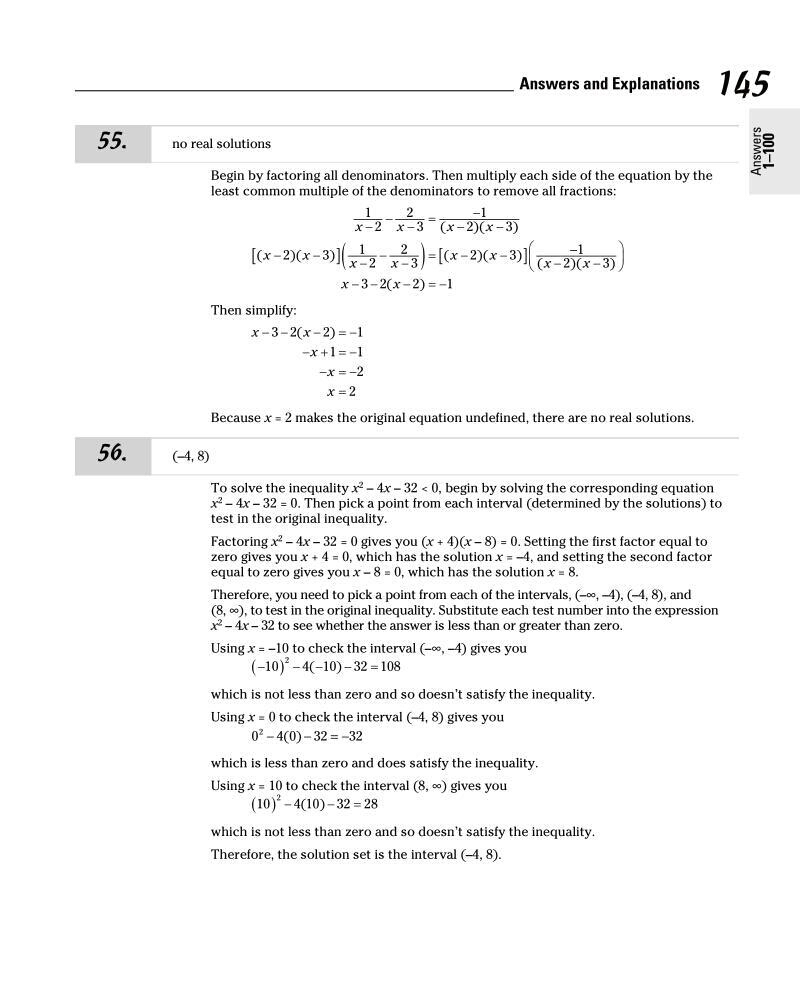
Begin by factoring all denominators. Then multiply each side of the equation by the
least common multiple of the denominators to remove all fractions:
1
2
2
3
1
2
3
2
3
1
2
2
3
2
3
x
x
x
x
x
x
x
x
x
x
−
− −
=
−
−
−
−
−
[
] −
− −
(
) = − −
[
]
(
)(
)
(
)(
)
(
)(
)
− −
−
−
− −
− = −
1
2
3
3 2
2
1
(
)(
)
(
)
x
x
x
x
Then simplify:
x
x
x
x
x
− −
− = −
− + = −
− = −
=
3 2
2
1
1
1
2
2
(
)
Because x = 2 makes the original equation undefined, there are no real solutions.
56.
(–4, 8)
To solve the inequality x
2
– 4x – 32 < 0, begin by solving the corresponding equation
x
2
– 4x – 32 = 0. Then pick a point from each interval (determined by the solutions) to
test in the original inequality.
Factoring x
2
– 4x – 32 = 0 gives you (x + 4)(x – 8) = 0. Setting the first factor equal to
zero gives you x + 4 = 0, which has the solution x = –4, and setting the second factor
equal to zero gives you x – 8 = 0, which has the solution x = 8.
Therefore, you need to pick a point from each of the intervals, (–∞, –4), (–4, 8), and
(8, ∞), to test in the original inequality. Substitute each test number into the expression
x
2
– 4x – 32 to see whether the answer is less than or greater than zero.
Using x = –10 to check the interval (–∞, –4) gives you
−
( ) − − − =
10
4 10 32 108
2
(
)
which is not less than zero and so doesn’t satisfy the inequality.
Using x = 0 to check the interval (–4, 8) gives you
0 4 0 32
32
2
−
− = −
( )
which is less than zero and does satisfy the inequality.
Using x = 10 to check the interval (8, ∞) gives you
10
4 10 32 28
2
( ) −
− =
( )
which is not less than zero and so doesn’t satisfy the inequality.
Therefore, the solution set is the interval (–4, 8).
Answers
1–100
55.
no real solutions
Begin by factoring all denominators. Then multiply each side of the equation by the
least common multiple of the denominators to remove all fractions:
1
2
2
3
1
2
3
2
3
1
2
2
3
2
3
x
x
x
x
x
x
x
x
x
x
−
− −
=
−
−
−
−
−
[
] −
− −
(
) = − −
[
]
(
)(
)
(
)(
)
(
)(
)
− −
−
−
− −
− = −
1
2
3
3 2
2
1
(
)(
)
(
)
x
x
x
x
Then simplify:
x
x
x
x
x
− −
− = −
− + = −
− = −
=
3 2
2
1
1
1
2
2
(
)
Because x = 2 makes the original equation undefined, there are no real solutions.
56.
(–4, 8)
To solve the inequality x
2
– 4x – 32 < 0, begin by solving the corresponding equation
x
2
– 4x – 32 = 0. Then pick a point from each interval (determined by the solutions) to
test in the original inequality.
Factoring x
2
– 4x – 32 = 0 gives you (x + 4)(x – 8) = 0. Setting the first factor equal to
zero gives you x + 4 = 0, which has the solution x = –4, and setting the second factor
equal to zero gives you x – 8 = 0, which has the solution x = 8.
Therefore, you need to pick a point from each of the intervals, (–∞, –4), (–4, 8), and
(8, ∞), to test in the original inequality. Substitute each test number into the expression
x
2
– 4x – 32 to see whether the answer is less than or greater than zero.
Using x = –10 to check the interval (–∞, –4) gives you
−
( ) − − − =
10
4 10 32 108
2
(
)
which is not less than zero and so doesn’t satisfy the inequality.
Using x = 0 to check the interval (–4, 8) gives you
0 4 0 32
32
2
−
− = −
( )
which is less than zero and does satisfy the inequality.
Using x = 10 to check the interval (8, ∞) gives you
10
4 10 32 28
2
( ) −
− =
( )
which is not less than zero and so doesn’t satisfy the inequality.
Therefore, the solution set is the interval (–4, 8).