

Part II: The Answers
144
Answers
1–100
52.
x = –1
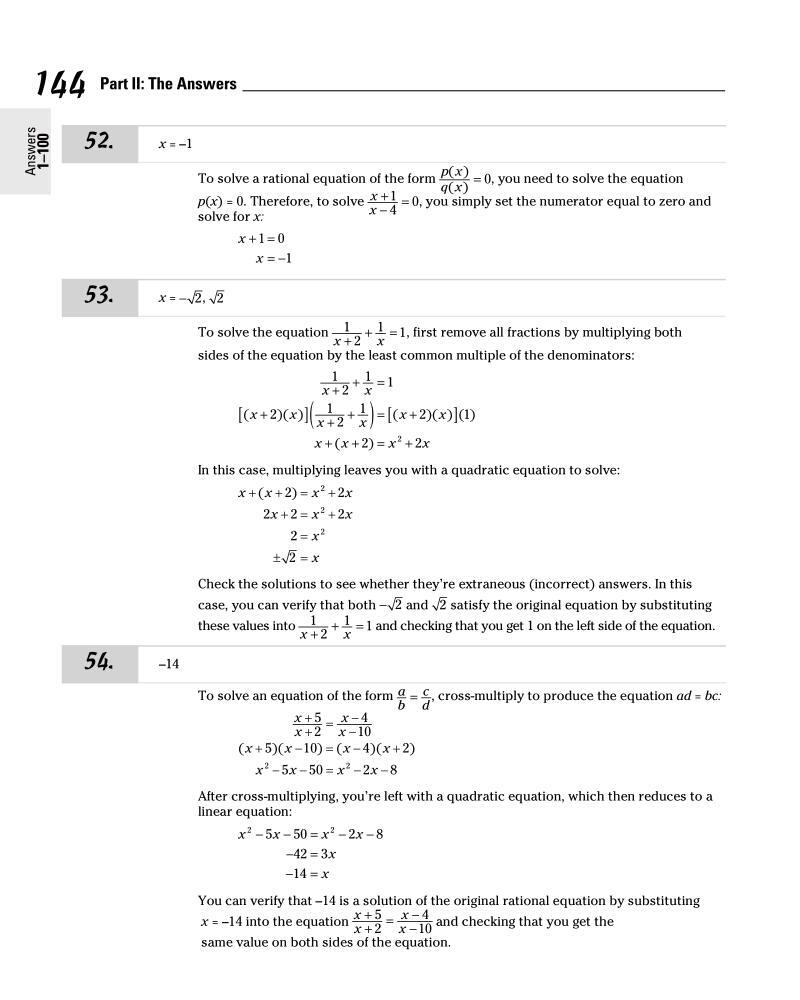
To solve a rational equation of the form
p x
q x
( )
( )
= 0, you need to solve the equation
p(x) = 0. Therefore, to solve x
x
+
−
=
1
4
0, you simply set the numerator equal to zero and
solve for x:
x
x
+ =
= −
1 0
1
53.
x = − 2, 2
To solve the equation 1
2
1 1
x
x
+
+ = , first remove all fractions by multiplying both
sides of the equation by the least common multiple of the denominators:
1
2
1 1
2
1
2
1
2
1
2
2
2
x
x
x
x
x
x
x
x
x x
x
x
+
+ =
+
[
] +
+
(
) = +
[
]
+ + =
+
(
)( )
(
)( ) ( )
(
)
In this case, multiplying leaves you with a quadratic equation to solve:
x x
x
x
x
x
x
x
x
+ + =
+
+ =
+
=
±
=
(
)
2
2
2
2
2
2
2
2
2
2
Check the solutions to see whether they’re extraneous (incorrect) answers. In this
case, you can verify that both − 2 and 2 satisfy the original equation by substituting
these values into 1
2
1 1
x
x
+
+ = and checking that you get 1 on the left side of the equation.
54.
–14
To solve an equation of the form a
b
c
d
= , cross-multiply to produce the equation ad = bc:
x
x
x
x
x
x
x
x
x
x
x
x
+
+
= −
−
+
−
=
−
+
−
− =
− −
5
2
4
10
5
10
4
2
5
50
2
8
2
2
(
)(
) (
)(
)
After cross-multiplying, you’re left with a quadratic equation, which then reduces to a
linear equation:
x
x
x
x
x
x
2
2
5
50
2
8
42 3
14
−
− =
−
−
− =
− =
You can verify that –14 is a solution of the original rational equation by substituting
x = –14 into the equation
x
x
x
x
+
+
= −
−
5
2
4
10
and checking that you get the
same value on both sides of the equation.
144
Answers
1–100
52.
x = –1
To solve a rational equation of the form
p x
q x
( )
( )
= 0, you need to solve the equation
p(x) = 0. Therefore, to solve x
x
+
−
=
1
4
0, you simply set the numerator equal to zero and
solve for x:
x
x
+ =
= −
1 0
1
53.
x = − 2, 2
To solve the equation 1
2
1 1
x
x
+
+ = , first remove all fractions by multiplying both
sides of the equation by the least common multiple of the denominators:
1
2
1 1
2
1
2
1
2
1
2
2
2
x
x
x
x
x
x
x
x
x x
x
x
+
+ =
+
[
] +
+
(
) = +
[
]
+ + =
+
(
)( )
(
)( ) ( )
(
)
In this case, multiplying leaves you with a quadratic equation to solve:
x x
x
x
x
x
x
x
x
+ + =
+
+ =
+
=
±
=
(
)
2
2
2
2
2
2
2
2
2
2
Check the solutions to see whether they’re extraneous (incorrect) answers. In this
case, you can verify that both − 2 and 2 satisfy the original equation by substituting
these values into 1
2
1 1
x
x
+
+ = and checking that you get 1 on the left side of the equation.
54.
–14
To solve an equation of the form a
b
c
d
= , cross-multiply to produce the equation ad = bc:
x
x
x
x
x
x
x
x
x
x
x
x
+
+
= −
−
+
−
=
−
+
−
− =
− −
5
2
4
10
5
10
4
2
5
50
2
8
2
2
(
)(
) (
)(
)
After cross-multiplying, you’re left with a quadratic equation, which then reduces to a
linear equation:
x
x
x
x
x
x
2
2
5
50
2
8
42 3
14
−
− =
−
−
− =
− =
You can verify that –14 is a solution of the original rational equation by substituting
x = –14 into the equation
x
x
x
x
+
+
= −
−
5
2
4
10
and checking that you get the
same value on both sides of the equation.