

Copyright© 2015 Dunod.
© Dunod. Toute reproduction non autorisée est un délit.
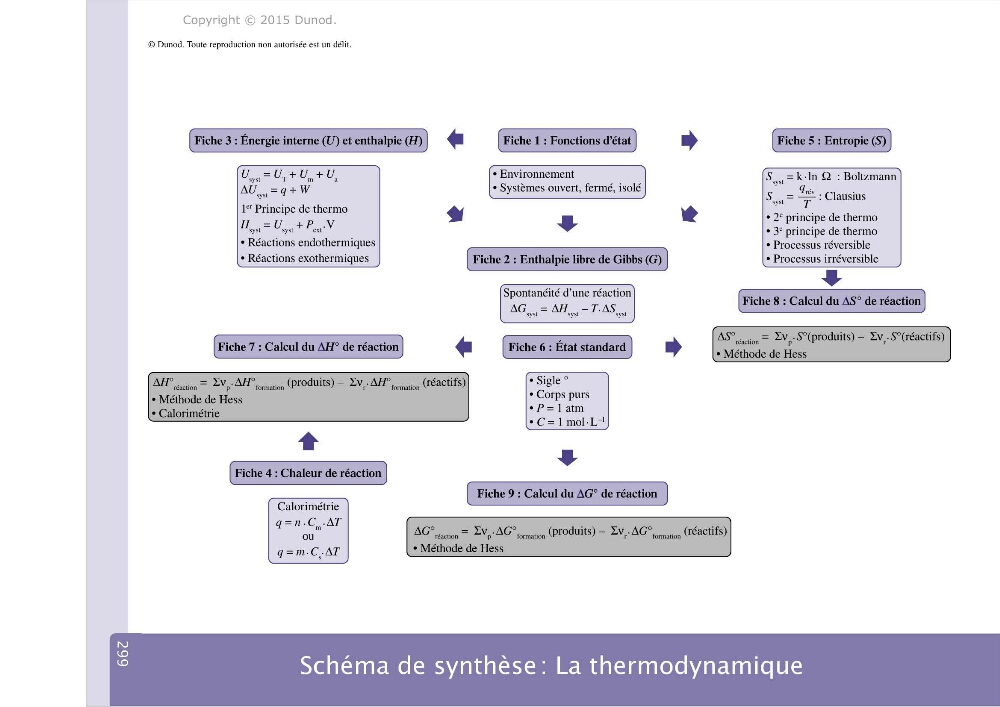
Fiche 3 : Énergie interne (U) et enthalpie (H)
•
(Fiche 1 : Fonctions d'état J
•
( Fiche 5 : Entropie (S) J
u syst = UT+ um + va
AUsyst =q + W
l er Principe de thermo
H = U +P .V
syst
syst
ext
•Réactions endothermiques
•Réactions exothermiques
(Fiche 7 : Calcul du /),.ff
0 de réaction J
• Environnement
• Systèmes ouvert, fermé, isolé
~
•
*
( Fiche 2 : Enthalpie libre de Gibbs (G) J
•
Spontanéité d'une réaction
AG
=AH - T.AS
sysl
syst
syst
( Fiche 6 : État standard )
•
S = k -ln Q : Boltzmann
syst
S
qrév Cl ·
= - T : ausms
syst
• 2° principe de thermo
• 3e principe de thermo
• Processus réversible
• Processus irréversible
•
(Fiche 8 : Calcul du AS
0 de réaction)
[
AS
0
ré .
= LV .S
0 (produits) - LV .S
0 (réactifs)
~~
p
r
• Méthode de Hess
AHo réaction = LVP. AHofomiation (produits)- LVr AHoformation (réactifs)
• Sigle
0
• Corps purs
• Méthode de Hess
• Calorimétrie
+
( Fiche 4 : Chaleur de réaction J
Calorimétrie
q =n.C .AT
Ill
ou
q = m. C 5 AT
• P = l atm
• C = 1 mol · L -
1
•
( Fiche 9 : Calcul du !1G
0 de réaction J
AGoréaction = LVP./1Goformation (produits)- LV, AGofom1ation (réactifs)
• Méthode de Hess
© Dunod. Toute reproduction non autorisée est un délit.
Fiche 3 : Énergie interne (U) et enthalpie (H)
•
(Fiche 1 : Fonctions d'état J
•
( Fiche 5 : Entropie (S) J
u syst = UT+ um + va
AUsyst =q + W
l er Principe de thermo
H = U +P .V
syst
syst
ext
•Réactions endothermiques
•Réactions exothermiques
(Fiche 7 : Calcul du /),.ff
0 de réaction J
• Environnement
• Systèmes ouvert, fermé, isolé
~
•
*
( Fiche 2 : Enthalpie libre de Gibbs (G) J
•
Spontanéité d'une réaction
AG
=AH - T.AS
sysl
syst
syst
( Fiche 6 : État standard )
•
S = k -ln Q : Boltzmann
syst
S
qrév Cl ·
= - T : ausms
syst
• 2° principe de thermo
• 3e principe de thermo
• Processus réversible
• Processus irréversible
•
(Fiche 8 : Calcul du AS
0 de réaction)
[
AS
0
ré .
= LV .S
0 (produits) - LV .S
0 (réactifs)
~~
p
r
• Méthode de Hess
AHo réaction = LVP. AHofomiation (produits)- LVr AHoformation (réactifs)
• Sigle
0
• Corps purs
• Méthode de Hess
• Calorimétrie
+
( Fiche 4 : Chaleur de réaction J
Calorimétrie
q =n.C .AT
Ill
ou
q = m. C 5 AT
• P = l atm
• C = 1 mol · L -
1
•
( Fiche 9 : Calcul du !1G
0 de réaction J
AGoréaction = LVP./1Goformation (produits)- LV, AGofom1ation (réactifs)
• Méthode de Hess