

.~
:;;
"O
"'O
c:
0
::l
c
"'
::i
" "
0
~
lJ)
·;::
.9
T"-i
::l
0
"' c:
N
0
c:
@
c:
.!2
.......
ü
..c
.g
0\
2
ï:::
Q.
>~
a. .!l
0
"
u
<2
-0
0
c:
::l
Cl
@
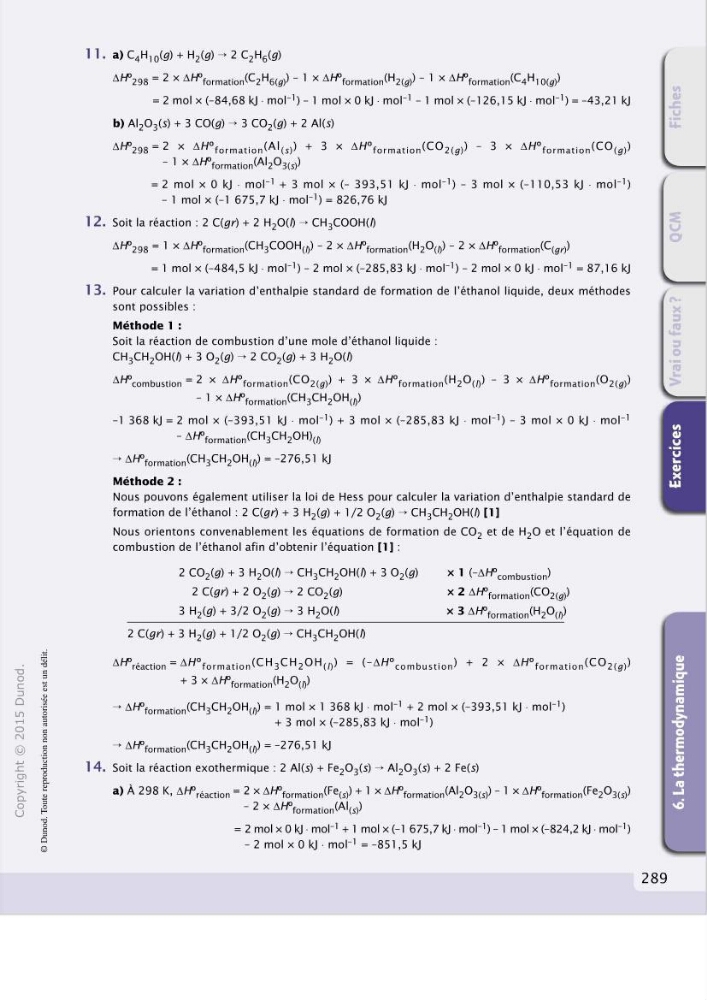
ô.H'293 = 2 X 6.H'formation
b) Al 2 0 3 (s) + 3 CO(g) --+ 3 C0 2 (g) + 2 Al(s)
ô.H'293 = 2 X 6.H
0 formation( Al (s)) + 3 X 6. H
0 formation(C02(g)) - 3 X 6.H
0 fo rm ati on(CO(g))
- 1 X ô.H'formation(Al203(s))
= 2 mol x 0 kJ. mo1 - 1 + 3 mol x (- 393,5 1 kJ. mol- 1 ) - 3 mol x (-1 10,53 kJ. mol - 1 )
- 1 mol x (- 1 675,7 kJ · mol- 1 ) = 826,76 kJ
12. Soit la réaction : 2 C(gr) + 2 H 2 0(b --. CH 3 COOH(b
6.H'293 = 1 X 6.H'formation(CH3COOH(/)) - 2 X 6.H'formation
l 3. Pour calculer la variation d'enthalpie standard de formation de l'éthanol liquide, deux méthodes
sont possibles :
14.
Méthode 1 :
Soit la réaction de combustion d'une mole d'éthanol liquide :
CH 3 CH 2 0HW + 3 0 2 (g) ___, 2 C0 2 (g) + 3 H 2 0W
ô.H'combustion = 2 x ô.H
0 formation(C02(g)) + 3 x ô. H
0 form ation(H20(I)) - 3 x ô.H
0 for mation<0 2(g))
- 1 X 6.H'formation(CH3CH20H(/))
- 1 368 kJ = 2 mol x (-393,5 1 kJ . mol- 1 ) + 3 mol x (- 285 ,8 3 kJ . mol- 1 ) - 3 mol x O kJ . mo1- 1
- ô.H'formation(CH3CH20H)(/)
--+ ô.H'formation(CH3C H20 H(/)) = -2 76, 51 kJ
Méthode 2:
Nou s pouvon s également utili se r la loi de Hess pour calcu ler la variation d'ent halpie standard de
formation de l'éthano l : 2 C(9r) + 3 H 2 (9) + 1 /2 0 2 (9) --+ CH 3 CH 2 0HW [1]
Nou s orientons convenablement les équations de formation de C0 2 et de H 2 0 et l'équation de
combustion de l'éthano l afin d'obtenir l 'équation [1] :
2 C0 2 (9) + 3 H 2 0(b --. CH 3 CH 2 0HW + 3 0 2 (9)
2 C(9r) + 2 0 2 (9) --+ 2 C0 2 (9)
3 H 2 (9) + 3/2 0 2 (9) --. 3 H 2 0 W
2 C(9r) + 3 H 2 (9) + 1 /2 0 2 (9) --+ CH 3 CH 2 0HW
X 1 (- 6.H' combustion)
X 2 ô.H'formation(C02(g))
X 3 6.H'formation(HzO(I))
6. H'réaction = 6. H
0 formation (CH 3 CH 2 0 H (/)) = ( - 6. H o co rn bust ion) + 2 X t.. H
0 for mat ion (C 0 2 (g))
+ 3 X ô.H'formation
--+ ô.H'formation(CH 3CH zOH(/)) = -2 76, 51 kJ
Soit la réaction exothermique : 2 Al(s) + Fe 2 0 3 (s) --+ Al 2 0 3 (s) + 2 Fe( s)
a) À 298 K, 6.H'réaction = 2 X 6.H'formation(Fe(s)) + 1 X 6.H'formation(Al 203(s)) - 1 X ô.H'formation
= 2 mol x 0 kJ · mo1- 1 +1 mol x (-1 675,7 kJ · mol- 1 )-1 mol x (-824,2 kJ · mol- 1 )
- 2 mol x O kJ . mo1-1 = -851,5 kJ
289
:;;
"O
"'O
c:
0
::l
c
"'
::i
" "
0
~
lJ)
·;::
.9
T"-i
::l
0
"' c:
N
0
c:
@
c:
.!2
.......
ü
..c
.g
0\
2
ï:::
Q.
>~
a. .!l
0
"
u
<2
-0
0
c:
::l
Cl
@
ô.H'293 = 2 X 6.H'formation
b) Al 2 0 3 (s) + 3 CO(g) --+ 3 C0 2 (g) + 2 Al(s)
ô.H'293 = 2 X 6.H
0 formation( Al (s)) + 3 X 6. H
0 formation(C02(g)) - 3 X 6.H
0 fo rm ati on(CO(g))
- 1 X ô.H'formation(Al203(s))
= 2 mol x 0 kJ. mo1 - 1 + 3 mol x (- 393,5 1 kJ. mol- 1 ) - 3 mol x (-1 10,53 kJ. mol - 1 )
- 1 mol x (- 1 675,7 kJ · mol- 1 ) = 826,76 kJ
12. Soit la réaction : 2 C(gr) + 2 H 2 0(b --. CH 3 COOH(b
6.H'293 = 1 X 6.H'formation(CH3COOH(/)) - 2 X 6.H'formation
l 3. Pour calculer la variation d'enthalpie standard de formation de l'éthanol liquide, deux méthodes
sont possibles :
14.
Méthode 1 :
Soit la réaction de combustion d'une mole d'éthanol liquide :
CH 3 CH 2 0HW + 3 0 2 (g) ___, 2 C0 2 (g) + 3 H 2 0W
ô.H'combustion = 2 x ô.H
0 formation(C02(g)) + 3 x ô. H
0 form ation(H20(I)) - 3 x ô.H
0 for mation<0 2(g))
- 1 X 6.H'formation(CH3CH20H(/))
- 1 368 kJ = 2 mol x (-393,5 1 kJ . mol- 1 ) + 3 mol x (- 285 ,8 3 kJ . mol- 1 ) - 3 mol x O kJ . mo1- 1
- ô.H'formation(CH3CH20H)(/)
--+ ô.H'formation(CH3C H20 H(/)) = -2 76, 51 kJ
Méthode 2:
Nou s pouvon s également utili se r la loi de Hess pour calcu ler la variation d'ent halpie standard de
formation de l'éthano l : 2 C(9r) + 3 H 2 (9) + 1 /2 0 2 (9) --+ CH 3 CH 2 0HW [1]
Nou s orientons convenablement les équations de formation de C0 2 et de H 2 0 et l'équation de
combustion de l'éthano l afin d'obtenir l 'équation [1] :
2 C0 2 (9) + 3 H 2 0(b --. CH 3 CH 2 0HW + 3 0 2 (9)
2 C(9r) + 2 0 2 (9) --+ 2 C0 2 (9)
3 H 2 (9) + 3/2 0 2 (9) --. 3 H 2 0 W
2 C(9r) + 3 H 2 (9) + 1 /2 0 2 (9) --+ CH 3 CH 2 0HW
X 1 (- 6.H' combustion)
X 2 ô.H'formation(C02(g))
X 3 6.H'formation(HzO(I))
6. H'réaction = 6. H
0 formation (CH 3 CH 2 0 H (/)) = ( - 6. H o co rn bust ion) + 2 X t.. H
0 for mat ion (C 0 2 (g))
+ 3 X ô.H'formation
--+ ô.H'formation(CH 3CH zOH(/)) = -2 76, 51 kJ
Soit la réaction exothermique : 2 Al(s) + Fe 2 0 3 (s) --+ Al 2 0 3 (s) + 2 Fe( s)
a) À 298 K, 6.H'réaction = 2 X 6.H'formation(Fe(s)) + 1 X 6.H'formation(Al 203(s)) - 1 X ô.H'formation
= 2 mol x 0 kJ · mo1- 1 +1 mol x (-1 675,7 kJ · mol- 1 )-1 mol x (-824,2 kJ · mol- 1 )
- 2 mol x O kJ . mo1-1 = -851,5 kJ
289