

should not be ignored and, moreover, that they do lead
to real solutions. After developing the algebra of complex numbers, Bombelli could show that the answer
presented above, for instance, is just the number x = 4
in disguise. Bombelli went on to show that, in fact,
every equation of the form x
3 = ax + b, with a and b
positive, has a real solution, thereby justifying the
method of complex numbers.
In addition to developing complex arithmetic,
Bombelli developed the basic algebra of NEGATIVE
NUMBERS. In particular, he provided a geometric argument to help explain why a negative number times
itself must be positive—a notion that still causes many
people difficulty today.
Bombelli died in 1572. (The exact date of his
death is not known.) GOTTFRIED WILHELM LEIBNIZ
(1646–1716), codiscoverer of CALCULUS, taught himself
mathematics from Bombelli’s L’Algebra and described the
scholar as “an outstanding master of the analytic art.”
Boole, George (1815–1864) British Logic Born on
November 2, 1815, in Lincolnshire, England, algebraist
George Boole is remembered for his highly innovative
work in the field of logic. In his pioneering piece, An
Investigation of the Laws of Thought, on Which are
Founded the Mathematical Theories of Logic and
Probability, published in 1854, Boole established the
effectiveness of symbolic manipulation as a means to
represent and perform operations of reasoning. Boole is
considered the founder of the field of symbolic logic.
Boole received no formal education in mathematics. As a young man he read the works of JOSEPH-LOUIS
LAGRANGE and PIERRE-SIMON LAPLACE, and by age 20
began publishing original results. His early work in the
field of DIFFERENTIAL EQUATIONs garnered him
national attention as a capable scholar. In 1845 Boole
was honored with a gold medal from the ROYAL SOCIETY of London, England’s most prestigious academic
society. Four years later, in 1849, he was appointed
chair of the mathematics department at Queens College, Cork, Ireland, despite having no university degree.
Boole stayed at this college for the rest of his life,
devoting himself to teaching and research.
Boole began work in mathematical logic before
moving to Ireland. At the time, logic was considered to
be a topic of interest only to philosophers, but in
1847, in his pamphlet The Mathematical Analysis of
Logic, Boole successfully argued that the topic has
merit in the art of mathematical reasoning. By using
symbols to represent statements, Boole developed an
“algebra of logic” whose rules and valid manipulations matched the processes of reasoning. Thus mathematical arguments and lines of thought could themselves
be reduced to simple algebraic manipulations. For
instance, if the symbol x is used to represent “all butterflies,” then 1 – x represents all that is not a butterfly. If y represents the color blue, then xy is the set of
all objects that are both butterflies and blue, that is, all
blue butterflies. The expression (1 – x)(1 – y) represents all the nonblue nonbutterflies.
Algebraically the quantity (1 – x)(1 – y) equals
1 – x – y + xy. One could argue that the INCLUSIONEXCLUSION PRINCIPLE is at play here, saying that the set
of nonblue nonbutterflies is the set of all objects that
are neither butterflies, nor blue, with an adjustment
48 Boole, George
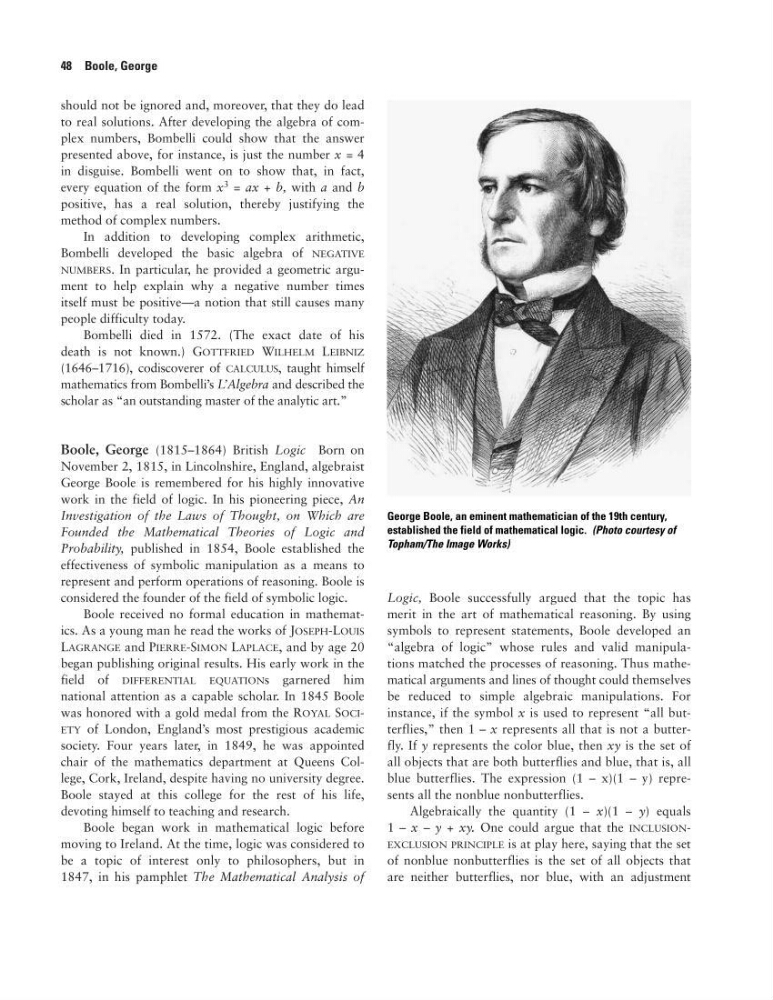
George Boole, an eminent mathematician of the 19th century,
established the field of mathematical logic. (Photo courtesy of
Topham/The Image Works)
to real solutions. After developing the algebra of complex numbers, Bombelli could show that the answer
presented above, for instance, is just the number x = 4
in disguise. Bombelli went on to show that, in fact,
every equation of the form x
3 = ax + b, with a and b
positive, has a real solution, thereby justifying the
method of complex numbers.
In addition to developing complex arithmetic,
Bombelli developed the basic algebra of NEGATIVE
NUMBERS. In particular, he provided a geometric argument to help explain why a negative number times
itself must be positive—a notion that still causes many
people difficulty today.
Bombelli died in 1572. (The exact date of his
death is not known.) GOTTFRIED WILHELM LEIBNIZ
(1646–1716), codiscoverer of CALCULUS, taught himself
mathematics from Bombelli’s L’Algebra and described the
scholar as “an outstanding master of the analytic art.”
Boole, George (1815–1864) British Logic Born on
November 2, 1815, in Lincolnshire, England, algebraist
George Boole is remembered for his highly innovative
work in the field of logic. In his pioneering piece, An
Investigation of the Laws of Thought, on Which are
Founded the Mathematical Theories of Logic and
Probability, published in 1854, Boole established the
effectiveness of symbolic manipulation as a means to
represent and perform operations of reasoning. Boole is
considered the founder of the field of symbolic logic.
Boole received no formal education in mathematics. As a young man he read the works of JOSEPH-LOUIS
LAGRANGE and PIERRE-SIMON LAPLACE, and by age 20
began publishing original results. His early work in the
field of DIFFERENTIAL EQUATIONs garnered him
national attention as a capable scholar. In 1845 Boole
was honored with a gold medal from the ROYAL SOCIETY of London, England’s most prestigious academic
society. Four years later, in 1849, he was appointed
chair of the mathematics department at Queens College, Cork, Ireland, despite having no university degree.
Boole stayed at this college for the rest of his life,
devoting himself to teaching and research.
Boole began work in mathematical logic before
moving to Ireland. At the time, logic was considered to
be a topic of interest only to philosophers, but in
1847, in his pamphlet The Mathematical Analysis of
Logic, Boole successfully argued that the topic has
merit in the art of mathematical reasoning. By using
symbols to represent statements, Boole developed an
“algebra of logic” whose rules and valid manipulations matched the processes of reasoning. Thus mathematical arguments and lines of thought could themselves
be reduced to simple algebraic manipulations. For
instance, if the symbol x is used to represent “all butterflies,” then 1 – x represents all that is not a butterfly. If y represents the color blue, then xy is the set of
all objects that are both butterflies and blue, that is, all
blue butterflies. The expression (1 – x)(1 – y) represents all the nonblue nonbutterflies.
Algebraically the quantity (1 – x)(1 – y) equals
1 – x – y + xy. One could argue that the INCLUSIONEXCLUSION PRINCIPLE is at play here, saying that the set
of nonblue nonbutterflies is the set of all objects that
are neither butterflies, nor blue, with an adjustment
48 Boole, George
George Boole, an eminent mathematician of the 19th century,
established the field of mathematical logic. (Photo courtesy of
Topham/The Image Works)