

Just before publishing his work, Bolyai learned that
the great CARL FRIEDRICH GAUSS (1777–1855) had
already anticipated much of this theory, even though he
had not published any material on the matter. Bolyai
decided to delay the release of his work. In 1832 he
printed the details of his new theory only as a 24-page
appendix to an essay his father was preparing. Later, in
1848, Bolyai discovered that Lobachevsky had published a similar piece of work in 1829. Bolyai never
published the full version of his original treatise. His
short 24-page piece was practically forgotten until
Richard Blatzer discussed the work of both Bolyai and
Lobachevsky in his 1867 text Elemente der Mathematik
(Elements of mathematics). At that point, Bolyai’s piece
was recognized as the first clear account of the mathematics of a new type of geometry. He is today regarded
as having independently founded the topic.
Bolyai died on January 27, 1860, in Marosvásárhely,
Hungary (now Tirgu-Mures, Romania). In 1945 the
University of Cluj honored Bolyai by including his name
in its title. It is today known as the Babes-Bolyai University of Cluj.
Bolzano, Bernard Placidus (1781–1848) Czech
Analysis, Philosophy, Theology Born on October 5,
1781, in Prague, Bernard Bolzano is remembered as the
first mathematician to offer a rigorous description of
what is meant by a CONTINUOUS FUNCTION. The related
theorem, the INTERMEDIATE-VALUE THEOREM, is sometimes named in his honor.
Bolzano studied philosophy and mathematics at
the University of Prague and earned a doctoral degree
in mathematics in 1804. He also completed three years
of theological study at the same time and was ordained
a Roman Catholic priest two days after receiving his
doctorate. Choosing to pursue a career in teaching,
Bolzano accepted a position as chair of philosophy and
religion at the university later that year.
In 1810 Bolzano began work on understanding the
foundations of mathematics and, in particular, the logical foundations of the newly discovered CALCULUS. He
found the notion of an INFINITESIMAL troublesome and
attempted to provide a new basis for the subject free
from this concept. In his 1817 paper “Rein Analytischer Beweis” (Pure analytical proof), Bolzano explored
the concept of a LIMIT—anticipating the foundational
approach of AUGUSTIN-LOUIS CAUCHY offered four
years later—and proved the famous intermediate value
theorem. Bolzano was also the first to provide an
example of a function that is continuous at every point
but differentiable at no point.
Bolzano also anticipated much of GEORG CANTOR’S work on the infinite. In his 1850 article “Paradoxien des Unendlichen” (Paradoxes of the infinite),
published by a student two years after his death,
Bolzano examined the nature of infinite sets and the
paradoxes that arise from them. This piece contains the
first use of the word “set” in a mathematical context.
Bolzano died on December 18, 1848, in Prague,
Bohemia (now the Czech Republic). His work paved
the way for providing rigorous underpinnings to the
subject of calculus. In particular, Bolzano identified for
the first time in “Rein Analytischer Beweis” the “completeness property” of the real numbers.
Bombelli, Rafael (1526–1572) Italian Algebra Born
in Bologna, Italy, in 1526 (the day and month of his
birth date are not known), scholar Rafael Bombelli is
remembered for his highly influential 1572 book L’Algebra (Algebra). In this work, Bombelli published rules for
the solution to the QUADRATIC, CUBIC, and QUARTIC
EQUATIONS, and was one of the first mathematicians to
accept COMPLEX NUMBERS as solutions to equations.
Bombelli began his career as an engineer specializing in hydraulics and worked on a number of projects
to turn salt marshes into usable land. Having read the
great Ars magna (The great art) by GIROLAMO CARDANO (1501–76), Bombelli decided to write an algebra
text that would make the methods developed there
accessible to a general audience and be of interest and
use to surveyors and engineers. He intended to write a
five-volume piece but only managed to publish three
volumes before his death in 1572.
Bombelli noted that Cardano’s method of solving
cubic equations often leads to solutions that, at first
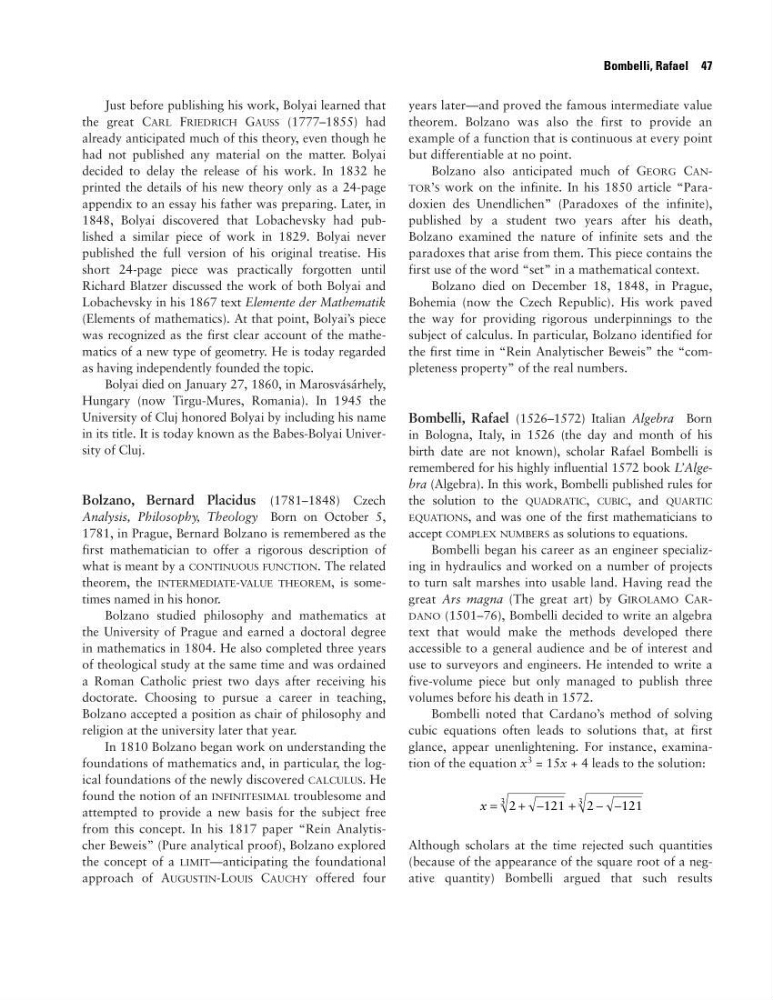
glance, appear unenlightening. For instance, examination of the equation x
3 = 15x + 4 leads to the solution:
Although scholars at the time rejected such quantities
(because of the appearance of the square root of a negative quantity) Bombelli argued that such results
x =
+ −
+
− −
2
121
2
121
3
3
Bombelli, Rafael 47
the great CARL FRIEDRICH GAUSS (1777–1855) had
already anticipated much of this theory, even though he
had not published any material on the matter. Bolyai
decided to delay the release of his work. In 1832 he
printed the details of his new theory only as a 24-page
appendix to an essay his father was preparing. Later, in
1848, Bolyai discovered that Lobachevsky had published a similar piece of work in 1829. Bolyai never
published the full version of his original treatise. His
short 24-page piece was practically forgotten until
Richard Blatzer discussed the work of both Bolyai and
Lobachevsky in his 1867 text Elemente der Mathematik
(Elements of mathematics). At that point, Bolyai’s piece
was recognized as the first clear account of the mathematics of a new type of geometry. He is today regarded
as having independently founded the topic.
Bolyai died on January 27, 1860, in Marosvásárhely,
Hungary (now Tirgu-Mures, Romania). In 1945 the
University of Cluj honored Bolyai by including his name
in its title. It is today known as the Babes-Bolyai University of Cluj.
Bolzano, Bernard Placidus (1781–1848) Czech
Analysis, Philosophy, Theology Born on October 5,
1781, in Prague, Bernard Bolzano is remembered as the
first mathematician to offer a rigorous description of
what is meant by a CONTINUOUS FUNCTION. The related
theorem, the INTERMEDIATE-VALUE THEOREM, is sometimes named in his honor.
Bolzano studied philosophy and mathematics at
the University of Prague and earned a doctoral degree
in mathematics in 1804. He also completed three years
of theological study at the same time and was ordained
a Roman Catholic priest two days after receiving his
doctorate. Choosing to pursue a career in teaching,
Bolzano accepted a position as chair of philosophy and
religion at the university later that year.
In 1810 Bolzano began work on understanding the
foundations of mathematics and, in particular, the logical foundations of the newly discovered CALCULUS. He
found the notion of an INFINITESIMAL troublesome and
attempted to provide a new basis for the subject free
from this concept. In his 1817 paper “Rein Analytischer Beweis” (Pure analytical proof), Bolzano explored
the concept of a LIMIT—anticipating the foundational
approach of AUGUSTIN-LOUIS CAUCHY offered four
years later—and proved the famous intermediate value
theorem. Bolzano was also the first to provide an
example of a function that is continuous at every point
but differentiable at no point.
Bolzano also anticipated much of GEORG CANTOR’S work on the infinite. In his 1850 article “Paradoxien des Unendlichen” (Paradoxes of the infinite),
published by a student two years after his death,
Bolzano examined the nature of infinite sets and the
paradoxes that arise from them. This piece contains the
first use of the word “set” in a mathematical context.
Bolzano died on December 18, 1848, in Prague,
Bohemia (now the Czech Republic). His work paved
the way for providing rigorous underpinnings to the
subject of calculus. In particular, Bolzano identified for
the first time in “Rein Analytischer Beweis” the “completeness property” of the real numbers.
Bombelli, Rafael (1526–1572) Italian Algebra Born
in Bologna, Italy, in 1526 (the day and month of his
birth date are not known), scholar Rafael Bombelli is
remembered for his highly influential 1572 book L’Algebra (Algebra). In this work, Bombelli published rules for
the solution to the QUADRATIC, CUBIC, and QUARTIC
EQUATIONS, and was one of the first mathematicians to
accept COMPLEX NUMBERS as solutions to equations.
Bombelli began his career as an engineer specializing in hydraulics and worked on a number of projects
to turn salt marshes into usable land. Having read the
great Ars magna (The great art) by GIROLAMO CARDANO (1501–76), Bombelli decided to write an algebra
text that would make the methods developed there
accessible to a general audience and be of interest and
use to surveyors and engineers. He intended to write a
five-volume piece but only managed to publish three
volumes before his death in 1572.
Bombelli noted that Cardano’s method of solving
cubic equations often leads to solutions that, at first
glance, appear unenlightening. For instance, examination of the equation x
3 = 15x + 4 leads to the solution:
Although scholars at the time rejected such quantities
(because of the appearance of the square root of a negative quantity) Bombelli argued that such results
x =
+ −
+
− −
2
121
2
121
3
3
Bombelli, Rafael 47