

The number 2
86 is the largest known power of 2
whose decimal expansion contains no digit equal to
zero. (Notice that 2
10 = 1024, for instance, has second
digit equal to zero.) All the powers of two up to
2
46,000,000 have been checked.
See also BABYLONIAN MATHEMATICS; EVEN AND ODD
NUMBERS; GREEK MATHEMATICS; INDIAN MATHEMATICS.
zeta function In 1740 the Swiss mathematician
LEONHARD EULER (1707–83) studied infinite series of
the form:
The INTEGRAL TEST shows that this series converges if s
is a real number greater than 1. Euler called this function, defined for values s > 1, the zeta function.
This function is intimately connected to the distribution of PRIME numbers. To see this, recall that the
FUNDAMENTAL THEOREM OF ARITHMETIC asserts that
every number is a product of a unique set of primes.
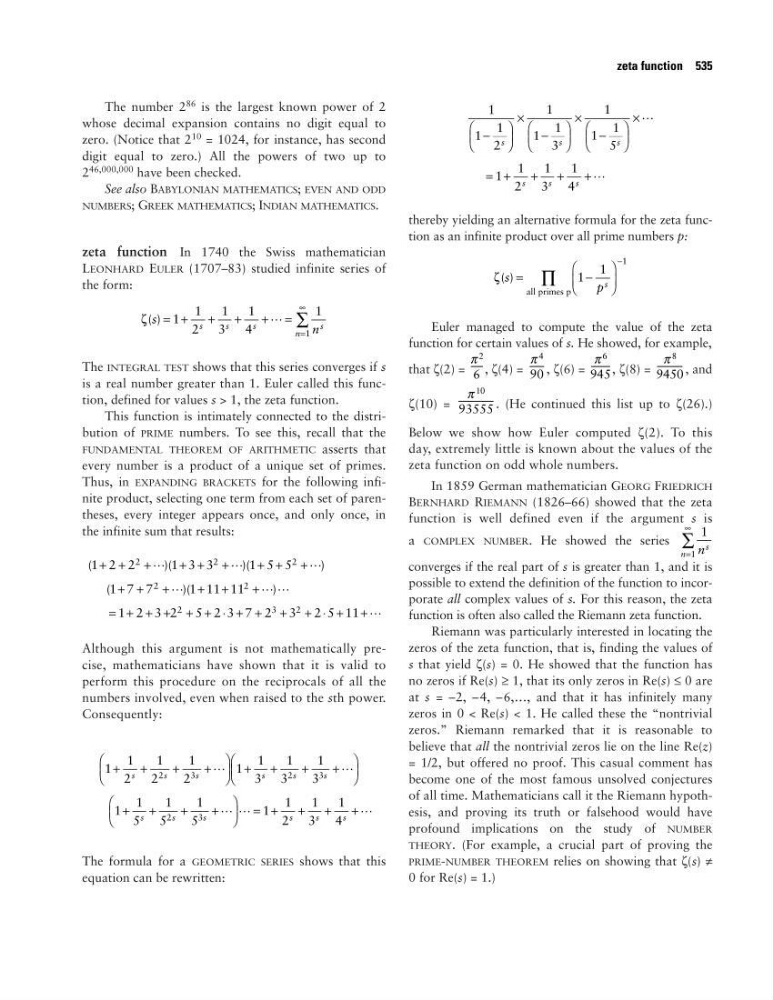
Thus, in EXPANDING BRACKETS for the following infinite product, selecting one term from each set of parentheses, every integer appears once, and only once, in
the infinite sum that results:
Although this argument is not mathematically precise, mathematicians have shown that it is valid to
perform this procedure on the reciprocals of all the
numbers involved, even when raised to the sth power.
Consequently:
The formula for a GEOMETRIC SERIES shows that this
equation can be rewritten:
thereby yielding an alternative formula for the zeta function as an infinite product over all prime numbers p:
Euler managed to compute the value of the zeta
function for certain values of s. He showed, for example,
that ζ(2) =
, ζ(4) =
, ζ(6) =
, ζ(8) =
, and
ζ(10) =
. (He continued this list up to ζ(26).)
Below we show how Euler computed ζ(2). To this
day, extremely little is known about the values of the
zeta function on odd whole numbers.
In 1859 German mathematician GEORG FRIEDRICH
BERNHARD RIEMANN (1826–66) showed that the zeta
function is well defined even if the argument s is
a COMPLEX NUMBER. He showed the series
converges if the real part of s is greater than 1, and it is
possible to extend the definition of the function to incorporate all complex values of s. For this reason, the zeta
function is often also called the Riemann zeta function.
Riemann was particularly interested in locating the
zeros of the zeta function, that is, finding the values of
s that yield ζ(s) = 0. He showed that the function has
no zeros if Re(s) ≥ 1, that its only zeros in Re(s) ≤ 0 are
at s = –2, –4, –6,…, and that it has infinitely many
zeros in 0 < Re(s) < 1. He called these the “nontrivial
zeros.” Riemann remarked that it is reasonable to
believe that all the nontrivial zeros lie on the line Re(z)
= 1/2, but offered no proof. This casual comment has
become one of the most famous unsolved conjectures
of all time. Mathematicians call it the Riemann hypothesis, and proving its truth or falsehood would have
profound implications on the study of NUMBER
THEORY. (For example, a crucial part of proving the
PRIME-NUMBER THEOREM relies on showing that ζ(s) ≠
0 for Re(s) = 1.)
1
1 n
s
n=
∞
∑
π
10
––
93555
π
8
–
9450
π
6
–
945
π
4
–
90
π
2
–
6
ζ( )
s
p
s
=
−
−
∏ 1
1
1
all primes p
1
1
1
2
1
1
1
3
1
1
1
5
1
1
2
1
3
1
4
−
×
−
×
−
×
= +
+
+
+
s
s
s
s
s
s
L
L
1
1
2
1
2
1
2
1
1
3
1
3
1
3
1
1
5
1
5
1
5
1
1
2
1
3
1
4
2
3
2
3
2
3
+
+
+
+
+
+
+
+
+
+
+
+
= +
+
+
+
s
s
s
s
s
s
s
s
s
s
s
s
L
L
L L
L
(
) (
) (
)
(
) (
)
1 2 2
1 3 3
1 5 5
1 7 7
1 11 11
1 2 3 2 5 2 3 7 2 3 2 5 11
2
2
2
2
2
2
3
2
+ + +
+ + +
+ + +
+ + +
+ +
+
= + + + + + ⋅ + + + + ⋅ + +
L
L
L
L
L L
L
ζ( )
s
n
s
s
s
s
n
= +
+
+
+ =
=
∞
∑
1
1
2
1
3
1
4
1
1
L
zeta function 535
86 is the largest known power of 2
whose decimal expansion contains no digit equal to
zero. (Notice that 2
10 = 1024, for instance, has second
digit equal to zero.) All the powers of two up to
2
46,000,000 have been checked.
See also BABYLONIAN MATHEMATICS; EVEN AND ODD
NUMBERS; GREEK MATHEMATICS; INDIAN MATHEMATICS.
zeta function In 1740 the Swiss mathematician
LEONHARD EULER (1707–83) studied infinite series of
the form:
The INTEGRAL TEST shows that this series converges if s
is a real number greater than 1. Euler called this function, defined for values s > 1, the zeta function.
This function is intimately connected to the distribution of PRIME numbers. To see this, recall that the
FUNDAMENTAL THEOREM OF ARITHMETIC asserts that
every number is a product of a unique set of primes.
Thus, in EXPANDING BRACKETS for the following infinite product, selecting one term from each set of parentheses, every integer appears once, and only once, in
the infinite sum that results:
Although this argument is not mathematically precise, mathematicians have shown that it is valid to
perform this procedure on the reciprocals of all the
numbers involved, even when raised to the sth power.
Consequently:
The formula for a GEOMETRIC SERIES shows that this
equation can be rewritten:
thereby yielding an alternative formula for the zeta function as an infinite product over all prime numbers p:
Euler managed to compute the value of the zeta
function for certain values of s. He showed, for example,
that ζ(2) =
, ζ(4) =
, ζ(6) =
, ζ(8) =
, and
ζ(10) =
. (He continued this list up to ζ(26).)
Below we show how Euler computed ζ(2). To this
day, extremely little is known about the values of the
zeta function on odd whole numbers.
In 1859 German mathematician GEORG FRIEDRICH
BERNHARD RIEMANN (1826–66) showed that the zeta
function is well defined even if the argument s is
a COMPLEX NUMBER. He showed the series
converges if the real part of s is greater than 1, and it is
possible to extend the definition of the function to incorporate all complex values of s. For this reason, the zeta
function is often also called the Riemann zeta function.
Riemann was particularly interested in locating the
zeros of the zeta function, that is, finding the values of
s that yield ζ(s) = 0. He showed that the function has
no zeros if Re(s) ≥ 1, that its only zeros in Re(s) ≤ 0 are
at s = –2, –4, –6,…, and that it has infinitely many
zeros in 0 < Re(s) < 1. He called these the “nontrivial
zeros.” Riemann remarked that it is reasonable to
believe that all the nontrivial zeros lie on the line Re(z)
= 1/2, but offered no proof. This casual comment has
become one of the most famous unsolved conjectures
of all time. Mathematicians call it the Riemann hypothesis, and proving its truth or falsehood would have
profound implications on the study of NUMBER
THEORY. (For example, a crucial part of proving the
PRIME-NUMBER THEOREM relies on showing that ζ(s) ≠
0 for Re(s) = 1.)
1
1 n
s
n=
∞
∑
π
10
––
93555
π
8
–
9450
π
6
–
945
π
4
–
90
π
2
–
6
ζ( )
s
p
s
=
−
−
∏ 1
1
1
all primes p
1
1
1
2
1
1
1
3
1
1
1
5
1
1
2
1
3
1
4
−
×
−
×
−
×
= +
+
+
+
s
s
s
s
s
s
L
L
1
1
2
1
2
1
2
1
1
3
1
3
1
3
1
1
5
1
5
1
5
1
1
2
1
3
1
4
2
3
2
3
2
3
+
+
+
+
+
+
+
+
+
+
+
+
= +
+
+
+
s
s
s
s
s
s
s
s
s
s
s
s
L
L
L L
L
(
) (
) (
)
(
) (
)
1 2 2
1 3 3
1 5 5
1 7 7
1 11 11
1 2 3 2 5 2 3 7 2 3 2 5 11
2
2
2
2
2
2
3
2
+ + +
+ + +
+ + +
+ + +
+ +
+
= + + + + + ⋅ + + + + ⋅ + +
L
L
L
L
L L
L
ζ( )
s
n
s
s
s
s
n
= +
+
+
+ =
=
∞
∑
1
1
2
1
3
1
4
1
1
L
zeta function 535