

transfinite cardinals), and 2 years later succeeded in
proving the well-ordering conjecture in his 1904 article
“Beweis, dass jede Menge wohlgeordnet werden kann”
(Proof that every set can be well ordered). His success
garnered him international fame and recognition as a
brilliant mathematician. The University of Göttingen
immediately awarded him a full professorship.
In 1905, leaving further work on the continuum
hypothesis aside, Zermelo began the task of axiomatizing set theory. By identifying a small set of basic
assumptions about the topic, he hoped to resolve some
of the paradoxes about infinite sets that were arising in
the subject. Unfortunately, he found it necessary to
include an “axiom of infinity” asserting, essentially, that
infinite sets exist, along with the extraordinarily controversial AXIOM OF CHOICE, which asserts that it is always
possible to select, in one fell swoop, one object from
each set in any infinite collection of sets. Mathematicians were uncomfortable with each of these assumptions at the time. Moreover, despite his efforts, Zermelo
was unable to prove that the axioms he put forward
were free from contradictions. Other mathematicians
then began to work on this task, and some 15 years
later, in 1922, mathematicians Adolf Fraenkel and Thoralf Skolem independently developed a refined system of
10 axioms that were deemed of sufficiently good stead.
Zermelo left Göttingen in 1910 to take an
appointment as the chair of mathematics at Zurich
University, where he stayed for 6 years. Zermelo spent
the remainder of his life in Freiburg. He died there on
May 21, 1953.
See also RUSSELL’S PARADOX.
zero (naught) The counting number, denoted 0, used
to signify that no objects are present is called zero. This
number has the arithmetical property that its addition
to any other number does not change that number:
a + 0 = a = 0 + a for all values a. Thus zero serves as the
additive IDENTITY ELEMENT in arithmetic. Zero is the
only real number that is neither POSITIVE nor negative.
It was only recently in the history of mathematics
that zero was recognized as a valid and important mathematical entity. In times of antiquity numbers were
thought only to represent counts or magnitudes of quantities. Thus if there were no objects to be counted, there
was no number to consider (and so speaking of zero as a
number consequently had no meaning). The ancient
Egyptian and Greek scholars never used zero in their
computations. The ancient Babylonians were the first to
utilize a notion of zero by using it, in some sense, as a
placeholder when expressing large numbers (much as we
use zeros today to distinguish between 102 and 12.) The
Hindu mathematician BRAHMAGUPTA (ca. 598–665) is
credited today as being the first scholar to acknowledge
zero as a valid number and use it in arithmetical computations. His idea was later expanded upon by MUHAMMAD IBN M –
US
–
A AL-KHW
–
ARIZM
– ı (ca. 780–850) in his
famous development of a theory of algebra. Italian
mathematician FIBONACCI (ca. 1170–1250) popularized
much of al-Khw –
arizm – ı’s work in Western Europe, but it
was not until the Renaissance that the notion of zero
was finally deemed a valid concept.
Arithmetic involving zero can be troublesome.
Although any number can be multiplied by zero (to
produce the answer zero), no number can be divided by
zero. For instance, there can be no answer to the division problem 1 ÷ 0. (If 1/0 = x, then multiplying
through by the denominator gives the absurd result: 1
= x × 0 = 0.) The quantity 0/0 is also deemed undefined. (One could argue that the answer to this division
problem is 17, since 0 = 17 × 0, or, by the same token,
that the answer is 2 since 0 = 2 × 0. There is no single
well-defined solution to 0 ÷ 0.)
A counting number is considered even if it can be
written as a sum of two equal whole numbers. Since
zero equals 0 + 0, it follows that zero is an even number.
The study of EXPONENTs shows that it is appropriate to define x
0 to be 1 for any real number x other
than zero. (For example, 2
0 = 1 and 173
0 = 1.)
Although it is true that lim x→0 + x
x = 1, it is not valid to
assume that 0
0 also equals 1. (This LIMIT does not exist
if one permits COMPLEX NUMBERS in our considerations, and so the notion of raising zero to the zeroth
power is problematic in this setting.) A study of the
FACTORIAL shows that it is appropriate to define 0! = 1.
A ROOT of a function is sometimes called a zero of
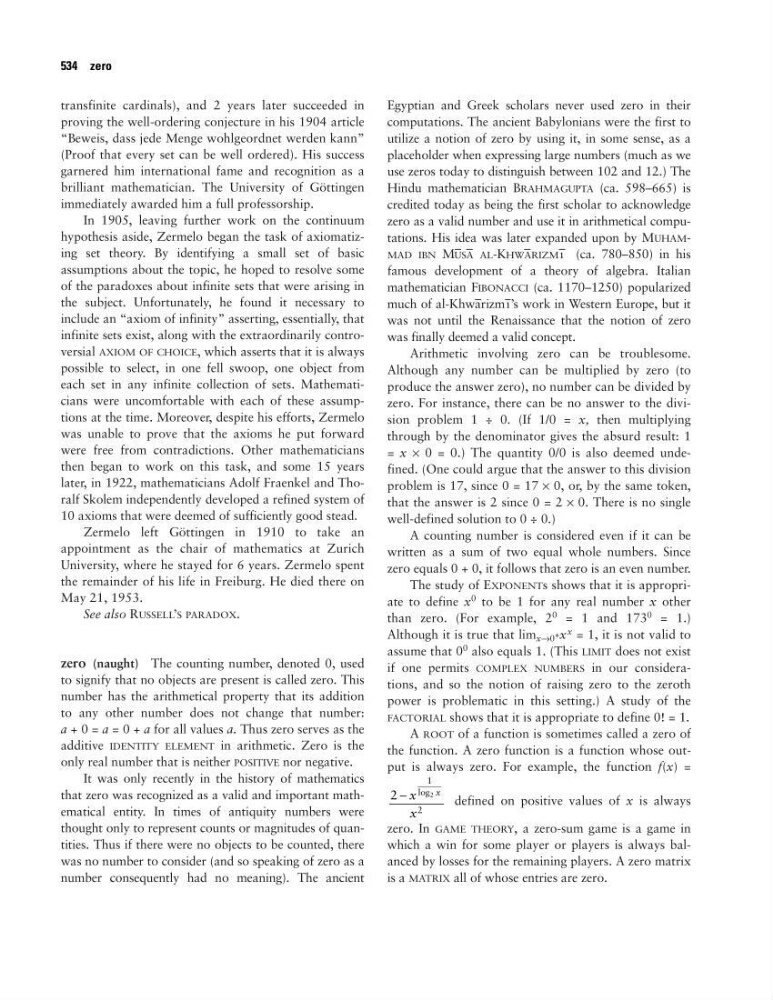
the function. A zero function is a function whose output is always zero. For example, the function f(x) =
defined on positive values of x is always
zero. In GAME THEORY, a zero-sum game is a game in
which a win for some player or players is always balanced by losses for the remaining players. A zero matrix
is a MATRIX all of whose entries are zero.
2
1
2
2
− x
x
x
log
534 zero
proving the well-ordering conjecture in his 1904 article
“Beweis, dass jede Menge wohlgeordnet werden kann”
(Proof that every set can be well ordered). His success
garnered him international fame and recognition as a
brilliant mathematician. The University of Göttingen
immediately awarded him a full professorship.
In 1905, leaving further work on the continuum
hypothesis aside, Zermelo began the task of axiomatizing set theory. By identifying a small set of basic
assumptions about the topic, he hoped to resolve some
of the paradoxes about infinite sets that were arising in
the subject. Unfortunately, he found it necessary to
include an “axiom of infinity” asserting, essentially, that
infinite sets exist, along with the extraordinarily controversial AXIOM OF CHOICE, which asserts that it is always
possible to select, in one fell swoop, one object from
each set in any infinite collection of sets. Mathematicians were uncomfortable with each of these assumptions at the time. Moreover, despite his efforts, Zermelo
was unable to prove that the axioms he put forward
were free from contradictions. Other mathematicians
then began to work on this task, and some 15 years
later, in 1922, mathematicians Adolf Fraenkel and Thoralf Skolem independently developed a refined system of
10 axioms that were deemed of sufficiently good stead.
Zermelo left Göttingen in 1910 to take an
appointment as the chair of mathematics at Zurich
University, where he stayed for 6 years. Zermelo spent
the remainder of his life in Freiburg. He died there on
May 21, 1953.
See also RUSSELL’S PARADOX.
zero (naught) The counting number, denoted 0, used
to signify that no objects are present is called zero. This
number has the arithmetical property that its addition
to any other number does not change that number:
a + 0 = a = 0 + a for all values a. Thus zero serves as the
additive IDENTITY ELEMENT in arithmetic. Zero is the
only real number that is neither POSITIVE nor negative.
It was only recently in the history of mathematics
that zero was recognized as a valid and important mathematical entity. In times of antiquity numbers were
thought only to represent counts or magnitudes of quantities. Thus if there were no objects to be counted, there
was no number to consider (and so speaking of zero as a
number consequently had no meaning). The ancient
Egyptian and Greek scholars never used zero in their
computations. The ancient Babylonians were the first to
utilize a notion of zero by using it, in some sense, as a
placeholder when expressing large numbers (much as we
use zeros today to distinguish between 102 and 12.) The
Hindu mathematician BRAHMAGUPTA (ca. 598–665) is
credited today as being the first scholar to acknowledge
zero as a valid number and use it in arithmetical computations. His idea was later expanded upon by MUHAMMAD IBN M –
US
–
A AL-KHW
–
ARIZM
– ı (ca. 780–850) in his
famous development of a theory of algebra. Italian
mathematician FIBONACCI (ca. 1170–1250) popularized
much of al-Khw –
arizm – ı’s work in Western Europe, but it
was not until the Renaissance that the notion of zero
was finally deemed a valid concept.
Arithmetic involving zero can be troublesome.
Although any number can be multiplied by zero (to
produce the answer zero), no number can be divided by
zero. For instance, there can be no answer to the division problem 1 ÷ 0. (If 1/0 = x, then multiplying
through by the denominator gives the absurd result: 1
= x × 0 = 0.) The quantity 0/0 is also deemed undefined. (One could argue that the answer to this division
problem is 17, since 0 = 17 × 0, or, by the same token,
that the answer is 2 since 0 = 2 × 0. There is no single
well-defined solution to 0 ÷ 0.)
A counting number is considered even if it can be
written as a sum of two equal whole numbers. Since
zero equals 0 + 0, it follows that zero is an even number.
The study of EXPONENTs shows that it is appropriate to define x
0 to be 1 for any real number x other
than zero. (For example, 2
0 = 1 and 173
0 = 1.)
Although it is true that lim x→0 + x
x = 1, it is not valid to
assume that 0
0 also equals 1. (This LIMIT does not exist
if one permits COMPLEX NUMBERS in our considerations, and so the notion of raising zero to the zeroth
power is problematic in this setting.) A study of the
FACTORIAL shows that it is appropriate to define 0! = 1.
A ROOT of a function is sometimes called a zero of
the function. A zero function is a function whose output is always zero. For example, the function f(x) =
defined on positive values of x is always
zero. In GAME THEORY, a zero-sum game is a game in
which a win for some player or players is always balanced by losses for the remaining players. A zero matrix
is a MATRIX all of whose entries are zero.
2
1
2
2
− x
x
x
log
534 zero