

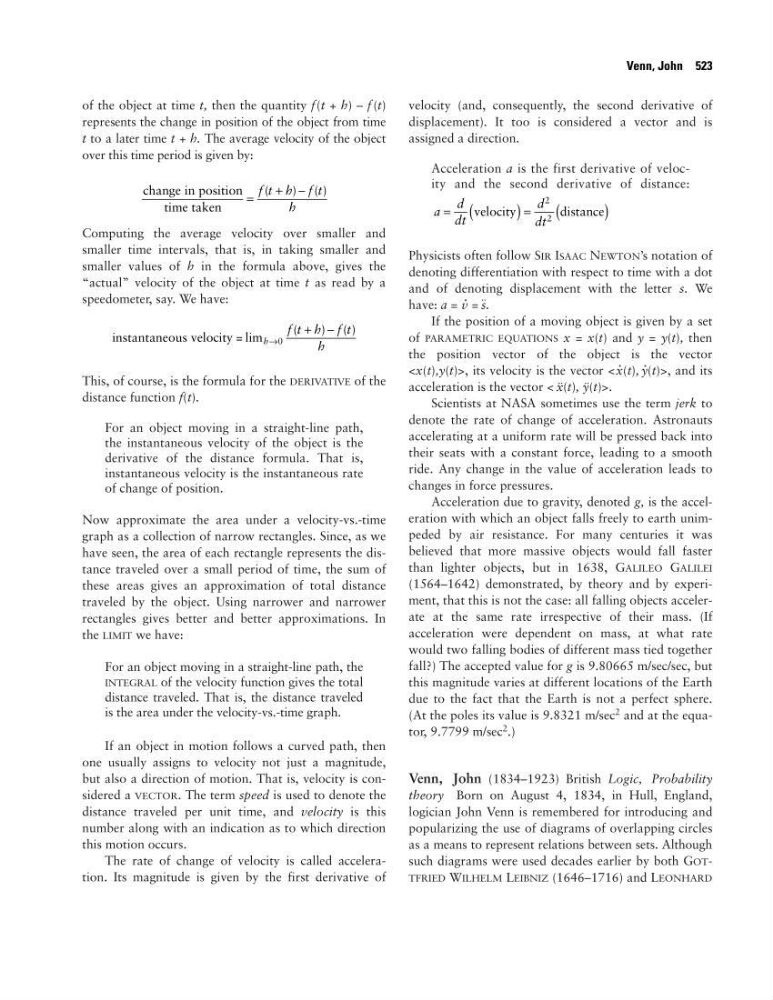
of the object at time t, then the quantity f(t + h) – f (t)
represents the change in position of the object from time
t to a later time t + h. The average velocity of the object
over this time period is given by:
Computing the average velocity over smaller and
smaller time intervals, that is, in taking smaller and
smaller values of h in the formula above, gives the
“actual” velocity of the object at time t as read by a
speedometer, say. We have:
This, of course, is the formula for the DERIVATIVE of the
distance function f(t).
For an object moving in a straight-line path,
the instantaneous velocity of the object is the
derivative of the distance formula. That is,
instantaneous velocity is the instantaneous rate
of change of position.
Now approximate the area under a velocity-vs.-time
graph as a collection of narrow rectangles. Since, as we
have seen, the area of each rectangle represents the distance traveled over a small period of time, the sum of
these areas gives an approximation of total distance
traveled by the object. Using narrower and narrower
rectangles gives better and better approximations. In
the LIMIT we have:
For an object moving in a straight-line path, the
INTEGRAL of the velocity function gives the total
distance traveled. That is, the distance traveled
is the area under the velocity-vs.-time graph.
If an object in motion follows a curved path, then
one usually assigns to velocity not just a magnitude,
but also a direction of motion. That is, velocity is considered a VECTOR. The term speed is used to denote the
distance traveled per unit time, and velocity is this
number along with an indication as to which direction
this motion occurs.
The rate of change of velocity is called acceleration. Its magnitude is given by the first derivative of
velocity (and, consequently, the second derivative of
displacement). It too is considered a vector and is
assigned a direction.
Acceleration a is the first derivative of velocity and the second derivative of distance:
Physicists often follow SIR ISAAC NEWTON’s notation of
denoting differentiation with respect to time with a dot
and of denoting displacement with the letter s. We
have: a = ·
v = ¨
s.
If the position of a moving object is given by a set
of PARAMETRIC EQUATIONS x = x(t) and y = y(t), then
the position vector of the object is the vector
, its velocity is the vector < ·
x(t), ·
y(t)>, and its
acceleration is the vector < x ¨ (t), ÿ(t)>.
Scientists at NASA sometimes use the term jerk to
denote the rate of change of acceleration. Astronauts
accelerating at a uniform rate will be pressed back into
their seats with a constant force, leading to a smooth
ride. Any change in the value of acceleration leads to
changes in force pressures.
Acceleration due to gravity, denoted g, is the acceleration with which an object falls freely to earth unimpeded by air resistance. For many centuries it was
believed that more massive objects would fall faster
than lighter objects, but in 1638, GALILEO GALILEI
(1564–1642) demonstrated, by theory and by experiment, that this is not the case: all falling objects accelerate at the same rate irrespective of their mass. (If
acceleration were dependent on mass, at what rate
would two falling bodies of different mass tied together
fall?) The accepted value for g is 9.80665 m/sec/sec, but
this magnitude varies at different locations of the Earth
due to the fact that the Earth is not a perfect sphere.
(At the poles its value is 9.8321 m/sec
2 and at the equator, 9.7799 m/sec
2
.)
Venn, John (1834–1923) British Logic, Probability
theory Born on August 4, 1834, in Hull, England,
logician John Venn is remembered for introducing and
popularizing the use of diagrams of overlapping circles
as a means to represent relations between sets. Although
such diagrams were used decades earlier by both GOTTFRIED WILHELM LEIBNIZ (1646–1716) and LEONHARD
a
d
dt
d
dt
= (
) = (
)
velocity
distance
2
2
instantaneous velocity = lim
(
) ( )
h
f t h f t
h
→
+ −
0
change in position
time taken
=
+ −
f t h f t
h
(
) ( )
Venn, John 523
represents the change in position of the object from time
t to a later time t + h. The average velocity of the object
over this time period is given by:
Computing the average velocity over smaller and
smaller time intervals, that is, in taking smaller and
smaller values of h in the formula above, gives the
“actual” velocity of the object at time t as read by a
speedometer, say. We have:
This, of course, is the formula for the DERIVATIVE of the
distance function f(t).
For an object moving in a straight-line path,
the instantaneous velocity of the object is the
derivative of the distance formula. That is,
instantaneous velocity is the instantaneous rate
of change of position.
Now approximate the area under a velocity-vs.-time
graph as a collection of narrow rectangles. Since, as we
have seen, the area of each rectangle represents the distance traveled over a small period of time, the sum of
these areas gives an approximation of total distance
traveled by the object. Using narrower and narrower
rectangles gives better and better approximations. In
the LIMIT we have:
For an object moving in a straight-line path, the
INTEGRAL of the velocity function gives the total
distance traveled. That is, the distance traveled
is the area under the velocity-vs.-time graph.
If an object in motion follows a curved path, then
one usually assigns to velocity not just a magnitude,
but also a direction of motion. That is, velocity is considered a VECTOR. The term speed is used to denote the
distance traveled per unit time, and velocity is this
number along with an indication as to which direction
this motion occurs.
The rate of change of velocity is called acceleration. Its magnitude is given by the first derivative of
velocity (and, consequently, the second derivative of
displacement). It too is considered a vector and is
assigned a direction.
Acceleration a is the first derivative of velocity and the second derivative of distance:
Physicists often follow SIR ISAAC NEWTON’s notation of
denoting differentiation with respect to time with a dot
and of denoting displacement with the letter s. We
have: a = ·
v = ¨
s.
If the position of a moving object is given by a set
of PARAMETRIC EQUATIONS x = x(t) and y = y(t), then
the position vector of the object is the vector
x(t), ·
y(t)>, and its
acceleration is the vector < x ¨ (t), ÿ(t)>.
Scientists at NASA sometimes use the term jerk to
denote the rate of change of acceleration. Astronauts
accelerating at a uniform rate will be pressed back into
their seats with a constant force, leading to a smooth
ride. Any change in the value of acceleration leads to
changes in force pressures.
Acceleration due to gravity, denoted g, is the acceleration with which an object falls freely to earth unimpeded by air resistance. For many centuries it was
believed that more massive objects would fall faster
than lighter objects, but in 1638, GALILEO GALILEI
(1564–1642) demonstrated, by theory and by experiment, that this is not the case: all falling objects accelerate at the same rate irrespective of their mass. (If
acceleration were dependent on mass, at what rate
would two falling bodies of different mass tied together
fall?) The accepted value for g is 9.80665 m/sec/sec, but
this magnitude varies at different locations of the Earth
due to the fact that the Earth is not a perfect sphere.
(At the poles its value is 9.8321 m/sec
2 and at the equator, 9.7799 m/sec
2
.)
Venn, John (1834–1923) British Logic, Probability
theory Born on August 4, 1834, in Hull, England,
logician John Venn is remembered for introducing and
popularizing the use of diagrams of overlapping circles
as a means to represent relations between sets. Although
such diagrams were used decades earlier by both GOTTFRIED WILHELM LEIBNIZ (1646–1716) and LEONHARD
a
d
dt
d
dt
= (
) = (
)
velocity
distance
2
2
instantaneous velocity = lim
(
) ( )
h
f t h f t
h
→
+ −
0
change in position
time taken
=
+ −
f t h f t
h
(
) ( )
Venn, John 523