

This is known today as Student’s t-distribution (with
N – 1 degrees of freedom). Student’s t-test is used to
test whether any difference in the means of two different samples is statistically meaningful. For example, a
study might indicate that the mean height of 100 randomly selected basketball players is 8 in. higher than
the mean height of 100 baseball players. Student’s ttest would test the hypothesis, “Both samples were
drawn from the same normal population.” If the value
8 in. is deemed too high, the hypothesis would be
rejected and the difference in the means would be considered significant.
The F-test tests whether or not two samples come
from the same population by focusing instead on the
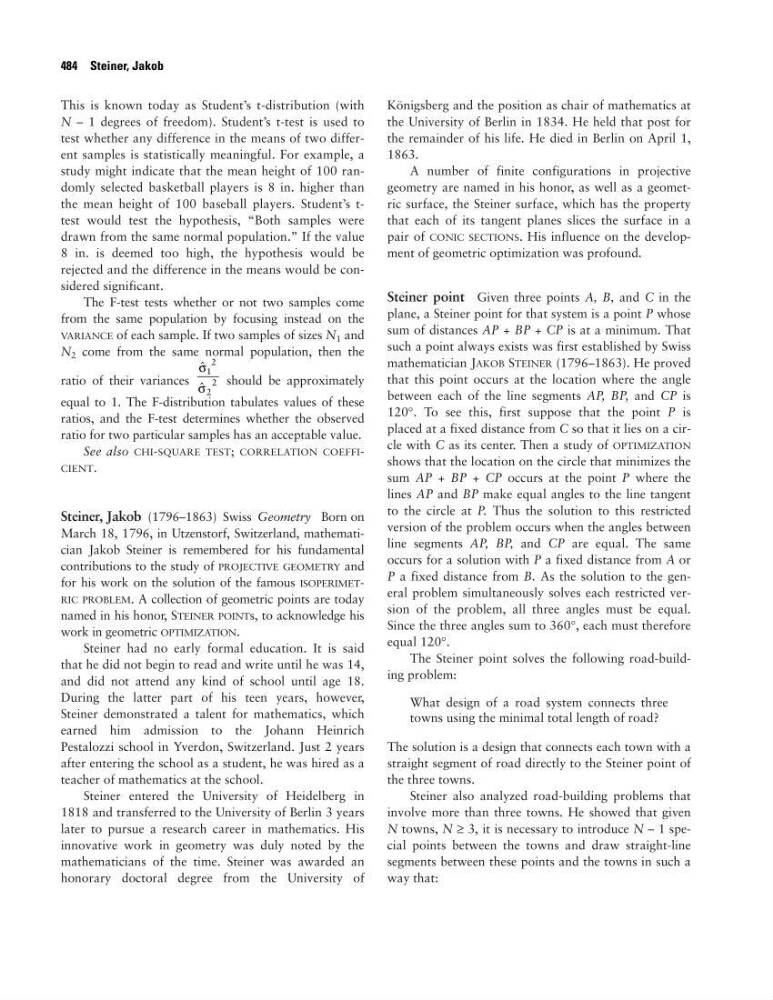
VARIANCE of each sample. If two samples of sizes N 1 and
N 2 come from the same normal population, then the
ratio of their variances
should be approximately
equal to 1. The F-distribution tabulates values of these
ratios, and the F-test determines whether the observed
ratio for two particular samples has an acceptable value.
See also CHI-SQUARE TEST; CORRELATION COEFFICIENT.
Steiner, Jakob (1796–1863) Swiss Geometry Born on
March 18, 1796, in Utzenstorf, Switzerland, mathematician Jakob Steiner is remembered for his fundamental
contributions to the study of PROJECTIVE GEOMETRY and
for his work on the solution of the famous ISOPERIMETRIC PROBLEM. A collection of geometric points are today
named in his honor, STEINER POINTs, to acknowledge his
work in geometric OPTIMIZATION.
Steiner had no early formal education. It is said
that he did not begin to read and write until he was 14,
and did not attend any kind of school until age 18.
During the latter part of his teen years, however,
Steiner demonstrated a talent for mathematics, which
earned him admission to the Johann Heinrich
Pestalozzi school in Yverdon, Switzerland. Just 2 years
after entering the school as a student, he was hired as a
teacher of mathematics at the school.
Steiner entered the University of Heidelberg in
1818 and transferred to the University of Berlin 3 years
later to pursue a research career in mathematics. His
innovative work in geometry was duly noted by the
mathematicians of the time. Steiner was awarded an
honorary doctoral degree from the University of
Königsberg and the position as chair of mathematics at
the University of Berlin in 1834. He held that post for
the remainder of his life. He died in Berlin on April 1,
1863.
A number of finite configurations in projective
geometry are named in his honor, as well as a geometric surface, the Steiner surface, which has the property
that each of its tangent planes slices the surface in a
pair of CONIC SECTIONS. His influence on the development of geometric optimization was profound.
Steiner point Given three points A, B, and C in the
plane, a Steiner point for that system is a point P whose
sum of distances AP + BP + CP is at a minimum. That
such a point always exists was first established by Swiss
mathematician JAKOB STEINER (1796–1863). He proved
that this point occurs at the location where the angle
between each of the line segments AP, BP, and CP is
120°. To see this, first suppose that the point P is
placed at a fixed distance from C so that it lies on a circle with C as its center. Then a study of OPTIMIZATION
shows that the location on the circle that minimizes the
sum AP + BP + CP occurs at the point P where the
lines AP and BP make equal angles to the line tangent
to the circle at P. Thus the solution to this restricted
version of the problem occurs when the angles between
line segments AP, BP, and CP are equal. The same
occurs for a solution with P a fixed distance from A or
P a fixed distance from B. As the solution to the general problem simultaneously solves each restricted version of the problem, all three angles must be equal.
Since the three angles sum to 360°, each must therefore
equal 120°.
The Steiner point solves the following road-building problem:
What design of a road system connects three
towns using the minimal total length of road?
The solution is a design that connects each town with a
straight segment of road directly to the Steiner point of
the three towns.
Steiner also analyzed road-building problems that
involve more than three towns. He showed that given
N towns, N ≥ 3, it is necessary to introduce N – 1 special points between the towns and draw straight-line
segments between these points and the towns in such a
way that:
ˆ
ˆ
σ
σ
1
2
2
2
484 Steiner, Jakob
N – 1 degrees of freedom). Student’s t-test is used to
test whether any difference in the means of two different samples is statistically meaningful. For example, a
study might indicate that the mean height of 100 randomly selected basketball players is 8 in. higher than
the mean height of 100 baseball players. Student’s ttest would test the hypothesis, “Both samples were
drawn from the same normal population.” If the value
8 in. is deemed too high, the hypothesis would be
rejected and the difference in the means would be considered significant.
The F-test tests whether or not two samples come
from the same population by focusing instead on the
VARIANCE of each sample. If two samples of sizes N 1 and
N 2 come from the same normal population, then the
ratio of their variances
should be approximately
equal to 1. The F-distribution tabulates values of these
ratios, and the F-test determines whether the observed
ratio for two particular samples has an acceptable value.
See also CHI-SQUARE TEST; CORRELATION COEFFICIENT.
Steiner, Jakob (1796–1863) Swiss Geometry Born on
March 18, 1796, in Utzenstorf, Switzerland, mathematician Jakob Steiner is remembered for his fundamental
contributions to the study of PROJECTIVE GEOMETRY and
for his work on the solution of the famous ISOPERIMETRIC PROBLEM. A collection of geometric points are today
named in his honor, STEINER POINTs, to acknowledge his
work in geometric OPTIMIZATION.
Steiner had no early formal education. It is said
that he did not begin to read and write until he was 14,
and did not attend any kind of school until age 18.
During the latter part of his teen years, however,
Steiner demonstrated a talent for mathematics, which
earned him admission to the Johann Heinrich
Pestalozzi school in Yverdon, Switzerland. Just 2 years
after entering the school as a student, he was hired as a
teacher of mathematics at the school.
Steiner entered the University of Heidelberg in
1818 and transferred to the University of Berlin 3 years
later to pursue a research career in mathematics. His
innovative work in geometry was duly noted by the
mathematicians of the time. Steiner was awarded an
honorary doctoral degree from the University of
Königsberg and the position as chair of mathematics at
the University of Berlin in 1834. He held that post for
the remainder of his life. He died in Berlin on April 1,
1863.
A number of finite configurations in projective
geometry are named in his honor, as well as a geometric surface, the Steiner surface, which has the property
that each of its tangent planes slices the surface in a
pair of CONIC SECTIONS. His influence on the development of geometric optimization was profound.
Steiner point Given three points A, B, and C in the
plane, a Steiner point for that system is a point P whose
sum of distances AP + BP + CP is at a minimum. That
such a point always exists was first established by Swiss
mathematician JAKOB STEINER (1796–1863). He proved
that this point occurs at the location where the angle
between each of the line segments AP, BP, and CP is
120°. To see this, first suppose that the point P is
placed at a fixed distance from C so that it lies on a circle with C as its center. Then a study of OPTIMIZATION
shows that the location on the circle that minimizes the
sum AP + BP + CP occurs at the point P where the
lines AP and BP make equal angles to the line tangent
to the circle at P. Thus the solution to this restricted
version of the problem occurs when the angles between
line segments AP, BP, and CP are equal. The same
occurs for a solution with P a fixed distance from A or
P a fixed distance from B. As the solution to the general problem simultaneously solves each restricted version of the problem, all three angles must be equal.
Since the three angles sum to 360°, each must therefore
equal 120°.
The Steiner point solves the following road-building problem:
What design of a road system connects three
towns using the minimal total length of road?
The solution is a design that connects each town with a
straight segment of road directly to the Steiner point of
the three towns.
Steiner also analyzed road-building problems that
involve more than three towns. He showed that given
N towns, N ≥ 3, it is necessary to introduce N – 1 special points between the towns and draw straight-line
segments between these points and the towns in such a
way that:
ˆ
ˆ
σ
σ
1
2
2
2
484 Steiner, Jakob