

Two different lines with the same slope are PARALLEL. For example, the lines y = 2x + 3 and y = 2x – 5 are
parallel. If two PERPENDICULAR lines have slopes m 1 and
m 2 respectively, then the following relationship holds:
m 1 · m 2 = –1
One can see this by drawing the horizontal and vertical line segments for the run and the rise for the first
line (and so m 1 =
), and then rotating that picture
counterclockwise 90°. In this new picture, what was
the run is now a rise for a perpendicular line, and
what was a rise is now a run pointing in the opposite
direction. Thus m 2 = –
= –
.
DIFFERENTIAL CALCULUS deals with the issue of
defining slope for curves that are not straight lines.
See also COLLINEAR; GRADIENT; TANGENT.
Snell’s law This principle, first described in 1621 by
Dutch mathematician Willebrord van Roijen Snell, is
best explained through the study of an OPTIMIZATION
problem. We phrase it here in a modern setting.
A lifesaver sets off to rescue a swimmer in distress. The drowning swimmer, however, is not
directly in front of the lifesaver but off at an
angle along the shore. To reach the swimmer,
the lifesaver must run across the sand and then
dive into the water and swim to the rescue. A
question arises: as the lifesaver can run much
faster than she can swim, toward which point
along the shore should she run so that the total
amount of time it takes to reach the swimmer
is at a minimum?
Surprisingly, the straight-line path from the lifesaver station to the swimmer does not provide the quickest route.
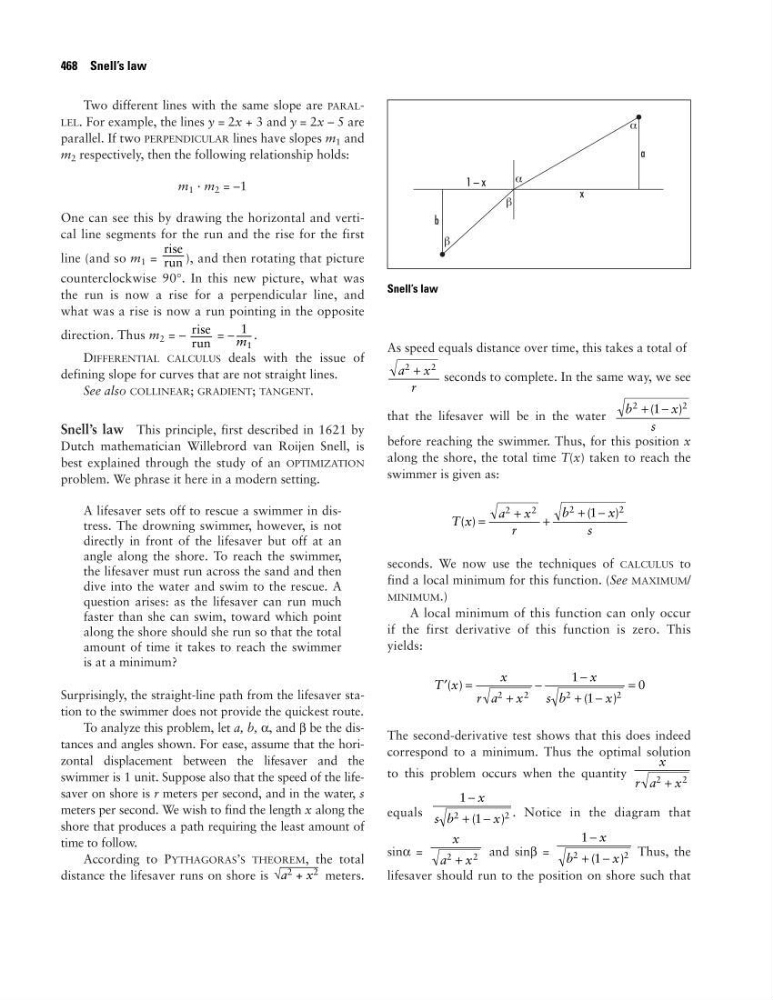
To analyze this problem, let a, b, α, and β be the distances and angles shown. For ease, assume that the horizontal displacement between the lifesaver and the
swimmer is 1 unit. Suppose also that the speed of the lifesaver on shore is r meters per second, and in the water, s
meters per second. We wish to find the length x along the
shore that produces a path requiring the least amount of
time to follow.
According to PYTHAGORAS’S THEOREM, the total
distance the lifesaver runs on shore is
meters.
As speed equals distance over time, this takes a total of
seconds to complete. In the same way, we see
that the lifesaver will be in the water
before reaching the swimmer. Thus, for this position x
along the shore, the total time T(x) taken to reach the
swimmer is given as:
seconds. We now use the techniques of CALCULUS to
find a local minimum for this function. (See MAXIMUM/
MINIMUM.)
A local minimum of this function can only occur
if the first derivative of this function is zero. This
yields:
The second-derivative test shows that this does indeed
correspond to a minimum. Thus the optimal solution
to this problem occurs when the quantity
equals
. Notice in the diagram that
sinα =
and sinβ =
Thus, the
lifesaver should run to the position on shore such that
1
1
2
2
−
+ −
x
b
x
(
)
x
a x
2
2
+
1
1
2
2
−
+ −
x
s b
x
(
)
x
r a x
2
2
+
′ =
+
−
−
+ −
=
T x
x
r a x
x
s b
x
( )
(
)
2
2
2
2
1
1
0
T x
a
x
r
b
x
s
( )
(
)
=
+
+
+ −
2
2
2
2
1
b
x
s
2
2
1
+ −
(
)
a
x
r
2
2
+
√a
2 + x
2
1
––
m 1
rise
––
run
rise
––
run
468 Snell’s law
Snell’s law
parallel. If two PERPENDICULAR lines have slopes m 1 and
m 2 respectively, then the following relationship holds:
m 1 · m 2 = –1
One can see this by drawing the horizontal and vertical line segments for the run and the rise for the first
line (and so m 1 =
), and then rotating that picture
counterclockwise 90°. In this new picture, what was
the run is now a rise for a perpendicular line, and
what was a rise is now a run pointing in the opposite
direction. Thus m 2 = –
= –
.
DIFFERENTIAL CALCULUS deals with the issue of
defining slope for curves that are not straight lines.
See also COLLINEAR; GRADIENT; TANGENT.
Snell’s law This principle, first described in 1621 by
Dutch mathematician Willebrord van Roijen Snell, is
best explained through the study of an OPTIMIZATION
problem. We phrase it here in a modern setting.
A lifesaver sets off to rescue a swimmer in distress. The drowning swimmer, however, is not
directly in front of the lifesaver but off at an
angle along the shore. To reach the swimmer,
the lifesaver must run across the sand and then
dive into the water and swim to the rescue. A
question arises: as the lifesaver can run much
faster than she can swim, toward which point
along the shore should she run so that the total
amount of time it takes to reach the swimmer
is at a minimum?
Surprisingly, the straight-line path from the lifesaver station to the swimmer does not provide the quickest route.
To analyze this problem, let a, b, α, and β be the distances and angles shown. For ease, assume that the horizontal displacement between the lifesaver and the
swimmer is 1 unit. Suppose also that the speed of the lifesaver on shore is r meters per second, and in the water, s
meters per second. We wish to find the length x along the
shore that produces a path requiring the least amount of
time to follow.
According to PYTHAGORAS’S THEOREM, the total
distance the lifesaver runs on shore is
meters.
As speed equals distance over time, this takes a total of
seconds to complete. In the same way, we see
that the lifesaver will be in the water
before reaching the swimmer. Thus, for this position x
along the shore, the total time T(x) taken to reach the
swimmer is given as:
seconds. We now use the techniques of CALCULUS to
find a local minimum for this function. (See MAXIMUM/
MINIMUM.)
A local minimum of this function can only occur
if the first derivative of this function is zero. This
yields:
The second-derivative test shows that this does indeed
correspond to a minimum. Thus the optimal solution
to this problem occurs when the quantity
equals
. Notice in the diagram that
sinα =
and sinβ =
Thus, the
lifesaver should run to the position on shore such that
1
1
2
2
−
+ −
x
b
x
(
)
x
a x
2
2
+
1
1
2
2
−
+ −
x
s b
x
(
)
x
r a x
2
2
+
′ =
+
−
−
+ −
=
T x
x
r a x
x
s b
x
( )
(
)
2
2
2
2
1
1
0
T x
a
x
r
b
x
s
( )
(
)
=
+
+
+ −
2
2
2
2
1
b
x
s
2
2
1
+ −
(
)
a
x
r
2
2
+
√a
2 + x
2
1
––
m 1
rise
––
run
rise
––
run
468 Snell’s law
Snell’s law