

For any positive whole number b, one can create a
place-value notational system of that base as follows:
Write a given number n as a sum of powers of b:
n = a k b
k + a k–1 b
k–1 + … + a 2 b
2 + a 1 b + a 0
with each number a i satisfying 0 ≤ a i < b. Then
the base b representation of n is the k-digit
quantity a k a k–1 …a 2 a 1 a 0 . Such a representation
uses only the symbols 0, 1, 2,…, b – 1.
For example, to write the number 18 in base four—
using the symbols 0, 1, 2, and 3—observe that 18 = 1 ×
4
2 + 0 × 4 + 2 × 1, yielding the base-4 representation:
102. In the reverse direction, if 5,142 is the base-6 representation of a number n, then n is the number 5 × 6
3
+ 1 × 6
2 + 4 × 6 + 2 × 1 = 1,142.
One may also make use of negative powers of the
base quantity b. For example, using a decimal point to
separate positive and negative powers of ten, the number 312.407, for instance, represents the fractional
quantity: 3 × 10
2 + 1 × 10 + 2 × 1 + 4 ×
+ 0 ×
+ 7 ×
. In base 4, the number 33.22 is the quantity
3 × 4 + 3 × 1 + 2 × + 2 ×
= 15 +
+
, which
is 15.625 in base 10.
The following table gives the names of the placevalue number systems that use different base values b.
The Babylonians of ancient times used a sexagesimal
system, and the Mayas of the first millennium used a
system close to being purely vigesimal.
The representation of numbers can be wellrepresented with the aid of a simple AUTOMATON
called a number-base machine. Beginning with a row of
boxes extending infinitely to the left, one places in the
rightmost box a finite number of pennies. The automaton then redistributes the pennies according to a preset
rule. A “1 ← 2” machine, for example, replaces a pair
of pennies in one box with a single penny in the box
one place to the left. Thus, for instance, six pennies
placed into the 1 ← 2 machine “fire” four times to
yield a final distribution that can be read as “1 1 0.”
This result is the number six written as a BINARY NUMBER and this machine converts all numbers to their
base-two representations. (The diagram in the entry for
automaton illustrates this.) A 1 ← 3 machine yields
base-three representations, and a 1 ← 10 machine
yields the ordinary base-ten representations.
Long Division
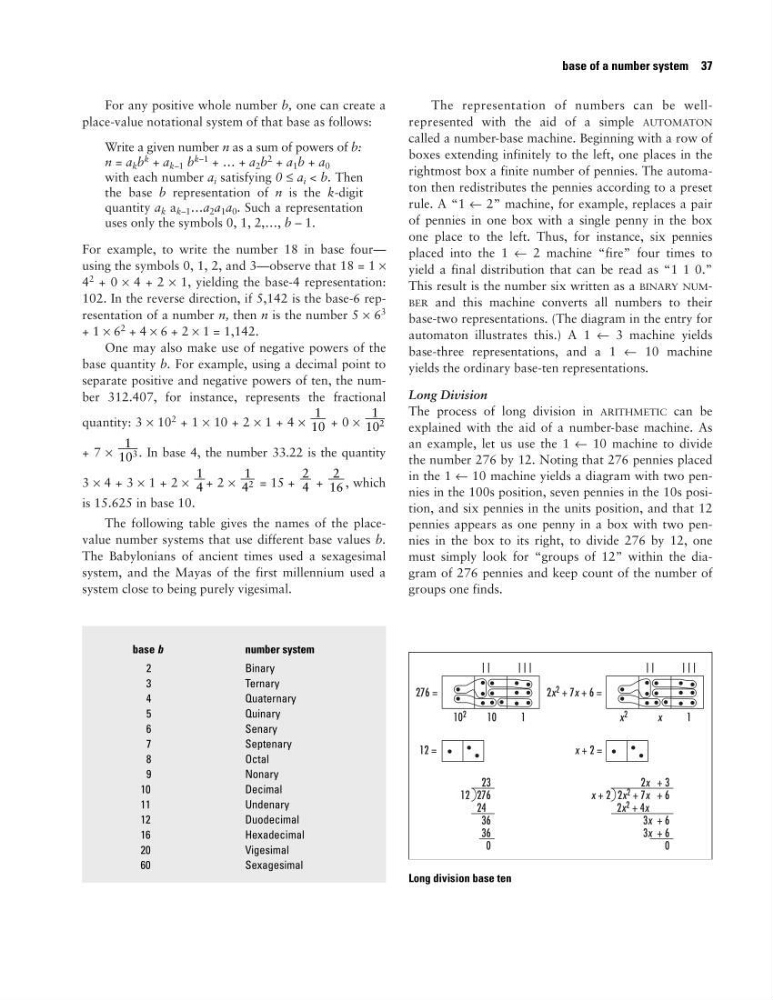
The process of long division in ARITHMETIC can be
explained with the aid of a number-base machine. As
an example, let us use the 1 ← 10 machine to divide
the number 276 by 12. Noting that 276 pennies placed
in the 1 ← 10 machine yields a diagram with two pennies in the 100s position, seven pennies in the 10s position, and six pennies in the units position, and that 12
pennies appears as one penny in a box with two pennies in the box to its right, to divide 276 by 12, one
must simply look for “groups of 12” within the diagram of 276 pennies and keep count of the number of
groups one finds.
2
16
2
4
1
4
2
1
4
1
10
3
1
10
2
1
10
base of a number system 37
base b
number system
2
Binary
3
Ternary
4
Quaternary
5
Quinary
6
Senary
7
Septenary
8
Octal
9
Nonary
10
Decimal
11
Undenary
12
Duodecimal
16
Hexadecimal
20
Vigesimal
60
Sexagesimal
Long division base ten
place-value notational system of that base as follows:
Write a given number n as a sum of powers of b:
n = a k b
k + a k–1 b
k–1 + … + a 2 b
2 + a 1 b + a 0
with each number a i satisfying 0 ≤ a i < b. Then
the base b representation of n is the k-digit
quantity a k a k–1 …a 2 a 1 a 0 . Such a representation
uses only the symbols 0, 1, 2,…, b – 1.
For example, to write the number 18 in base four—
using the symbols 0, 1, 2, and 3—observe that 18 = 1 ×
4
2 + 0 × 4 + 2 × 1, yielding the base-4 representation:
102. In the reverse direction, if 5,142 is the base-6 representation of a number n, then n is the number 5 × 6
3
+ 1 × 6
2 + 4 × 6 + 2 × 1 = 1,142.
One may also make use of negative powers of the
base quantity b. For example, using a decimal point to
separate positive and negative powers of ten, the number 312.407, for instance, represents the fractional
quantity: 3 × 10
2 + 1 × 10 + 2 × 1 + 4 ×
+ 0 ×
+ 7 ×
. In base 4, the number 33.22 is the quantity
3 × 4 + 3 × 1 + 2 × + 2 ×
= 15 +
+
, which
is 15.625 in base 10.
The following table gives the names of the placevalue number systems that use different base values b.
The Babylonians of ancient times used a sexagesimal
system, and the Mayas of the first millennium used a
system close to being purely vigesimal.
The representation of numbers can be wellrepresented with the aid of a simple AUTOMATON
called a number-base machine. Beginning with a row of
boxes extending infinitely to the left, one places in the
rightmost box a finite number of pennies. The automaton then redistributes the pennies according to a preset
rule. A “1 ← 2” machine, for example, replaces a pair
of pennies in one box with a single penny in the box
one place to the left. Thus, for instance, six pennies
placed into the 1 ← 2 machine “fire” four times to
yield a final distribution that can be read as “1 1 0.”
This result is the number six written as a BINARY NUMBER and this machine converts all numbers to their
base-two representations. (The diagram in the entry for
automaton illustrates this.) A 1 ← 3 machine yields
base-three representations, and a 1 ← 10 machine
yields the ordinary base-ten representations.
Long Division
The process of long division in ARITHMETIC can be
explained with the aid of a number-base machine. As
an example, let us use the 1 ← 10 machine to divide
the number 276 by 12. Noting that 276 pennies placed
in the 1 ← 10 machine yields a diagram with two pennies in the 100s position, seven pennies in the 10s position, and six pennies in the units position, and that 12
pennies appears as one penny in a box with two pennies in the box to its right, to divide 276 by 12, one
must simply look for “groups of 12” within the diagram of 276 pennies and keep count of the number of
groups one finds.
2
16
2
4
1
4
2
1
4
1
10
3
1
10
2
1
10
base of a number system 37
base b
number system
2
Binary
3
Ternary
4
Quaternary
5
Quinary
6
Senary
7
Septenary
8
Octal
9
Nonary
10
Decimal
11
Undenary
12
Duodecimal
16
Hexadecimal
20
Vigesimal
60
Sexagesimal
Long division base ten