

not known) Isaac Barrow is remembered in mathematics for his collection of lecture notes Lectiones geometricae (Geometrical lectures), published in 1670, in which
he describes a method for finding tangents to curves
similar to that used today in DIFFERENTIAL CALCULUS.
Barrow may have also been the first to realize that the
problem of finding tangents to curves is the inverse
problem to finding areas under curves. (This is THE
FUNDAMENTAL THEOREM OF CALCULUS.) The lectures
on which his notes were based were extremely influential. They provided SIR ISAAC NEWTON, who attended
the lectures and had many private discussions with Barrow, a starting point for his development of CALCULUS.
Barrow graduated from Trinity College, Cambridge, with a master’s degree in 1652, but was dissatisfied with the level of mathematics instruction he had
received. After leaving the college, Barrow taught himself GEOMETRY and published a simplified edition of
EUCLID’s THE ELEMENTS in 1655. He became professor
of geometry at Gresham College, London, in 1662, and
was elected as one of the first 150 fellows of the newly
established ROYAL SOCIETY in 1663. He returned to
Cambridge that same year to take the position of
Lucasian Chair of Mathematics, at Trinity College, and
worked hard to improve the standards of mathematics
education and interest in mathematical research at
Cambridge. With this aim in mind, Barrow gave a series
of lectures on the topics of optics, geometry, NUMBER
THEORY, and the nature of time and space. His discussions on geometry proved to be highly innovative and
fundamentally important for the new perspective they
offered. Newton advised Barrow to publish the notes.
In 1669 Barrow resigned from the Lucasian Chair
to allow Newton to take over, and he did no further
mathematical work. He died in London, England, on
May 4, 1677, of a malignant fever. Barrow’s influence
on modern-day mathematics is oblique. His effect on
the development of the subject lies chiefly with the
inspiration he provided for others.
base of a logarithm See LOGARITHM.
base of an exponential See EXPONENT; EXPONENTIAL FUNCTION.
base of a number system (radix, scale of a number
system) The number of different symbols used, perhaps in combination, to represent all numbers is called
the base of the number system being used. For example, today we use the ten symbols 0, 1, 2, 3, 4, 5, 6, 7,
8, and 9 to denote all numbers, making use of the position of these digits in a given combination to denote
large values. Thus we use a base-10 number system
(also called a decimal representation system). We also
use a place-value system to give meaning to the
repeated use of symbols. When we write 8,407, for
instance, we mean eight quantities of 1,000 (10
3
), four
quantities of 100 (10
2
), and seven single units (10
0
).
The placement of each DIGIT is thus important: the
number of places from the right in which a digit lies
determines the power of 10 being considered. Thus the
numbers 8, 80, 800, and 8,000, for instance, all represent different quantities. (The system of ROMAN
NUMERALS, for example, is not a place-value system.)
36 base of a logarithm
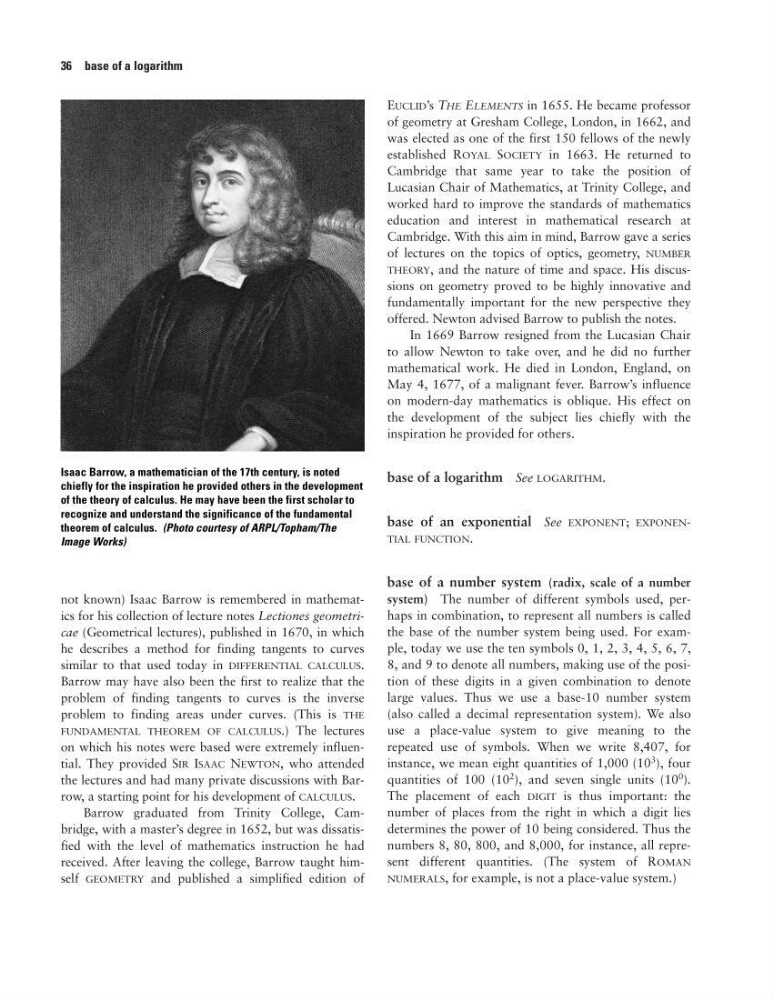
Isaac Barrow, a mathematician of the 17th century, is noted
chiefly for the inspiration he provided others in the development
of the theory of calculus. He may have been the first scholar to
recognize and understand the significance of the fundamental
theorem of calculus. (Photo courtesy of ARPL/Topham/The
Image Works)
he describes a method for finding tangents to curves
similar to that used today in DIFFERENTIAL CALCULUS.
Barrow may have also been the first to realize that the
problem of finding tangents to curves is the inverse
problem to finding areas under curves. (This is THE
FUNDAMENTAL THEOREM OF CALCULUS.) The lectures
on which his notes were based were extremely influential. They provided SIR ISAAC NEWTON, who attended
the lectures and had many private discussions with Barrow, a starting point for his development of CALCULUS.
Barrow graduated from Trinity College, Cambridge, with a master’s degree in 1652, but was dissatisfied with the level of mathematics instruction he had
received. After leaving the college, Barrow taught himself GEOMETRY and published a simplified edition of
EUCLID’s THE ELEMENTS in 1655. He became professor
of geometry at Gresham College, London, in 1662, and
was elected as one of the first 150 fellows of the newly
established ROYAL SOCIETY in 1663. He returned to
Cambridge that same year to take the position of
Lucasian Chair of Mathematics, at Trinity College, and
worked hard to improve the standards of mathematics
education and interest in mathematical research at
Cambridge. With this aim in mind, Barrow gave a series
of lectures on the topics of optics, geometry, NUMBER
THEORY, and the nature of time and space. His discussions on geometry proved to be highly innovative and
fundamentally important for the new perspective they
offered. Newton advised Barrow to publish the notes.
In 1669 Barrow resigned from the Lucasian Chair
to allow Newton to take over, and he did no further
mathematical work. He died in London, England, on
May 4, 1677, of a malignant fever. Barrow’s influence
on modern-day mathematics is oblique. His effect on
the development of the subject lies chiefly with the
inspiration he provided for others.
base of a logarithm See LOGARITHM.
base of an exponential See EXPONENT; EXPONENTIAL FUNCTION.
base of a number system (radix, scale of a number
system) The number of different symbols used, perhaps in combination, to represent all numbers is called
the base of the number system being used. For example, today we use the ten symbols 0, 1, 2, 3, 4, 5, 6, 7,
8, and 9 to denote all numbers, making use of the position of these digits in a given combination to denote
large values. Thus we use a base-10 number system
(also called a decimal representation system). We also
use a place-value system to give meaning to the
repeated use of symbols. When we write 8,407, for
instance, we mean eight quantities of 1,000 (10
3
), four
quantities of 100 (10
2
), and seven single units (10
0
).
The placement of each DIGIT is thus important: the
number of places from the right in which a digit lies
determines the power of 10 being considered. Thus the
numbers 8, 80, 800, and 8,000, for instance, all represent different quantities. (The system of ROMAN
NUMERALS, for example, is not a place-value system.)
36 base of a logarithm
Isaac Barrow, a mathematician of the 17th century, is noted
chiefly for the inspiration he provided others in the development
of the theory of calculus. He may have been the first scholar to
recognize and understand the significance of the fundamental
theorem of calculus. (Photo courtesy of ARPL/Topham/The
Image Works)