

Eventually, after being released, Pythagoras settled in
southern Italy, where he founded his famous school
around 518 B.C.E. Both men and women were welcomed as members.
Pythagoras believed that all physical (and metaphysical) phenomena could be understood through
numbers. This belief is said to have stemmed from his
observation that two vibrating strings produce a harmonious combination of tones only when the ratios of
their lengths can be expressed in terms of whole numbers. (Pythagoras was an accomplished musician and
made significant contributions to the theory of music.)
Pythagoras, and his followers, studied whole numbers and their ratios, and even went as far as to assign
mystical properties to numbers. For instance, they
believed that the first natural number, 1, acted as the
divine source of all numbers and so was of different
stature than an ordinary number. (The number 2 was
deemed the first number.) All even numbers were
assumed feminine and all odd numbers masculine, and
all odd numbers (except 13) represented good luck.
The number 4 stood for “justice,” being the first perfect square, and 5 marriage, as the union (sum) of the
first even number (2) and the first odd number (3). The
number 6 was “perfect” since it equals the sum of its
factors different from itself.
In GEOMETRY, the Pythagoreans knew that the interior angles of a TRIANGLE always sum to 180° (and,
more generally, that the interior angle of an n-sided figure sum to (n – 2) × 180°), and knew how to construct
three of the five PLATONIC SOLIDS. They could solve
equations of the form x
2 = a(a – x) using geometrical
methods, and they developed a number of techniques
for constructing figures of a given area. They attributed
great mystical significance to the PENTAGRAM because
of the geometric ratios it contains. In astronomy, the
Pythagoreans were aware that the Earth is round, but
believed it lay at the center of the universe. They were
aware that the orbit of the Moon is inclined to the
equator of the Earth and were the first to realize that
the evening star and the morning star were the same
heavenly object (namely, the planet Venus).
The exact date, location, and circumstance of
Pythagoras’s death are not known. Despite his passing,
the factions of the original Pythagorean order endured
for more than 200 years. Members of the Pythagorean
brotherhood so revered their founder that it was considered impious for any individual to claim a discovery
for his own glory without referring back to Pythagoras
himself. It is said, for instance, that member Hippasus
of Metapontum (ca. 470 B.C.E.) was put to death by
drowning for announcing his own discovery of the regular dodecahedroan, the fifth Platonic solid. (Other
versions of this popular story submit that he was executed for claiming to have discovered that the square
root of 2 is an irrational number.)
Pythagoras’s theorem (Pythagorean theorem, righttriangle principle) Hailed as the most important result
in all of geometry, Pythagoras’s theorem states that, for
a right-angled triangle, the square of the length of the
HYPOTENUSE is equal to the sum of the squares of the
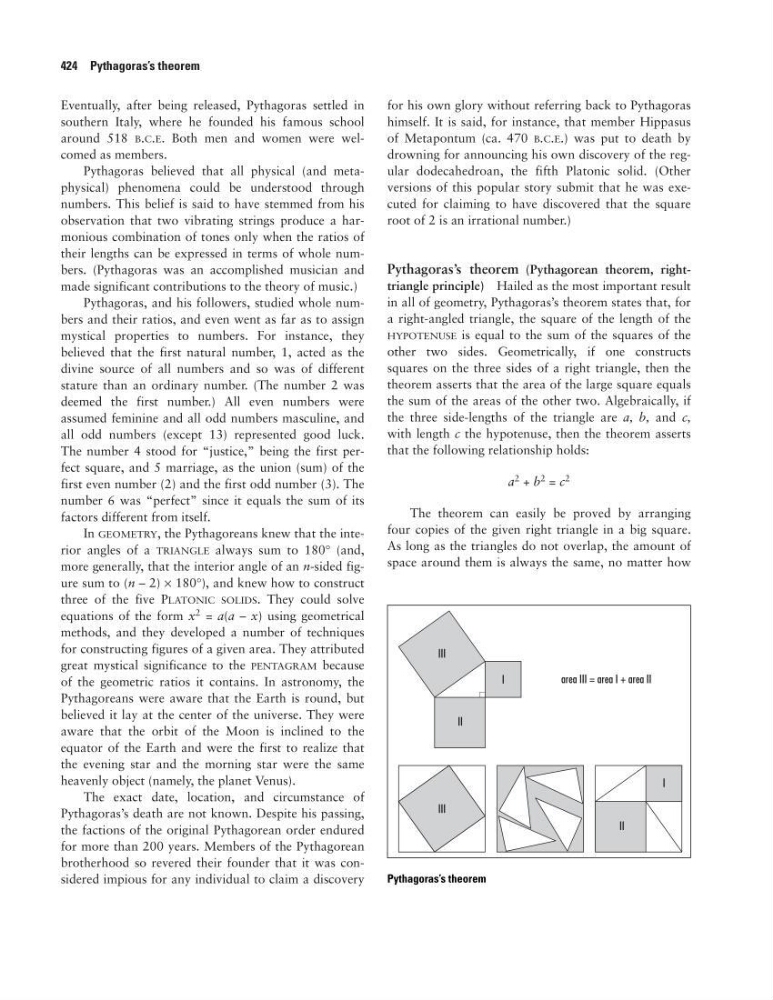
other two sides. Geometrically, if one constructs
squares on the three sides of a right triangle, then the
theorem asserts that the area of the large square equals
the sum of the areas of the other two. Algebraically, if
the three side-lengths of the triangle are a, b, and c,
with length c the hypotenuse, then the theorem asserts
that the following relationship holds:
a
2 + b
2 = c
2
The theorem can easily be proved by arranging
four copies of the given right triangle in a big square.
As long as the triangles do not overlap, the amount of
space around them is always the same, no matter how
424 Pythagoras’s theorem
Pythagoras’s theorem
southern Italy, where he founded his famous school
around 518 B.C.E. Both men and women were welcomed as members.
Pythagoras believed that all physical (and metaphysical) phenomena could be understood through
numbers. This belief is said to have stemmed from his
observation that two vibrating strings produce a harmonious combination of tones only when the ratios of
their lengths can be expressed in terms of whole numbers. (Pythagoras was an accomplished musician and
made significant contributions to the theory of music.)
Pythagoras, and his followers, studied whole numbers and their ratios, and even went as far as to assign
mystical properties to numbers. For instance, they
believed that the first natural number, 1, acted as the
divine source of all numbers and so was of different
stature than an ordinary number. (The number 2 was
deemed the first number.) All even numbers were
assumed feminine and all odd numbers masculine, and
all odd numbers (except 13) represented good luck.
The number 4 stood for “justice,” being the first perfect square, and 5 marriage, as the union (sum) of the
first even number (2) and the first odd number (3). The
number 6 was “perfect” since it equals the sum of its
factors different from itself.
In GEOMETRY, the Pythagoreans knew that the interior angles of a TRIANGLE always sum to 180° (and,
more generally, that the interior angle of an n-sided figure sum to (n – 2) × 180°), and knew how to construct
three of the five PLATONIC SOLIDS. They could solve
equations of the form x
2 = a(a – x) using geometrical
methods, and they developed a number of techniques
for constructing figures of a given area. They attributed
great mystical significance to the PENTAGRAM because
of the geometric ratios it contains. In astronomy, the
Pythagoreans were aware that the Earth is round, but
believed it lay at the center of the universe. They were
aware that the orbit of the Moon is inclined to the
equator of the Earth and were the first to realize that
the evening star and the morning star were the same
heavenly object (namely, the planet Venus).
The exact date, location, and circumstance of
Pythagoras’s death are not known. Despite his passing,
the factions of the original Pythagorean order endured
for more than 200 years. Members of the Pythagorean
brotherhood so revered their founder that it was considered impious for any individual to claim a discovery
for his own glory without referring back to Pythagoras
himself. It is said, for instance, that member Hippasus
of Metapontum (ca. 470 B.C.E.) was put to death by
drowning for announcing his own discovery of the regular dodecahedroan, the fifth Platonic solid. (Other
versions of this popular story submit that he was executed for claiming to have discovered that the square
root of 2 is an irrational number.)
Pythagoras’s theorem (Pythagorean theorem, righttriangle principle) Hailed as the most important result
in all of geometry, Pythagoras’s theorem states that, for
a right-angled triangle, the square of the length of the
HYPOTENUSE is equal to the sum of the squares of the
other two sides. Geometrically, if one constructs
squares on the three sides of a right triangle, then the
theorem asserts that the area of the large square equals
the sum of the areas of the other two. Algebraically, if
the three side-lengths of the triangle are a, b, and c,
with length c the hypotenuse, then the theorem asserts
that the following relationship holds:
a
2 + b
2 = c
2
The theorem can easily be proved by arranging
four copies of the given right triangle in a big square.
As long as the triangles do not overlap, the amount of
space around them is always the same, no matter how
424 Pythagoras’s theorem
Pythagoras’s theorem