

CALCULUS forced scholars to seek greater levels of rigor
and abstraction. Even the nature of logical reasoning
itself was examined as an attempt to understand and
resolve fundamental paradoxes. The need for abstract
ANALYSIS and synthesis was recognized as important,
and dichotomy between applied and pure mathematics
became more apparent.
Today many research universities possess two
departments of mathematics, one considered pure and
the other applied. Students can obtain advanced degrees
in either field.
See also BABYLONIAN MATHEMATICS; GREEK
MATHEMATICS.
pyramid A CONE with a polygon for the base is
called a pyramid. Specifically, a pyramid is the solid figure formed by a polygon and a number of triangles,
one attached to each side of the polygon, all meeting at
a common point called the APEX of the pyramid. The
pyramid is classified as a right pyramid if the line connecting the apex of the pyramid to the CENTER OF
GRAVITY of the base meets the base at a right angle.
(Otherwise it is called an oblique pyramid.) A square
pyramid is a right pyramid with a square base.
The study of volumes of cones shows that the volume of a pyramid is just one-third the area of the base
of the figure times its height. A TETRAHEDRON is a
right pyramid with four equilateral triangles as faces.
See also FRUSTUM.
Pythagoras (ca. 569–475 B.C.E.) Greek Geometry,
Number theory Born in Samos, Ionia, Greek mathematician and mystic Pythagoras is remembered as
founder of the Pythagorean School, which claimed to
have found universal truth through the study of number. As such, the Pythagoreans are credited as the first
to have taken mathematics seriously as a study in its
own right without regard to possible application and
practical need. What precisely Pythagoras contributed himself is no longer clear, but the school is
acknowledged to have discovered the role of ratios of
whole numbers in the musical scale, the properties of
FIGURATE NUMBERS, AMICABLE NUMBERS, PERFECT
NUMBERs, and the existence of IRRATIONAL NUMBERS.
Although PYTHAGORAS’S THEOREM was known to the
Babylonians over 1,000 years earlier, the Pythagoreans are the first to have provided a general proof of
the result.
Very little is known of Pythagoras’s life. The sect he
founded was half scientific and half religious and followed a code of secrecy that certainly promoted great
mystery about the man himself. Many historical writings attribute godlike qualities to Pythagoras and are
generally not regarded as accurate portrayals. It is
understood that Pythagoras visited with THALES OF
MILETUS (ca. 625–547 B.C.E.) as a young man who,
most likely, contributed to Pythagoras’s interest in
mathematics. Around 535 B.C.E., Pythagoras traveled
to Egypt and was certainly influenced by the secret
sects of the Egyptian priests. (Many of the practices the
Pythagoreans followed were the same as those practiced in Egypt—refusal to eat beans or to wear cloth
made from animal skins, for instance.)
In 525 B.C.E., Egypt was invaded by Persian forces,
and Pythagoras was captured and taken to Babylon.
Pythagoras 423
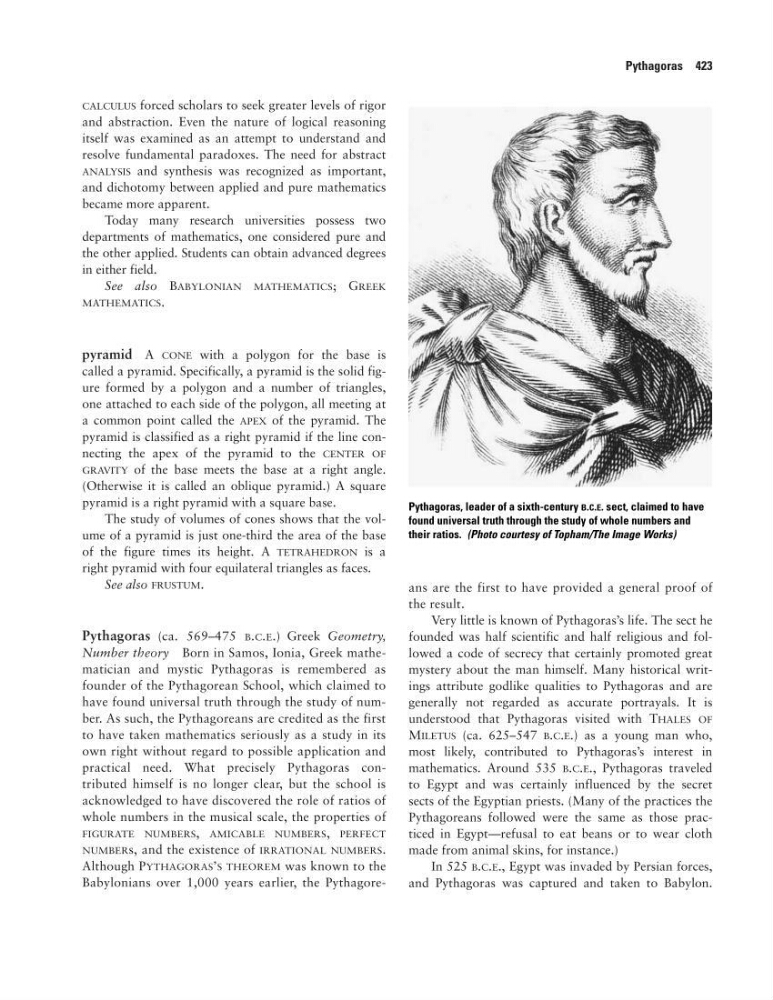
Pythagoras, leader of a sixth-century B.C.E. sect, claimed to have
found universal truth through the study of whole numbers and
their ratios. (Photo courtesy of Topham/The Image Works)
and abstraction. Even the nature of logical reasoning
itself was examined as an attempt to understand and
resolve fundamental paradoxes. The need for abstract
ANALYSIS and synthesis was recognized as important,
and dichotomy between applied and pure mathematics
became more apparent.
Today many research universities possess two
departments of mathematics, one considered pure and
the other applied. Students can obtain advanced degrees
in either field.
See also BABYLONIAN MATHEMATICS; GREEK
MATHEMATICS.
pyramid A CONE with a polygon for the base is
called a pyramid. Specifically, a pyramid is the solid figure formed by a polygon and a number of triangles,
one attached to each side of the polygon, all meeting at
a common point called the APEX of the pyramid. The
pyramid is classified as a right pyramid if the line connecting the apex of the pyramid to the CENTER OF
GRAVITY of the base meets the base at a right angle.
(Otherwise it is called an oblique pyramid.) A square
pyramid is a right pyramid with a square base.
The study of volumes of cones shows that the volume of a pyramid is just one-third the area of the base
of the figure times its height. A TETRAHEDRON is a
right pyramid with four equilateral triangles as faces.
See also FRUSTUM.
Pythagoras (ca. 569–475 B.C.E.) Greek Geometry,
Number theory Born in Samos, Ionia, Greek mathematician and mystic Pythagoras is remembered as
founder of the Pythagorean School, which claimed to
have found universal truth through the study of number. As such, the Pythagoreans are credited as the first
to have taken mathematics seriously as a study in its
own right without regard to possible application and
practical need. What precisely Pythagoras contributed himself is no longer clear, but the school is
acknowledged to have discovered the role of ratios of
whole numbers in the musical scale, the properties of
FIGURATE NUMBERS, AMICABLE NUMBERS, PERFECT
NUMBERs, and the existence of IRRATIONAL NUMBERS.
Although PYTHAGORAS’S THEOREM was known to the
Babylonians over 1,000 years earlier, the Pythagoreans are the first to have provided a general proof of
the result.
Very little is known of Pythagoras’s life. The sect he
founded was half scientific and half religious and followed a code of secrecy that certainly promoted great
mystery about the man himself. Many historical writings attribute godlike qualities to Pythagoras and are
generally not regarded as accurate portrayals. It is
understood that Pythagoras visited with THALES OF
MILETUS (ca. 625–547 B.C.E.) as a young man who,
most likely, contributed to Pythagoras’s interest in
mathematics. Around 535 B.C.E., Pythagoras traveled
to Egypt and was certainly influenced by the secret
sects of the Egyptian priests. (Many of the practices the
Pythagoreans followed were the same as those practiced in Egypt—refusal to eat beans or to wear cloth
made from animal skins, for instance.)
In 525 B.C.E., Egypt was invaded by Persian forces,
and Pythagoras was captured and taken to Babylon.
Pythagoras 423
Pythagoras, leader of a sixth-century B.C.E. sect, claimed to have
found universal truth through the study of whole numbers and
their ratios. (Photo courtesy of Topham/The Image Works)