

The PERIMETER of a regular n-gon, with sides of
length s, is ns, and its AREA is
× perimeter × r = nsr.
Here r is the APOTHEM of the polygon.
It is possible to construct an equilateral triangle
using a straightedge (a ruler without markings) and
compass alone. Draw a straight line. Set the compass at
a fixed angle and draw a circle with center anywhere
along this line. Choose one point of intersection of this
circle with the line and draw a second circle of the
same radius with this chosen point as its center. The
centers of each circle and their point of intersection
now form the three corners of an equilateral triangle.
One can also draw a square, regular 5-gon, and a
regular 6-gon, but not a regular 7-gon, using compass
and straightedge alone. The question of precisely
which regular n-gons are CONSTRUCTIBLE this way is
an old one.
Given a rectangular piece of paper, it is also possible to create the shape of an equilateral triangle by
creasing the sheet. Fold the paper in half along the
direction of its longest length, marking this midline as a
crease. Bring the bottom left corner of the paper to this
midline to form a diagonal crease that passes through
the bottom right corner. The location of this left corner
on the midline is the apex of an equilateral triangle
with the bottom edge of the paper as base.
Only three regular polygons tile the plane: the equilateral triangle, the square, and the regular hexagon. A
study of TESSELATION shows that no other regular polygon can do this.
All regular polygons have the following remarkable
property:
For any point inside a regular polygon, the
sum of the distances of that point from each of
the sides is always the same.
Suppose, for example, we choose an arbitrary point P
inside a regular hexagon of side-length s lying at distances h 1 , h 2 ,…, h 6 from the sides of the hexagon.
Lines connecting P to the vertices of the hexagon divide
the figure into six triangles. The area of the polygon is
consequently the sum of areas of these triangles, sh 1
+ sh 2 + sh 3 + sh 4 + sh 5 + sh 6 , and so h 1 + h 2
+ h 3 + h 4 + h 5 + h 6 has value
, no matter
which point is chosen. (In general, the quantity
equals the number of sides of the regular
polygon times its apothem.)
The three-dimensional generalization of a polygon
is a POLYHEDRON. The generalization into four dimensions is called a polychoron, and into an arbitrary
number of dimensions, a polytope.
See also CONCAVE/CONVEX; CYCLIC POLYGON;
LONG RADIUS.
polyhedron (plural, polyhedra) A three-dimensional solid figure with a surface composed of plane
polygonal surfaces is called a polyhedron. For example,
a CUBE, with six square faces, is a polyhedron, as is a
TETRAHEDRON with four triangular faces, and any
PYRAMID or PRISM, for instance. Each polygonal surface
is called a FACE of the polyhedron, and any line along
which two faces intersect is called an edge. Any point
at which three or more faces meet is called a vertex or a
corner of the polyhedron.
POLYGONs and polyhedra were first studied in
detail by the ancient Greeks, who also gave them their
name: poly means “many” and hédra means “seat.”
Thus a polyhedron was considered capable of being
seated on any of its faces. In this context, it is usually
assumed then that a polyhedron is convex, that is, no
plane containing a face of the figure also passes through
the interior of the figure. (Consequently a convex polygon can be “seated” on any of its faces on a tabletop.)
A polyhedron that is not convex is called concave.
Specific polyhedra are named according to the
number of faces they possess. For example, a tetrahedron is any solid figure with four polygonal faces, a
pentahedron is one with five faces, and a hexahedron is
2 × area
———– s
2 × area
———–
s
1
–
2
1
–
2
1
–
2
1
–
2
1
–
2
1
–
2
1
–
2
1
–
2
polyhedron 403
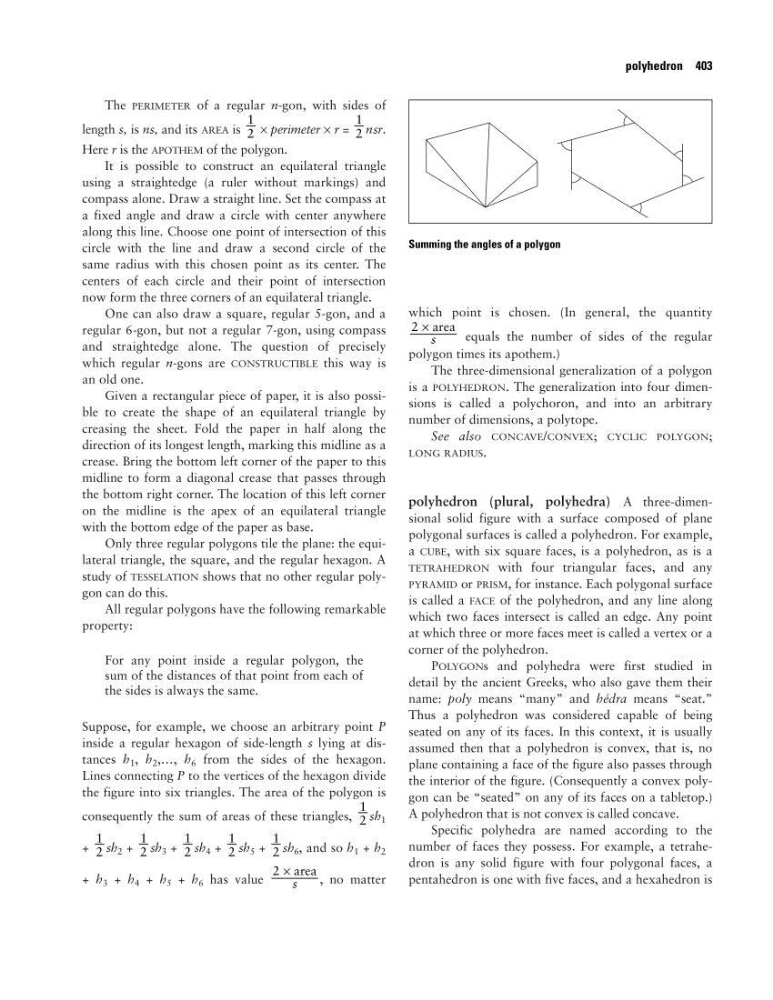
Summing the angles of a polygon
length s, is ns, and its AREA is
× perimeter × r = nsr.
Here r is the APOTHEM of the polygon.
It is possible to construct an equilateral triangle
using a straightedge (a ruler without markings) and
compass alone. Draw a straight line. Set the compass at
a fixed angle and draw a circle with center anywhere
along this line. Choose one point of intersection of this
circle with the line and draw a second circle of the
same radius with this chosen point as its center. The
centers of each circle and their point of intersection
now form the three corners of an equilateral triangle.
One can also draw a square, regular 5-gon, and a
regular 6-gon, but not a regular 7-gon, using compass
and straightedge alone. The question of precisely
which regular n-gons are CONSTRUCTIBLE this way is
an old one.
Given a rectangular piece of paper, it is also possible to create the shape of an equilateral triangle by
creasing the sheet. Fold the paper in half along the
direction of its longest length, marking this midline as a
crease. Bring the bottom left corner of the paper to this
midline to form a diagonal crease that passes through
the bottom right corner. The location of this left corner
on the midline is the apex of an equilateral triangle
with the bottom edge of the paper as base.
Only three regular polygons tile the plane: the equilateral triangle, the square, and the regular hexagon. A
study of TESSELATION shows that no other regular polygon can do this.
All regular polygons have the following remarkable
property:
For any point inside a regular polygon, the
sum of the distances of that point from each of
the sides is always the same.
Suppose, for example, we choose an arbitrary point P
inside a regular hexagon of side-length s lying at distances h 1 , h 2 ,…, h 6 from the sides of the hexagon.
Lines connecting P to the vertices of the hexagon divide
the figure into six triangles. The area of the polygon is
consequently the sum of areas of these triangles, sh 1
+ sh 2 + sh 3 + sh 4 + sh 5 + sh 6 , and so h 1 + h 2
+ h 3 + h 4 + h 5 + h 6 has value
, no matter
which point is chosen. (In general, the quantity
equals the number of sides of the regular
polygon times its apothem.)
The three-dimensional generalization of a polygon
is a POLYHEDRON. The generalization into four dimensions is called a polychoron, and into an arbitrary
number of dimensions, a polytope.
See also CONCAVE/CONVEX; CYCLIC POLYGON;
LONG RADIUS.
polyhedron (plural, polyhedra) A three-dimensional solid figure with a surface composed of plane
polygonal surfaces is called a polyhedron. For example,
a CUBE, with six square faces, is a polyhedron, as is a
TETRAHEDRON with four triangular faces, and any
PYRAMID or PRISM, for instance. Each polygonal surface
is called a FACE of the polyhedron, and any line along
which two faces intersect is called an edge. Any point
at which three or more faces meet is called a vertex or a
corner of the polyhedron.
POLYGONs and polyhedra were first studied in
detail by the ancient Greeks, who also gave them their
name: poly means “many” and hédra means “seat.”
Thus a polyhedron was considered capable of being
seated on any of its faces. In this context, it is usually
assumed then that a polyhedron is convex, that is, no
plane containing a face of the figure also passes through
the interior of the figure. (Consequently a convex polygon can be “seated” on any of its faces on a tabletop.)
A polyhedron that is not convex is called concave.
Specific polyhedra are named according to the
number of faces they possess. For example, a tetrahedron is any solid figure with four polygonal faces, a
pentahedron is one with five faces, and a hexahedron is
2 × area
———– s
2 × area
———–
s
1
–
2
1
–
2
1
–
2
1
–
2
1
–
2
1
–
2
1
–
2
1
–
2
polyhedron 403
Summing the angles of a polygon