

the National Academy of Sciences of the United States,
the American Academy of Arts and Sciences, and the
Swiss Mathematical Academy. In 1933 he was awarded
a Rockefeller Fellowship to support a visit to Princeton
University, and in the mid-1940s, Pólya accepted a
position at Stanford University, where he stayed for the
remainder of his career. He died in Palo Alto, California, on September 7, 1985. His classic text is still used
today as the standard model for high school- and college-level courses on problem solving.
polygon A planar geometric figure bounded by a
number of straight lines is called a polygon. The name
is derived from the Greek language with poly meaning
“many” and gonia meaning “angle.” It is usually
assumed that no two lines forming the figure intersect
(other than at the corners or vertices of the polygon).
The polygon is called convex if the interior of the figure lies entirely on one side of each line used to form
it. It is called concave otherwise. (For example, a
square is a convex polygon, and the shape of a star is a
concave polygon.)
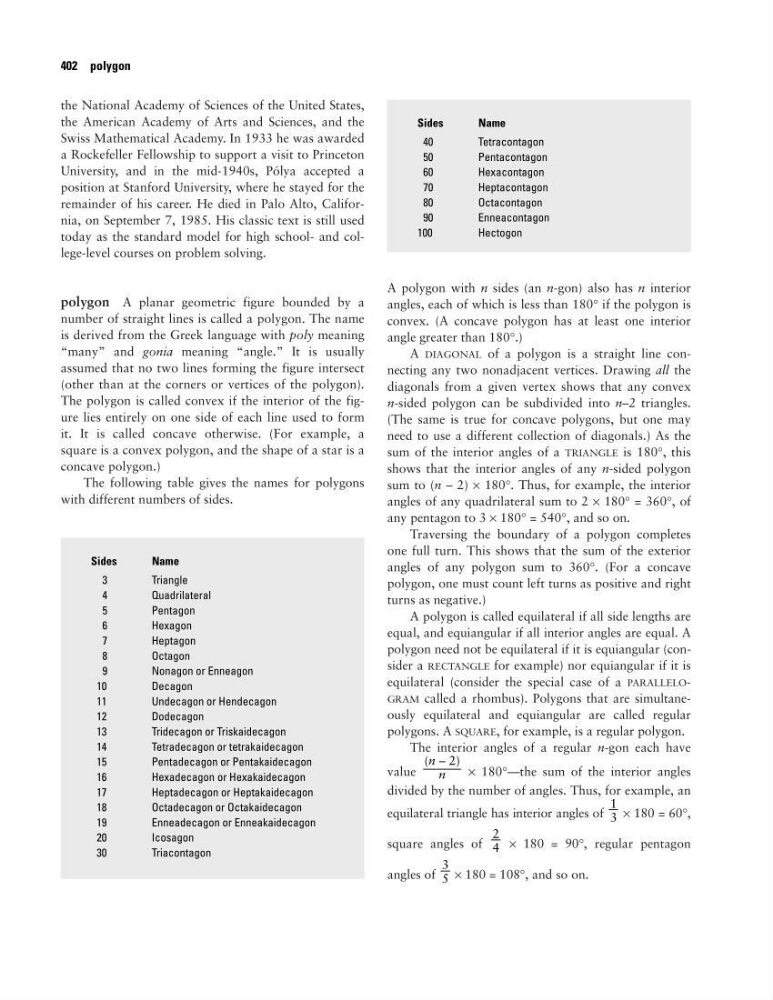
The following table gives the names for polygons
with different numbers of sides.
A polygon with n sides (an n-gon) also has n interior
angles, each of which is less than 180° if the polygon is
convex. (A concave polygon has at least one interior
angle greater than 180°.)
A DIAGONAL of a polygon is a straight line connecting any two nonadjacent vertices. Drawing all the
diagonals from a given vertex shows that any convex
n-sided polygon can be subdivided into n–2 triangles.
(The same is true for concave polygons, but one may
need to use a different collection of diagonals.) As the
sum of the interior angles of a TRIANGLE is 180°, this
shows that the interior angles of any n-sided polygon
sum to (n – 2) × 180°. Thus, for example, the interior
angles of any quadrilateral sum to 2 × 180° = 360°, of
any pentagon to 3 × 180° = 540°, and so on.
Traversing the boundary of a polygon completes
one full turn. This shows that the sum of the exterior
angles of any polygon sum to 360°. (For a concave
polygon, one must count left turns as positive and right
turns as negative.)
A polygon is called equilateral if all side lengths are
equal, and equiangular if all interior angles are equal. A
polygon need not be equilateral if it is equiangular (consider a RECTANGLE for example) nor equiangular if it is
equilateral (consider the special case of a PARALLELOGRAM called a rhombus). Polygons that are simultaneously equilateral and equiangular are called regular
polygons. A SQUARE, for example, is a regular polygon.
The interior angles of a regular n-gon each have
value
× 180°—the sum of the interior angles
divided by the number of angles. Thus, for example, an
equilateral triangle has interior angles of
× 180 = 60°,
square angles of
× 180 = 90°, regular pentagon
angles of
× 180 = 108°, and so on.
3
–
5
2
–
4
1
–
3
(n – 2)
——— n
402 polygon
Sides
Name
3
Triangle
4
Quadrilateral
5
Pentagon
6
Hexagon
7
Heptagon
8
Octagon
9
Nonagon or Enneagon
10
Decagon
11
Undecagon or Hendecagon
12
Dodecagon
13
Tridecagon or Triskaidecagon
14
Tetradecagon or tetrakaidecagon
15
Pentadecagon or Pentakaidecagon
16
Hexadecagon or Hexakaidecagon
17
Heptadecagon or Heptakaidecagon
18
Octadecagon or Octakaidecagon
19
Enneadecagon or Enneakaidecagon
20
Icosagon
30
Triacontagon
Sides
Name
40
Tetracontagon
50
Pentacontagon
60
Hexacontagon
70
Heptacontagon
80
Octacontagon
90
Enneacontagon
100
Hectogon
the American Academy of Arts and Sciences, and the
Swiss Mathematical Academy. In 1933 he was awarded
a Rockefeller Fellowship to support a visit to Princeton
University, and in the mid-1940s, Pólya accepted a
position at Stanford University, where he stayed for the
remainder of his career. He died in Palo Alto, California, on September 7, 1985. His classic text is still used
today as the standard model for high school- and college-level courses on problem solving.
polygon A planar geometric figure bounded by a
number of straight lines is called a polygon. The name
is derived from the Greek language with poly meaning
“many” and gonia meaning “angle.” It is usually
assumed that no two lines forming the figure intersect
(other than at the corners or vertices of the polygon).
The polygon is called convex if the interior of the figure lies entirely on one side of each line used to form
it. It is called concave otherwise. (For example, a
square is a convex polygon, and the shape of a star is a
concave polygon.)
The following table gives the names for polygons
with different numbers of sides.
A polygon with n sides (an n-gon) also has n interior
angles, each of which is less than 180° if the polygon is
convex. (A concave polygon has at least one interior
angle greater than 180°.)
A DIAGONAL of a polygon is a straight line connecting any two nonadjacent vertices. Drawing all the
diagonals from a given vertex shows that any convex
n-sided polygon can be subdivided into n–2 triangles.
(The same is true for concave polygons, but one may
need to use a different collection of diagonals.) As the
sum of the interior angles of a TRIANGLE is 180°, this
shows that the interior angles of any n-sided polygon
sum to (n – 2) × 180°. Thus, for example, the interior
angles of any quadrilateral sum to 2 × 180° = 360°, of
any pentagon to 3 × 180° = 540°, and so on.
Traversing the boundary of a polygon completes
one full turn. This shows that the sum of the exterior
angles of any polygon sum to 360°. (For a concave
polygon, one must count left turns as positive and right
turns as negative.)
A polygon is called equilateral if all side lengths are
equal, and equiangular if all interior angles are equal. A
polygon need not be equilateral if it is equiangular (consider a RECTANGLE for example) nor equiangular if it is
equilateral (consider the special case of a PARALLELOGRAM called a rhombus). Polygons that are simultaneously equilateral and equiangular are called regular
polygons. A SQUARE, for example, is a regular polygon.
The interior angles of a regular n-gon each have
value
× 180°—the sum of the interior angles
divided by the number of angles. Thus, for example, an
equilateral triangle has interior angles of
× 180 = 60°,
square angles of
× 180 = 90°, regular pentagon
angles of
× 180 = 108°, and so on.
3
–
5
2
–
4
1
–
3
(n – 2)
——— n
402 polygon
Sides
Name
3
Triangle
4
Quadrilateral
5
Pentagon
6
Hexagon
7
Heptagon
8
Octagon
9
Nonagon or Enneagon
10
Decagon
11
Undecagon or Hendecagon
12
Dodecagon
13
Tridecagon or Triskaidecagon
14
Tetradecagon or tetrakaidecagon
15
Pentadecagon or Pentakaidecagon
16
Hexadecagon or Hexakaidecagon
17
Heptadecagon or Heptakaidecagon
18
Octadecagon or Octakaidecagon
19
Enneadecagon or Enneakaidecagon
20
Icosagon
30
Triacontagon
Sides
Name
40
Tetracontagon
50
Pentacontagon
60
Hexacontagon
70
Heptacontagon
80
Octacontagon
90
Enneacontagon
100
Hectogon