

to represent an (“imaginary”) solution to the equation
x
2 + 1 = 0, the COMPLEX NUMBERS C are born. Surprisingly, as shown by the FUNDAMENTAL THEOREM OF
ALGEBRA, the introduction of this single number is all
that is needed to solve any POLYNOMIAL equation a n x
n
+…+ a 1 x + a 0 = 0. Thus the complex numbers represent
a system of numbers that is algebraically closed in the
sense that the construction of no new type of number is
needed to solve arithmetic equations.
On a conceptual level, the notion of “number” is
intimately connected with the act of counting. Simple
counting systems of ancient times used tally marks to
record numbers, and over the millennia this basic
numeration scheme evolved to the sophisticated PLACEVALUE SYSTEM we use today. (The ancient Egyptians of
around 3000 B.C.E. were perhaps the first to move
from the use of tally marks alone.) It was a great intellectual achievement for mankind when the notion of
“number” was removed from the specific objects being
counted, recognizing, for instance, that two cows, two
houses, and two days all share a common property of
“two-ness.” (Even today we sometimes use different
words to count different types of “two.” For instance,
the words twins, couple, and pair cannot be used interchangeably to represent two people.) This simple recognition of an abstract commonality between sets of
objects was exploited by German mathematician
GEORG CANTOR (1845–1918) who, in the late 1800s,
developed a general notion of CARDINALITY. With it,
Cantor extended the notion of “number” to include
counts of sets of infinite size. He established, for
instance, that there are an infinite number of different
types of infinity and managed to develop a meaningful
system of arithmetic for his transfinite numbers.
Irish mathematician SIR WILLIAM ROWAN HAMILTON (1805–65) followed a different route and worked
to extend the notion of “number” to represent operations on n-dimensional space. AN ARGAND DIAGRAM
shows that the complex numbers have a natural representation as points on a plane. Hamilton sought to give
meaning to an arithmetic for points in three- and
higher-dimensional space. Although he did not succeed
in accomplishing this goal for three-dimensional space,
his invention of the QUATERNIONS shows this feat can
be done in four-dimensional space. (The octonions provide an arithmetic for eight-dimensional space.)
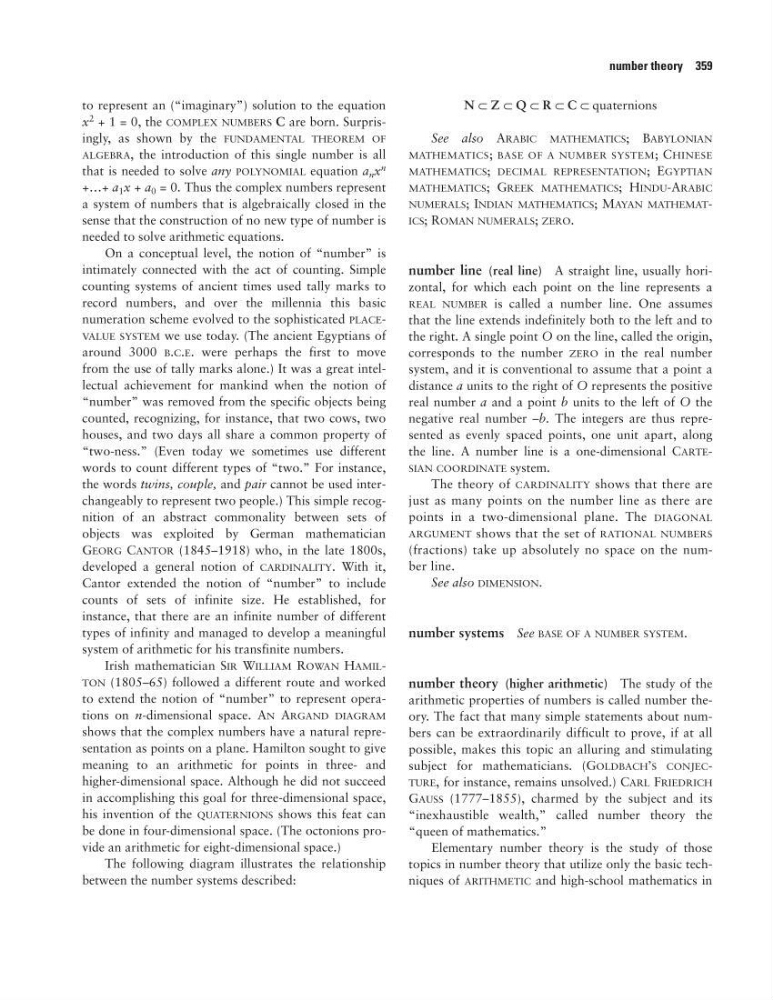
The following diagram illustrates the relationship
between the number systems described:
N ⊂ Z ⊂ Q ⊂ R ⊂ C ⊂ quaternions
See also ARABIC MATHEMATICS; BABYLONIAN
MATHEMATICS; BASE OF A NUMBER SYSTEM; CHINESE
MATHEMATICS; DECIMAL REPRESENTATION; EGYPTIAN
MATHEMATICS; GREEK MATHEMATICS; HINDU-ARABIC
NUMERALS; INDIAN MATHEMATICS; MAYAN MATHEMATICS; ROMAN NUMERALS; ZERO.
number line (real line) A straight line, usually horizontal, for which each point on the line represents a
REAL NUMBER is called a number line. One assumes
that the line extends indefinitely both to the left and to
the right. A single point O on the line, called the origin,
corresponds to the number ZERO in the real number
system, and it is conventional to assume that a point a
distance a units to the right of O represents the positive
real number a and a point b units to the left of O the
negative real number –b. The integers are thus represented as evenly spaced points, one unit apart, along
the line. A number line is a one-dimensional CARTESIAN COORDINATE system.
The theory of CARDINALITY shows that there are
just as many points on the number line as there are
points in a two-dimensional plane. The DIAGONAL
ARGUMENT shows that the set of RATIONAL NUMBERS
(fractions) take up absolutely no space on the number line.
See also DIMENSION.
number systems See BASE OF A NUMBER SYSTEM.
number theory (higher arithmetic) The study of the
arithmetic properties of numbers is called number theory. The fact that many simple statements about numbers can be extraordinarily difficult to prove, if at all
possible, makes this topic an alluring and stimulating
subject for mathematicians. (GOLDBACH’S CONJECTURE, for instance, remains unsolved.) CARL FRIEDRICH
GAUSS (1777–1855), charmed by the subject and its
“inexhaustible wealth,” called number theory the
“queen of mathematics.”
Elementary number theory is the study of those
topics in number theory that utilize only the basic techniques of ARITHMETIC and high-school mathematics in
number theory 359
x
2 + 1 = 0, the COMPLEX NUMBERS C are born. Surprisingly, as shown by the FUNDAMENTAL THEOREM OF
ALGEBRA, the introduction of this single number is all
that is needed to solve any POLYNOMIAL equation a n x
n
+…+ a 1 x + a 0 = 0. Thus the complex numbers represent
a system of numbers that is algebraically closed in the
sense that the construction of no new type of number is
needed to solve arithmetic equations.
On a conceptual level, the notion of “number” is
intimately connected with the act of counting. Simple
counting systems of ancient times used tally marks to
record numbers, and over the millennia this basic
numeration scheme evolved to the sophisticated PLACEVALUE SYSTEM we use today. (The ancient Egyptians of
around 3000 B.C.E. were perhaps the first to move
from the use of tally marks alone.) It was a great intellectual achievement for mankind when the notion of
“number” was removed from the specific objects being
counted, recognizing, for instance, that two cows, two
houses, and two days all share a common property of
“two-ness.” (Even today we sometimes use different
words to count different types of “two.” For instance,
the words twins, couple, and pair cannot be used interchangeably to represent two people.) This simple recognition of an abstract commonality between sets of
objects was exploited by German mathematician
GEORG CANTOR (1845–1918) who, in the late 1800s,
developed a general notion of CARDINALITY. With it,
Cantor extended the notion of “number” to include
counts of sets of infinite size. He established, for
instance, that there are an infinite number of different
types of infinity and managed to develop a meaningful
system of arithmetic for his transfinite numbers.
Irish mathematician SIR WILLIAM ROWAN HAMILTON (1805–65) followed a different route and worked
to extend the notion of “number” to represent operations on n-dimensional space. AN ARGAND DIAGRAM
shows that the complex numbers have a natural representation as points on a plane. Hamilton sought to give
meaning to an arithmetic for points in three- and
higher-dimensional space. Although he did not succeed
in accomplishing this goal for three-dimensional space,
his invention of the QUATERNIONS shows this feat can
be done in four-dimensional space. (The octonions provide an arithmetic for eight-dimensional space.)
The following diagram illustrates the relationship
between the number systems described:
N ⊂ Z ⊂ Q ⊂ R ⊂ C ⊂ quaternions
See also ARABIC MATHEMATICS; BABYLONIAN
MATHEMATICS; BASE OF A NUMBER SYSTEM; CHINESE
MATHEMATICS; DECIMAL REPRESENTATION; EGYPTIAN
MATHEMATICS; GREEK MATHEMATICS; HINDU-ARABIC
NUMERALS; INDIAN MATHEMATICS; MAYAN MATHEMATICS; ROMAN NUMERALS; ZERO.
number line (real line) A straight line, usually horizontal, for which each point on the line represents a
REAL NUMBER is called a number line. One assumes
that the line extends indefinitely both to the left and to
the right. A single point O on the line, called the origin,
corresponds to the number ZERO in the real number
system, and it is conventional to assume that a point a
distance a units to the right of O represents the positive
real number a and a point b units to the left of O the
negative real number –b. The integers are thus represented as evenly spaced points, one unit apart, along
the line. A number line is a one-dimensional CARTESIAN COORDINATE system.
The theory of CARDINALITY shows that there are
just as many points on the number line as there are
points in a two-dimensional plane. The DIAGONAL
ARGUMENT shows that the set of RATIONAL NUMBERS
(fractions) take up absolutely no space on the number line.
See also DIMENSION.
number systems See BASE OF A NUMBER SYSTEM.
number theory (higher arithmetic) The study of the
arithmetic properties of numbers is called number theory. The fact that many simple statements about numbers can be extraordinarily difficult to prove, if at all
possible, makes this topic an alluring and stimulating
subject for mathematicians. (GOLDBACH’S CONJECTURE, for instance, remains unsolved.) CARL FRIEDRICH
GAUSS (1777–1855), charmed by the subject and its
“inexhaustible wealth,” called number theory the
“queen of mathematics.”
Elementary number theory is the study of those
topics in number theory that utilize only the basic techniques of ARITHMETIC and high-school mathematics in
number theory 359