

Napier, John (Jhone Neper) (1550–1617) British Logarithms Born in Edinburgh, Scotland, in 1550 (his exact
birth date is not known), John Napier is remembered in
mathematics for his work on TRIGONOMETRY and methods of computation, most notably for his invention of
LOGARITHMs.
As was usual at the time, Napier entered the St.
Andrew’s University in 1563 at the age of 13. It is
unlikely that Napier studied mathematics at this institution, and historians today are unsure by what
means he acquired a working knowledge of the subject. Napier took an active interest in theology and
published a number of important works on the role of
religion in society. His study of mathematics was only
ever a hobby.
Napier was aware that astronomers at his time
were hampered by the difficulty of doing large computations by hand, in particular, computing the products
of very large numbers. He sought for a method that
would simplify the process. Using the curious geometrical model of an object moving along a straight segment
of unit length with speed varying according to its distance from the endpoint, Napier found a formula that
converted problems of multiplication into simpler computations of addition. Today we would say that Napier
worked with the formula:
N
L
=
−
10 1
1
10
7
7
345
N
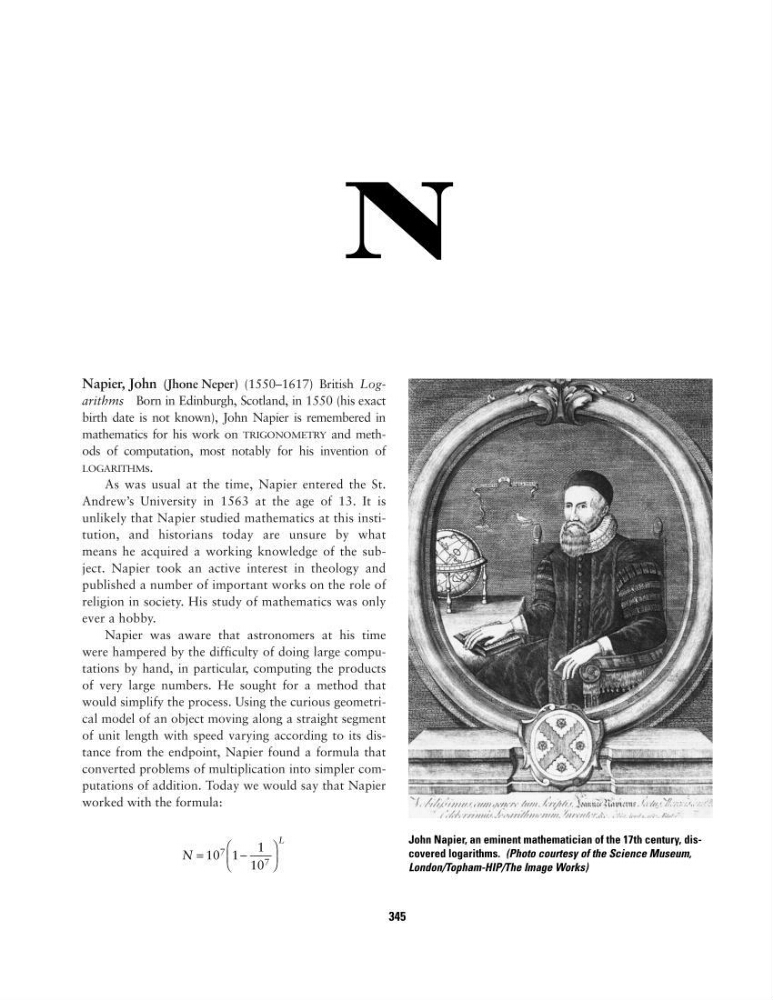
John Napier, an eminent mathematician of the 17th century, discovered logarithms. (Photo courtesy of the Science Museum,
London/Topham-HIP/The Image Works)
birth date is not known), John Napier is remembered in
mathematics for his work on TRIGONOMETRY and methods of computation, most notably for his invention of
LOGARITHMs.
As was usual at the time, Napier entered the St.
Andrew’s University in 1563 at the age of 13. It is
unlikely that Napier studied mathematics at this institution, and historians today are unsure by what
means he acquired a working knowledge of the subject. Napier took an active interest in theology and
published a number of important works on the role of
religion in society. His study of mathematics was only
ever a hobby.
Napier was aware that astronomers at his time
were hampered by the difficulty of doing large computations by hand, in particular, computing the products
of very large numbers. He sought for a method that
would simplify the process. Using the curious geometrical model of an object moving along a straight segment
of unit length with speed varying according to its distance from the endpoint, Napier found a formula that
converted problems of multiplication into simpler computations of addition. Today we would say that Napier
worked with the formula:
N
L
=
−
10 1
1
10
7
7
345
N
John Napier, an eminent mathematician of the 17th century, discovered logarithms. (Photo courtesy of the Science Museum,
London/Topham-HIP/The Image Works)