

COMMUTATIVE PROPERTY: a × b = b × a for all counting numbers a and b.
If a number a is multiplied by a number b to form
a product a × b, then the first number a is called a
multiplicand and the second number b a multiplier.
(Of course, the commutative property of multiplication obviates the need to distinguish the multiplicand
from the multiplier.)
The symbol × for multiplication was used in
WILLIAM OUGHTRED’S (1574–1660) 1631 work Clavis
mathematicae (The key to mathematics), but historians
suspect that the symbol was in use up to 100 years earlier. Mathematicians today also use a raised dot to indicate multiplication (4 · 3 = 12, for instance), or they
simply write symbols side by side if variables are being
used (x × y = xy or 2 × w = 2w, for example).
There are a number of methods for computing the
product of two large numbers, such as ELIZABETHAN
MULTIPLICATION, EGYPTIAN MULTIPLICATION, and RUSSIAN MULTIPLICATION.
The process of multiplication can be extended to
NEGATIVE NUMBERS (yielding the necessary consequence
that the product of two negative quantities is positive),
FRACTIONs, REAL NUMBERS, COMPLEX NUMBERS, and
MATRIXes. Two VECTORs can be multiplied by a DOT
PRODUCT or a CROSS PRODUCT. The product of two sets
is called a CARTESIAN PRODUCT.
The number 1 is a multiplicative IDENTITY ELEMENT in the theory of arithmetic. We have that a × 1 =
a = 1 × a for any number a.
The product of two real-valued functions f and g
is the function f · g, whose value at any input x is the
product of the outputs of f and g at that input value:
(f · g)(x) = f(x) · g(x). For example, if f(x) = x
2 + 2x
and g(x) = 5x + 7, then (f · g)(x) = (x
2 + 2x)(5x + 7) =
5x
3 + 17x
2 + 14x.
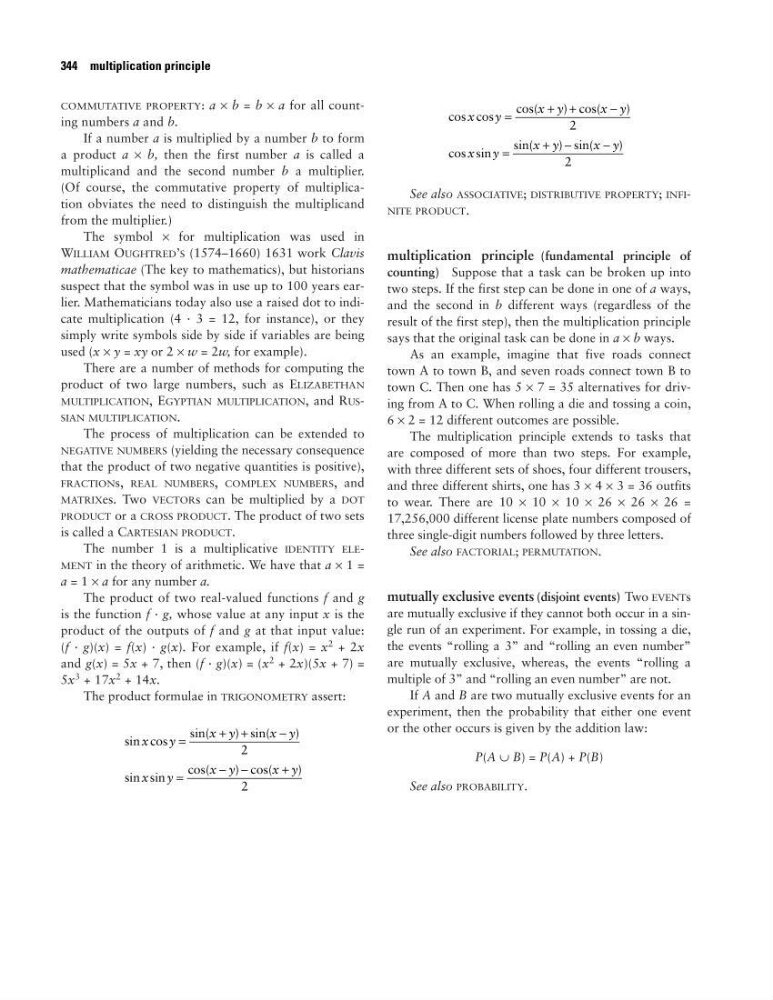
The product formulae in TRIGONOMETRY assert:
See also ASSOCIATIVE; DISTRIBUTIVE PROPERTY; INFINITE PRODUCT.
multiplication principle (fundamental principle of
counting) Suppose that a task can be broken up into
two steps. If the first step can be done in one of a ways,
and the second in b different ways (regardless of the
result of the first step), then the multiplication principle
says that the original task can be done in a × b ways.
As an example, imagine that five roads connect
town A to town B, and seven roads connect town B to
town C. Then one has 5 × 7 = 35 alternatives for driving from A to C. When rolling a die and tossing a coin,
6 × 2 = 12 different outcomes are possible.
The multiplication principle extends to tasks that
are composed of more than two steps. For example,
with three different sets of shoes, four different trousers,
and three different shirts, one has 3 × 4 × 3 = 36 outfits
to wear. There are 10 × 10 × 10 × 26 × 26 × 26 =
17,256,000 different license plate numbers composed of
three single-digit numbers followed by three letters.
See also FACTORIAL; PERMUTATION.
mutually exclusive events (disjoint events) Two EVENTs
are mutually exclusive if they cannot both occur in a single run of an experiment. For example, in tossing a die,
the events “rolling a 3” and “rolling an even number”
are mutually exclusive, whereas, the events “rolling a
multiple of 3” and “rolling an even number” are not.
If A and B are two mutually exclusive events for an
experiment, then the probability that either one event
or the other occurs is given by the addition law:
P(A ∪ B) = P(A) + P(B)
See also PROBABILITY.
cos cos
cos(
) cos(
)
cos sin
sin(
) sin(
)
x
y
x y
x y
x y
x y
x y
=
+ +
−
=
+ −
−
2
2
sin cos
sin(
) sin(
)
sin sin
cos(
) cos(
)
x
y
x y
x y
x y
x y
x y
=
+ +
−
=
− −
+
2
2
344 multiplication principle
If a number a is multiplied by a number b to form
a product a × b, then the first number a is called a
multiplicand and the second number b a multiplier.
(Of course, the commutative property of multiplication obviates the need to distinguish the multiplicand
from the multiplier.)
The symbol × for multiplication was used in
WILLIAM OUGHTRED’S (1574–1660) 1631 work Clavis
mathematicae (The key to mathematics), but historians
suspect that the symbol was in use up to 100 years earlier. Mathematicians today also use a raised dot to indicate multiplication (4 · 3 = 12, for instance), or they
simply write symbols side by side if variables are being
used (x × y = xy or 2 × w = 2w, for example).
There are a number of methods for computing the
product of two large numbers, such as ELIZABETHAN
MULTIPLICATION, EGYPTIAN MULTIPLICATION, and RUSSIAN MULTIPLICATION.
The process of multiplication can be extended to
NEGATIVE NUMBERS (yielding the necessary consequence
that the product of two negative quantities is positive),
FRACTIONs, REAL NUMBERS, COMPLEX NUMBERS, and
MATRIXes. Two VECTORs can be multiplied by a DOT
PRODUCT or a CROSS PRODUCT. The product of two sets
is called a CARTESIAN PRODUCT.
The number 1 is a multiplicative IDENTITY ELEMENT in the theory of arithmetic. We have that a × 1 =
a = 1 × a for any number a.
The product of two real-valued functions f and g
is the function f · g, whose value at any input x is the
product of the outputs of f and g at that input value:
(f · g)(x) = f(x) · g(x). For example, if f(x) = x
2 + 2x
and g(x) = 5x + 7, then (f · g)(x) = (x
2 + 2x)(5x + 7) =
5x
3 + 17x
2 + 14x.
The product formulae in TRIGONOMETRY assert:
See also ASSOCIATIVE; DISTRIBUTIVE PROPERTY; INFINITE PRODUCT.
multiplication principle (fundamental principle of
counting) Suppose that a task can be broken up into
two steps. If the first step can be done in one of a ways,
and the second in b different ways (regardless of the
result of the first step), then the multiplication principle
says that the original task can be done in a × b ways.
As an example, imagine that five roads connect
town A to town B, and seven roads connect town B to
town C. Then one has 5 × 7 = 35 alternatives for driving from A to C. When rolling a die and tossing a coin,
6 × 2 = 12 different outcomes are possible.
The multiplication principle extends to tasks that
are composed of more than two steps. For example,
with three different sets of shoes, four different trousers,
and three different shirts, one has 3 × 4 × 3 = 36 outfits
to wear. There are 10 × 10 × 10 × 26 × 26 × 26 =
17,256,000 different license plate numbers composed of
three single-digit numbers followed by three letters.
See also FACTORIAL; PERMUTATION.
mutually exclusive events (disjoint events) Two EVENTs
are mutually exclusive if they cannot both occur in a single run of an experiment. For example, in tossing a die,
the events “rolling a 3” and “rolling an even number”
are mutually exclusive, whereas, the events “rolling a
multiple of 3” and “rolling an even number” are not.
If A and B are two mutually exclusive events for an
experiment, then the probability that either one event
or the other occurs is given by the addition law:
P(A ∪ B) = P(A) + P(B)
See also PROBABILITY.
cos cos
cos(
) cos(
)
cos sin
sin(
) sin(
)
x
y
x y
x y
x y
x y
x y
=
+ +
−
=
+ −
−
2
2
sin cos
sin(
) sin(
)
sin sin
cos(
) cos(
)
x
y
x y
x y
x y
x y
x y
=
+ +
−
=
− −
+
2
2
344 multiplication principle