

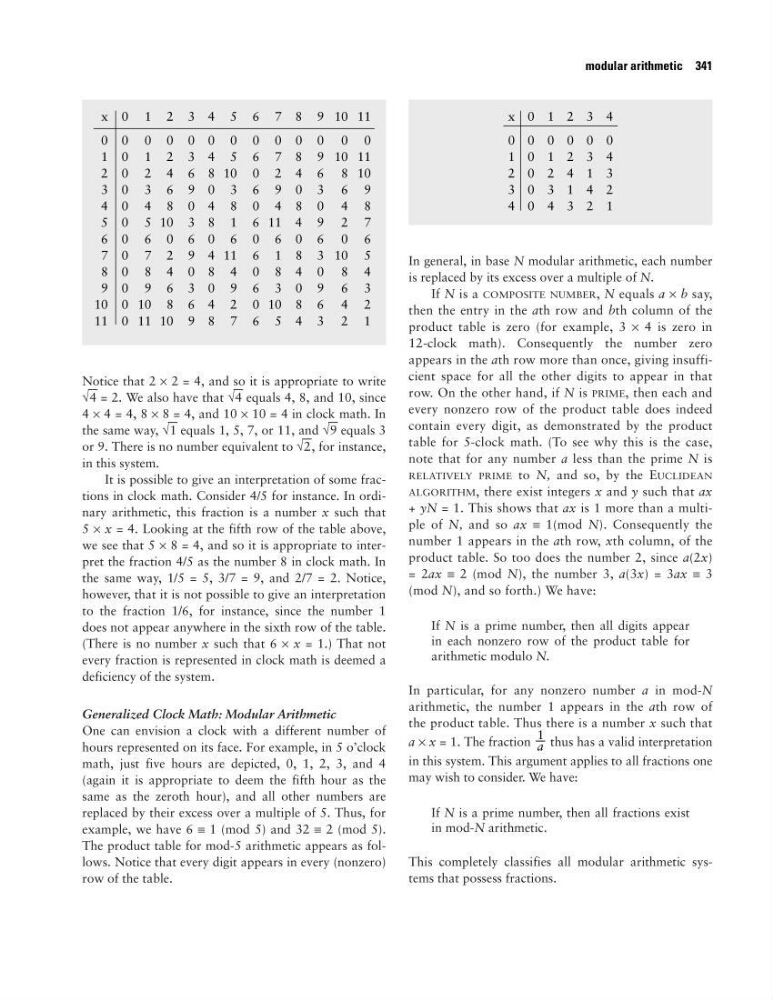
Notice that 2 × 2 = 4, and so it is appropriate to write
√
–
4 = 2. We also have that √
–
4 equals 4, 8, and 10, since
4 × 4 = 4, 8 × 8 = 4, and 10 × 10 = 4 in clock math. In
the same way, √
–
1 equals 1, 5, 7, or 11, and √
–
9 equals 3
or 9. There is no number equivalent to √
–
2, for instance,
in this system.
It is possible to give an interpretation of some fractions in clock math. Consider 4/5 for instance. In ordinary arithmetic, this fraction is a number x such that
5 × x = 4. Looking at the fifth row of the table above,
we see that 5 × 8 = 4, and so it is appropriate to interpret the fraction 4/5 as the number 8 in clock math. In
the same way, 1/5 = 5, 3/7 = 9, and 2/7 = 2. Notice,
however, that it is not possible to give an interpretation
to the fraction 1/6, for instance, since the number 1
does not appear anywhere in the sixth row of the table.
(There is no number x such that 6 × x = 1.) That not
every fraction is represented in clock math is deemed a
deficiency of the system.
Generalized Clock Math: Modular Arithmetic
One can envision a clock with a different number of
hours represented on its face. For example, in 5 o’clock
math, just five hours are depicted, 0, 1, 2, 3, and 4
(again it is appropriate to deem the fifth hour as the
same as the zeroth hour), and all other numbers are
replaced by their excess over a multiple of 5. Thus, for
example, we have 6 ≡ 1 (mod 5) and 32 ≡ 2 (mod 5).
The product table for mod-5 arithmetic appears as follows. Notice that every digit appears in every (nonzero)
row of the table.
In general, in base N modular arithmetic, each number
is replaced by its excess over a multiple of N.
If N is a COMPOSITE NUMBER, N equals a × b say,
then the entry in the ath row and bth column of the
product table is zero (for example, 3 × 4 is zero in
12-clock math). Consequently the number zero
appears in the ath row more than once, giving insufficient space for all the other digits to appear in that
row. On the other hand, if N is PRIME, then each and
every nonzero row of the product table does indeed
contain every digit, as demonstrated by the product
table for 5-clock math. (To see why this is the case,
note that for any number a less than the prime N is
RELATIVELY PRIME to N, and so, by the EUCLIDEAN
ALGORITHM, there exist integers x and y such that ax
+ yN = 1. This shows that ax is 1 more than a multiple of N, and so ax ≡ 1(mod N). Consequently the
number 1 appears in the ath row, xth column, of the
product table. So too does the number 2, since a(2x)
= 2ax ≡ 2 (mod N), the number 3, a(3x) = 3ax ≡ 3
(mod N), and so forth.) We have:
If N is a prime number, then all digits appear
in each nonzero row of the product table for
arithmetic modulo N.
In particular, for any nonzero number a in mod-N
arithmetic, the number 1 appears in the ath row of
the product table. Thus there is a number x such that
a × x = 1. The fraction
thus has a valid interpretation
in this system. This argument applies to all fractions one
may wish to consider. We have:
If N is a prime number, then all fractions exist
in mod-N arithmetic.
This completely classifies all modular arithmetic systems that possess fractions.
1
– a
modular arithmetic 341
x 0 1 2 3 4 5 6 7 8 9 10 11
0 0 0 0 0 0 0 0 0 0 0 0 0
1 0 1 2 3 4 5 6 7 8 9 10 11
2 0 2 4 6 8 10 0 2 4 6 8 10
3 0 3 6 9 0 3 6 9 0 3 6 9
4 0 4 8 0 4 8 0 4 8 0 4 8
5 0 5 10 3 8 1 6 11 4 9 2 7
6 0 6 0 6 0 6 0 6 0 6 0 6
7 0 7 2 9 4 11 6 1 8 3 10 5
8 0 8 4 0 8 4 0 8 4 0 8 4
9 0 9 6 3 0 9 6 3 0 9 6 3
10 0 10 8 6 4 2 0 10 8 6 4 2
11 0 11 10 9 8 7 6 5 4 3 2 1
x 0 1 2 3 4
0 0 0 0 0 0
1 0 1 2 3 4
2 0 2 4 1 3
3 0 3 1 4 2
4 0 4 3 2 1
√
–
4 = 2. We also have that √
–
4 equals 4, 8, and 10, since
4 × 4 = 4, 8 × 8 = 4, and 10 × 10 = 4 in clock math. In
the same way, √
–
1 equals 1, 5, 7, or 11, and √
–
9 equals 3
or 9. There is no number equivalent to √
–
2, for instance,
in this system.
It is possible to give an interpretation of some fractions in clock math. Consider 4/5 for instance. In ordinary arithmetic, this fraction is a number x such that
5 × x = 4. Looking at the fifth row of the table above,
we see that 5 × 8 = 4, and so it is appropriate to interpret the fraction 4/5 as the number 8 in clock math. In
the same way, 1/5 = 5, 3/7 = 9, and 2/7 = 2. Notice,
however, that it is not possible to give an interpretation
to the fraction 1/6, for instance, since the number 1
does not appear anywhere in the sixth row of the table.
(There is no number x such that 6 × x = 1.) That not
every fraction is represented in clock math is deemed a
deficiency of the system.
Generalized Clock Math: Modular Arithmetic
One can envision a clock with a different number of
hours represented on its face. For example, in 5 o’clock
math, just five hours are depicted, 0, 1, 2, 3, and 4
(again it is appropriate to deem the fifth hour as the
same as the zeroth hour), and all other numbers are
replaced by their excess over a multiple of 5. Thus, for
example, we have 6 ≡ 1 (mod 5) and 32 ≡ 2 (mod 5).
The product table for mod-5 arithmetic appears as follows. Notice that every digit appears in every (nonzero)
row of the table.
In general, in base N modular arithmetic, each number
is replaced by its excess over a multiple of N.
If N is a COMPOSITE NUMBER, N equals a × b say,
then the entry in the ath row and bth column of the
product table is zero (for example, 3 × 4 is zero in
12-clock math). Consequently the number zero
appears in the ath row more than once, giving insufficient space for all the other digits to appear in that
row. On the other hand, if N is PRIME, then each and
every nonzero row of the product table does indeed
contain every digit, as demonstrated by the product
table for 5-clock math. (To see why this is the case,
note that for any number a less than the prime N is
RELATIVELY PRIME to N, and so, by the EUCLIDEAN
ALGORITHM, there exist integers x and y such that ax
+ yN = 1. This shows that ax is 1 more than a multiple of N, and so ax ≡ 1(mod N). Consequently the
number 1 appears in the ath row, xth column, of the
product table. So too does the number 2, since a(2x)
= 2ax ≡ 2 (mod N), the number 3, a(3x) = 3ax ≡ 3
(mod N), and so forth.) We have:
If N is a prime number, then all digits appear
in each nonzero row of the product table for
arithmetic modulo N.
In particular, for any nonzero number a in mod-N
arithmetic, the number 1 appears in the ath row of
the product table. Thus there is a number x such that
a × x = 1. The fraction
thus has a valid interpretation
in this system. This argument applies to all fractions one
may wish to consider. We have:
If N is a prime number, then all fractions exist
in mod-N arithmetic.
This completely classifies all modular arithmetic systems that possess fractions.
1
– a
modular arithmetic 341
x 0 1 2 3 4 5 6 7 8 9 10 11
0 0 0 0 0 0 0 0 0 0 0 0 0
1 0 1 2 3 4 5 6 7 8 9 10 11
2 0 2 4 6 8 10 0 2 4 6 8 10
3 0 3 6 9 0 3 6 9 0 3 6 9
4 0 4 8 0 4 8 0 4 8 0 4 8
5 0 5 10 3 8 1 6 11 4 9 2 7
6 0 6 0 6 0 6 0 6 0 6 0 6
7 0 7 2 9 4 11 6 1 8 3 10 5
8 0 8 4 0 8 4 0 8 4 0 8 4
9 0 9 6 3 0 9 6 3 0 9 6 3
10 0 10 8 6 4 2 0 10 8 6 4 2
11 0 11 10 9 8 7 6 5 4 3 2 1
x 0 1 2 3 4
0 0 0 0 0 0
1 0 1 2 3 4
2 0 2 4 1 3
3 0 3 1 4 2
4 0 4 3 2 1