

can also obtain a Klein bottle by “folding” a Möbius
band in half along the central line parallel to its edge and
gluing together the points of the edge that meet. (If one
does this for an ordinary band of paper containing no
half twists, the resulting surface is a TORUS.) Unfortunately these constructions cannot be fully completed in
three-dimensional space, and one must make use of the
fourth dimension to obtain sufficient maneuverability.
In a CARTESIAN COORDINATE system, if one rotates
a line segment in the yz-plane about the z-axis, the
resulting surface of revolution is a band with no halftwists. If that line segment were to rotate about its MIDPOINT 180° during the course of being rotated about the
z-axis, then the resulting surface is a Möbius band. For
convenience, suppose the line segment is of length 2 and
is initially positioned in the yz-plane parallel to the zaxis with midpoint at distance position 2 along the yaxis. Each point on the line segment is determined by a
parameter v, between –1 and 1, with v = 0 corresponding to the midpoint of the segment. Suppose that when
the segment has turned an angle θ about the z-axis, the
segment has turned an angle
about its midpoint.
Then a careful analysis of the positions of points along
this segment as they are rotated about the z-axis shows
that the PARAMETRIC EQUATIONS of the resulting Möbius
band are given by:
Mathematicians have shown that, for any map of
regions drawn on a Möbius band, at most six colors
would ever be needed to paint the design so that no two
regions sharing a boundary are painted the same color.
The Möbius band was independently discovered
by German mathematician Johann Listing (1808–88)
and German scholar AUGUST FERDINAND MÖBIUS
(1790–1868). The one-sided nature of the band was
later exploited by the B.F. Goodrich Company in their
design of Möbius-like conveyor belts. By spreading the
“wear and tear” on both sides of a strip, these belts
lasted twice as long as conventional belts.
See also DIMENSION; FOUR-COLOR THEOREM; SOLID
OF REVOLUTION.
mode See STATISTICS: DESCRIPTIVE.
modular arithmetic The numerals on the face of a
clock provide a model for an unusual mathematical
system called “clock math” or “arithmetic mod 12.”
One thinks as follows: if it is currently 3:00, then 8
hours later it will be 11:00. We write 3 + 8 = 11, noting
nothing unusual here. However, waiting 6 hours from
10:00, say, gives the equation 10 + 6 = 4, for the time
at the end of that wait will be 4:00. Following this new
interpretation for addition, clock math gives, for example, 4 + 11 = 3, 8 + 2 = 10, and 7 + 7 = 2.
It is convenient to call the number 12 “zero.”
(After all, in clock math, adding 12 hours to any time
does not change the time registered on the clock and so
has no effect in this system.) The number 13 is
regarded the same as 1, (the 13th hour on a clock lies
at the same position as the first hour), the number 14 is
2, and so forth. In general, clock math replaces any
number with its excess over a multiple of 12. For
example, 26 is two more than a multiple of 12, and so
26 is equivalent to 2. We write 26 ≡ 2 (mod 12). Similarly, 29 ≡ 5 (mod 12), 43 ≡ 7 (mod 12), and 72 ≡ 0
(mod 12). The number –2 is 10 more than a multiple of
12 and so –2 ≡ 10 (mod 12). The symbol ≡ is called
CONGRUENCE.
One can perform multiplication in clock math. We
have, for instance, that 3 × 7, normally 21, equals 9 in
clock math: 3 × 7 = 9. (This can also be realized in
terms of repeated addition: 3 × 7 = 7 + 7 + 7 = 2 + 7
= 9.) In the same way, 2 × 4 = 8, 4 × 5 = 8, and 6 × 6 =
0 in clock math. The following table shows all products in this system.
x
v
y
v
z v
= −
( )
= −
( )
=
2
2
2
2
2
sin
sin
sin
cos
cos
θ
θ
θ
θ
θ
θ
–
2
340 mode
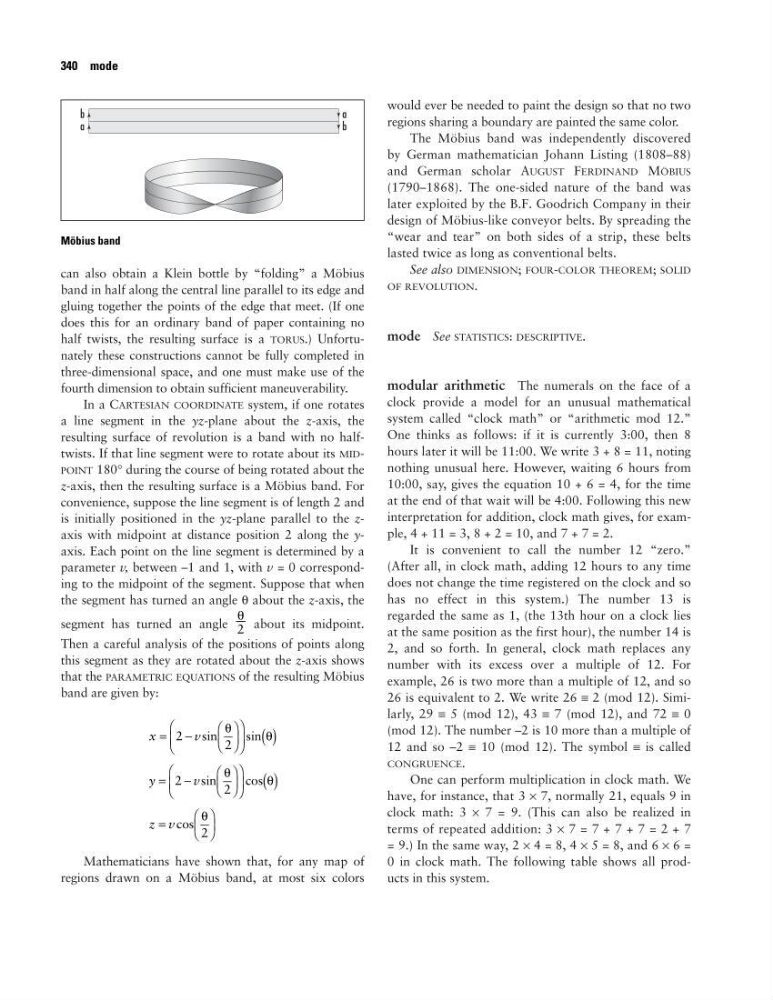
Möbius band
band in half along the central line parallel to its edge and
gluing together the points of the edge that meet. (If one
does this for an ordinary band of paper containing no
half twists, the resulting surface is a TORUS.) Unfortunately these constructions cannot be fully completed in
three-dimensional space, and one must make use of the
fourth dimension to obtain sufficient maneuverability.
In a CARTESIAN COORDINATE system, if one rotates
a line segment in the yz-plane about the z-axis, the
resulting surface of revolution is a band with no halftwists. If that line segment were to rotate about its MIDPOINT 180° during the course of being rotated about the
z-axis, then the resulting surface is a Möbius band. For
convenience, suppose the line segment is of length 2 and
is initially positioned in the yz-plane parallel to the zaxis with midpoint at distance position 2 along the yaxis. Each point on the line segment is determined by a
parameter v, between –1 and 1, with v = 0 corresponding to the midpoint of the segment. Suppose that when
the segment has turned an angle θ about the z-axis, the
segment has turned an angle
about its midpoint.
Then a careful analysis of the positions of points along
this segment as they are rotated about the z-axis shows
that the PARAMETRIC EQUATIONS of the resulting Möbius
band are given by:
Mathematicians have shown that, for any map of
regions drawn on a Möbius band, at most six colors
would ever be needed to paint the design so that no two
regions sharing a boundary are painted the same color.
The Möbius band was independently discovered
by German mathematician Johann Listing (1808–88)
and German scholar AUGUST FERDINAND MÖBIUS
(1790–1868). The one-sided nature of the band was
later exploited by the B.F. Goodrich Company in their
design of Möbius-like conveyor belts. By spreading the
“wear and tear” on both sides of a strip, these belts
lasted twice as long as conventional belts.
See also DIMENSION; FOUR-COLOR THEOREM; SOLID
OF REVOLUTION.
mode See STATISTICS: DESCRIPTIVE.
modular arithmetic The numerals on the face of a
clock provide a model for an unusual mathematical
system called “clock math” or “arithmetic mod 12.”
One thinks as follows: if it is currently 3:00, then 8
hours later it will be 11:00. We write 3 + 8 = 11, noting
nothing unusual here. However, waiting 6 hours from
10:00, say, gives the equation 10 + 6 = 4, for the time
at the end of that wait will be 4:00. Following this new
interpretation for addition, clock math gives, for example, 4 + 11 = 3, 8 + 2 = 10, and 7 + 7 = 2.
It is convenient to call the number 12 “zero.”
(After all, in clock math, adding 12 hours to any time
does not change the time registered on the clock and so
has no effect in this system.) The number 13 is
regarded the same as 1, (the 13th hour on a clock lies
at the same position as the first hour), the number 14 is
2, and so forth. In general, clock math replaces any
number with its excess over a multiple of 12. For
example, 26 is two more than a multiple of 12, and so
26 is equivalent to 2. We write 26 ≡ 2 (mod 12). Similarly, 29 ≡ 5 (mod 12), 43 ≡ 7 (mod 12), and 72 ≡ 0
(mod 12). The number –2 is 10 more than a multiple of
12 and so –2 ≡ 10 (mod 12). The symbol ≡ is called
CONGRUENCE.
One can perform multiplication in clock math. We
have, for instance, that 3 × 7, normally 21, equals 9 in
clock math: 3 × 7 = 9. (This can also be realized in
terms of repeated addition: 3 × 7 = 7 + 7 + 7 = 2 + 7
= 9.) In the same way, 2 × 4 = 8, 4 × 5 = 8, and 6 × 6 =
0 in clock math. The following table shows all products in this system.
x
v
y
v
z v
= −
( )
= −
( )
=
2
2
2
2
2
sin
sin
sin
cos
cos
θ
θ
θ
θ
θ
θ
–
2
340 mode
Möbius band