

had succeeded in extending Euler’s result in establishing
that e raised to a fractional power, e
p
–
q
, is never rational,
and, moreover, noting that tan
= 1, that
also cannot
be rational. Lambert also conjectured that both e and π
are TRANSCENDENTAL NUMBERs. (It was not for another
100 years that, in 1873, French mathematician Charles
Hermite proved the transcendence of e, and German
mathematician CARL LOUIS FERDINAND VON LINDEMANN, in 1883, the transcendence of π.)
Lambert also worked on the theory of PROBABILITY
and, in physics, made important contributions to the
study of heat and light. He died in Berlin, Germany, on
September 25, 1777. Much of Lambert’s work, although
significant at his time, can be seen today as having paved
the way for others to achieve greater advances.
Laplace, Pierre-Simon, marquis de (1749–1827)
French Mechanics, Analysis, Differential equations,
Probability theory Born on March 23, 1749, in Normandy, France, scholar Pierre-Simon Laplace is best
remembered for his influential five-volume treatise
Traité de mécanique céleste (Celestial mechanics), published between the years 1799 and 1825. In this work
Laplace tried to develop a rigorous mathematical
understanding of the motion of the heavenly bodies,
including the various anomalies and inequalities that
were observed in their orbits. In doing so, Laplace
made significant strides in the development of DIFFERENTIAL EQUATIONs, DIFFERENCE equations, PROBABILITY, and STATISTICS. He was the first to extend SIR
ISAAC NEWTON’s theory of gravitation to the study of
the whole solar system. In 1812 Laplace also published
his Théorie analytique des probabilités (Analytic theory
of probability), which advanced the topics of probability and statistics considerably.
At the age of 16 Laplace entered Caen University
and soon discovered a love for mathematics. Three
years later, without completing his degree, Laplace
moved to Paris to work with the mathematician JEAN
LE ROND D’ALEMBERT (1717–83), supporting himself
as a professor of mathematics at the École Militaire. By
the time he was 24, Laplace had produced 13 highquality papers on the topics of INTEGRAL CALCULUS,
mechanics, and physical astronomy, earning him
national attention. He continued to produce fundamentally important results, and was soon regarded as one
of the most influential scientists of his time.
In 1773 Laplace was elected to the Paris Académie
des Sciences and was awarded a senior position there
12 years later. He was assigned to a special committtee
of the Paris Académie in 1790 with the charge of standardizing all European weights and measures.
Laplace’s work on celestial mechanics was revolutionary. In 1786 he had proved that the small perturbations observed in the orbital motion of the planets
will forever remain small, constant, and self-correcting, and in 1796 he was the first to propose the idea
that the solar system originated from the contraction
and cooling of a large rotating, and consequently flattened, nebula of incandescent gas. In 1799 he published the first two volumes of his famous Mécanique
céleste, in which he described the general laws of
motion of solids and fluids, applied the universal law
of gravity to studies of the solar system, and developed
methods for analyzing the difference and differential
π
–
4
π
–
4
Laplace, Pierre-Simon, marquis de 301
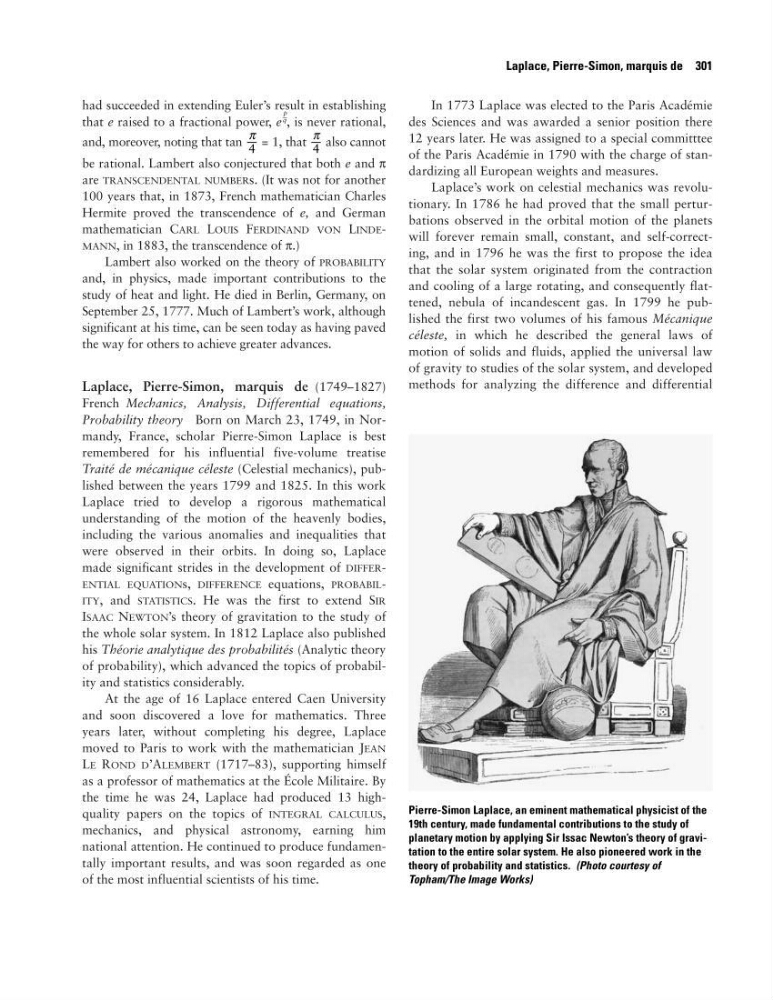
Pierre-Simon Laplace, an eminent mathematical physicist of the
19th century, made fundamental contributions to the study of
planetary motion by applying Sir Issac Newton’s theory of gravitation to the entire solar system. He also pioneered work in the
theory of probability and statistics. (Photo courtesy of
Topham/The Image Works)
that e raised to a fractional power, e
p
–
q
, is never rational,
and, moreover, noting that tan
= 1, that
also cannot
be rational. Lambert also conjectured that both e and π
are TRANSCENDENTAL NUMBERs. (It was not for another
100 years that, in 1873, French mathematician Charles
Hermite proved the transcendence of e, and German
mathematician CARL LOUIS FERDINAND VON LINDEMANN, in 1883, the transcendence of π.)
Lambert also worked on the theory of PROBABILITY
and, in physics, made important contributions to the
study of heat and light. He died in Berlin, Germany, on
September 25, 1777. Much of Lambert’s work, although
significant at his time, can be seen today as having paved
the way for others to achieve greater advances.
Laplace, Pierre-Simon, marquis de (1749–1827)
French Mechanics, Analysis, Differential equations,
Probability theory Born on March 23, 1749, in Normandy, France, scholar Pierre-Simon Laplace is best
remembered for his influential five-volume treatise
Traité de mécanique céleste (Celestial mechanics), published between the years 1799 and 1825. In this work
Laplace tried to develop a rigorous mathematical
understanding of the motion of the heavenly bodies,
including the various anomalies and inequalities that
were observed in their orbits. In doing so, Laplace
made significant strides in the development of DIFFERENTIAL EQUATIONs, DIFFERENCE equations, PROBABILITY, and STATISTICS. He was the first to extend SIR
ISAAC NEWTON’s theory of gravitation to the study of
the whole solar system. In 1812 Laplace also published
his Théorie analytique des probabilités (Analytic theory
of probability), which advanced the topics of probability and statistics considerably.
At the age of 16 Laplace entered Caen University
and soon discovered a love for mathematics. Three
years later, without completing his degree, Laplace
moved to Paris to work with the mathematician JEAN
LE ROND D’ALEMBERT (1717–83), supporting himself
as a professor of mathematics at the École Militaire. By
the time he was 24, Laplace had produced 13 highquality papers on the topics of INTEGRAL CALCULUS,
mechanics, and physical astronomy, earning him
national attention. He continued to produce fundamentally important results, and was soon regarded as one
of the most influential scientists of his time.
In 1773 Laplace was elected to the Paris Académie
des Sciences and was awarded a senior position there
12 years later. He was assigned to a special committtee
of the Paris Académie in 1790 with the charge of standardizing all European weights and measures.
Laplace’s work on celestial mechanics was revolutionary. In 1786 he had proved that the small perturbations observed in the orbital motion of the planets
will forever remain small, constant, and self-correcting, and in 1796 he was the first to propose the idea
that the solar system originated from the contraction
and cooling of a large rotating, and consequently flattened, nebula of incandescent gas. In 1799 he published the first two volumes of his famous Mécanique
céleste, in which he described the general laws of
motion of solids and fluids, applied the universal law
of gravity to studies of the solar system, and developed
methods for analyzing the difference and differential
π
–
4
π
–
4
Laplace, Pierre-Simon, marquis de 301
Pierre-Simon Laplace, an eminent mathematical physicist of the
19th century, made fundamental contributions to the study of
planetary motion by applying Sir Issac Newton’s theory of gravitation to the entire solar system. He also pioneered work in the
theory of probability and statistics. (Photo courtesy of
Topham/The Image Works)