

worked with the Paris Académie to standardize the
weights and measures of the day. The committee formulated the metric system and advocated the general
use of a decimal base.
Lagrange’s significant achievements were recognized by the emperor Napoleon in 1808, when he was
named to the Legion of Honour and a count of the
empire. Five years later he was also named Grand
Croix of the Ordre Impérial de la Réunion. He died in
Paris, France, on April 10, 1813.
Lagrange’s impact in mathematics, especially in
mathematical physics, is still felt today. Many fundamental concepts in mechanics and multivariable calculus—such as the Lagrangian (the difference between
kinetic energy and potential energy of a set of particles), the Lagrangian description (a measure of deformation of a physical body), and Lagrange multipliers
in calculus—play a vital role in the current study of
these subjects.
See also LAGRANGE’S FORMULA.
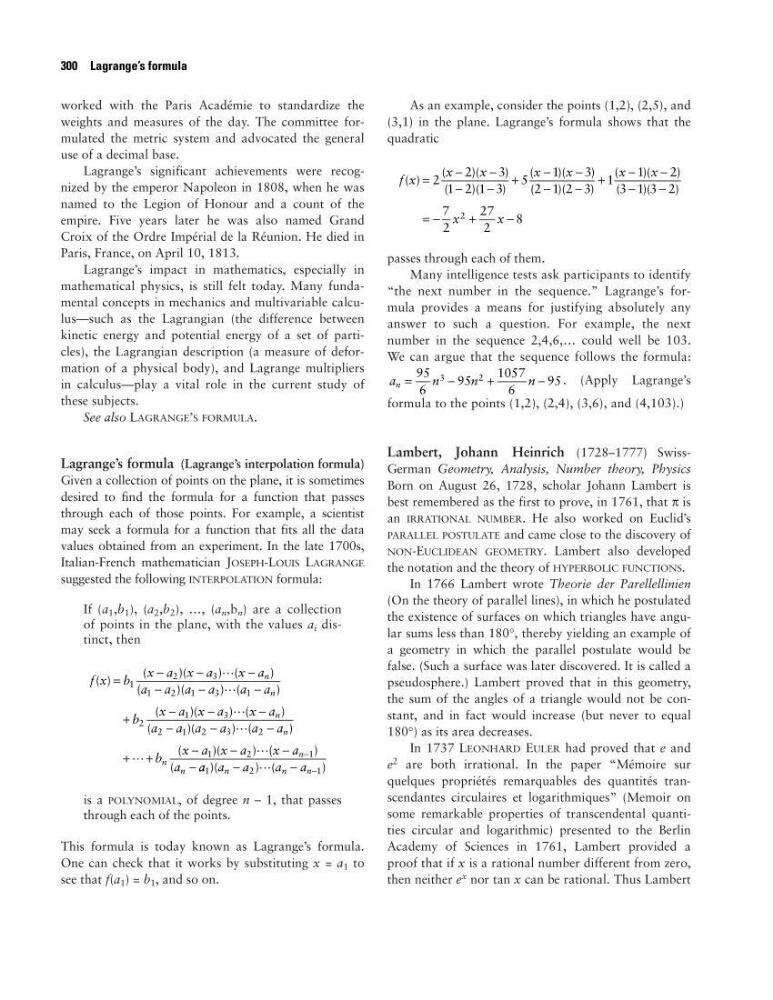
Lagrange’s formula (Lagrange’s interpolation formula)
Given a collection of points on the plane, it is sometimes
desired to find the formula for a function that passes
through each of those points. For example, a scientist
may seek a formula for a function that fits all the data
values obtained from an experiment. In the late 1700s,
Italian-French mathematician JOSEPH-LOUIS LAGRANGE
suggested the following INTERPOLATION formula:
If (a 1 ,b 1 ), (a 2 ,b 2 ), …, (a n ,b n ) are a collection
of points in the plane, with the values a i distinct, then
is a POLYNOMIAL, of degree n – 1, that passes
through each of the points.
This formula is today known as Lagrange’s formula.
One can check that it works by substituting x = a 1 to
see that f(a 1 ) = b 1 , and so on.
As an example, consider the points (1,2), (2,5), and
(3,1) in the plane. Lagrange’s formula shows that the
quadratic
passes through each of them.
Many intelligence tests ask participants to identify
“the next number in the sequence.” Lagrange’s formula provides a means for justifying absolutely any
answer to such a question. For example, the next
number in the sequence 2,4,6,… could well be 103.
We can argue that the sequence follows the formula:
. (Apply Lagrange’s
formula to the points (1,2), (2,4), (3,6), and (4,103).)
Lambert, Johann Heinrich (1728–1777) SwissGerman Geometry, Analysis, Number theory, Physics
Born on August 26, 1728, scholar Johann Lambert is
best remembered as the first to prove, in 1761, that π is
an IRRATIONAL NUMBER. He also worked on Euclid’s
PARALLEL POSTULATE and came close to the discovery of
NON-EUCLIDEAN GEOMETRY. Lambert also developed
the notation and the theory of HYPERBOLIC FUNCTIONS.
In 1766 Lambert wrote Theorie der Parellellinien
(On the theory of parallel lines), in which he postulated
the existence of surfaces on which triangles have angular sums less than 180°, thereby yielding an example of
a geometry in which the parallel postulate would be
false. (Such a surface was later discovered. It is called a
pseudosphere.) Lambert proved that in this geometry,
the sum of the angles of a triangle would not be constant, and in fact would increase (but never to equal
180°) as its area decreases.
In 1737 LEONHARD EULER had proved that e and
e
2 are both irrational. In the paper “Mémoire sur
quelques propriétés remarquables des quantités transcendantes circulaires et logarithmiques” (Memoir on
some remarkable properties of transcendental quantities circular and logarithmic) presented to the Berlin
Academy of Sciences in 1761, Lambert provided a
proof that if x is a rational number different from zero,
then neither e
x nor tan x can be rational. Thus Lambert
a
n
n
n
n =
−
+
−
95
6
95
1057
6
95
3
2
f x
x
x
x
x
x
x
x
x
( )
(
)(
)
(
)(
)
(
)(
)
(
)(
)
(
)(
)
(
)(
)
=
−
−
−
−
+
−
−
−
−
+
−
−
−
−
= −
+
−
2
2
3
1 2 1 3
5
1
3
2 1 2 3
1
1
2
3 1 3 2
7
2
27
2
8
2
f x b
x a x a
x a
a a a a
a a
b
x a x a
x a
a a a a
a a
b
x a x a
x a
a
n
n
n
n
n
n
n
( )
(
)(
) (
)
(
)(
) (
)
(
)(
) (
)
(
)(
) (
)
(
)(
) (
)
(
=
−
−
−
−
−
−
+
−
−
−
−
−
−
+ +
−
−
−
−
−
1
2
3
1
2
1
3
1
2
1
3
2
1
2
3
2
1
2
1
L
L
L
L
L
L
a a a a
a a
n
n
n
1
2
1
)(
) (
)
−
− −
L
300 Lagrange’s formula
weights and measures of the day. The committee formulated the metric system and advocated the general
use of a decimal base.
Lagrange’s significant achievements were recognized by the emperor Napoleon in 1808, when he was
named to the Legion of Honour and a count of the
empire. Five years later he was also named Grand
Croix of the Ordre Impérial de la Réunion. He died in
Paris, France, on April 10, 1813.
Lagrange’s impact in mathematics, especially in
mathematical physics, is still felt today. Many fundamental concepts in mechanics and multivariable calculus—such as the Lagrangian (the difference between
kinetic energy and potential energy of a set of particles), the Lagrangian description (a measure of deformation of a physical body), and Lagrange multipliers
in calculus—play a vital role in the current study of
these subjects.
See also LAGRANGE’S FORMULA.
Lagrange’s formula (Lagrange’s interpolation formula)
Given a collection of points on the plane, it is sometimes
desired to find the formula for a function that passes
through each of those points. For example, a scientist
may seek a formula for a function that fits all the data
values obtained from an experiment. In the late 1700s,
Italian-French mathematician JOSEPH-LOUIS LAGRANGE
suggested the following INTERPOLATION formula:
If (a 1 ,b 1 ), (a 2 ,b 2 ), …, (a n ,b n ) are a collection
of points in the plane, with the values a i distinct, then
is a POLYNOMIAL, of degree n – 1, that passes
through each of the points.
This formula is today known as Lagrange’s formula.
One can check that it works by substituting x = a 1 to
see that f(a 1 ) = b 1 , and so on.
As an example, consider the points (1,2), (2,5), and
(3,1) in the plane. Lagrange’s formula shows that the
quadratic
passes through each of them.
Many intelligence tests ask participants to identify
“the next number in the sequence.” Lagrange’s formula provides a means for justifying absolutely any
answer to such a question. For example, the next
number in the sequence 2,4,6,… could well be 103.
We can argue that the sequence follows the formula:
. (Apply Lagrange’s
formula to the points (1,2), (2,4), (3,6), and (4,103).)
Lambert, Johann Heinrich (1728–1777) SwissGerman Geometry, Analysis, Number theory, Physics
Born on August 26, 1728, scholar Johann Lambert is
best remembered as the first to prove, in 1761, that π is
an IRRATIONAL NUMBER. He also worked on Euclid’s
PARALLEL POSTULATE and came close to the discovery of
NON-EUCLIDEAN GEOMETRY. Lambert also developed
the notation and the theory of HYPERBOLIC FUNCTIONS.
In 1766 Lambert wrote Theorie der Parellellinien
(On the theory of parallel lines), in which he postulated
the existence of surfaces on which triangles have angular sums less than 180°, thereby yielding an example of
a geometry in which the parallel postulate would be
false. (Such a surface was later discovered. It is called a
pseudosphere.) Lambert proved that in this geometry,
the sum of the angles of a triangle would not be constant, and in fact would increase (but never to equal
180°) as its area decreases.
In 1737 LEONHARD EULER had proved that e and
e
2 are both irrational. In the paper “Mémoire sur
quelques propriétés remarquables des quantités transcendantes circulaires et logarithmiques” (Memoir on
some remarkable properties of transcendental quantities circular and logarithmic) presented to the Berlin
Academy of Sciences in 1761, Lambert provided a
proof that if x is a rational number different from zero,
then neither e
x nor tan x can be rational. Thus Lambert
a
n
n
n
n =
−
+
−
95
6
95
1057
6
95
3
2
f x
x
x
x
x
x
x
x
x
( )
(
)(
)
(
)(
)
(
)(
)
(
)(
)
(
)(
)
(
)(
)
=
−
−
−
−
+
−
−
−
−
+
−
−
−
−
= −
+
−
2
2
3
1 2 1 3
5
1
3
2 1 2 3
1
1
2
3 1 3 2
7
2
27
2
8
2
f x b
x a x a
x a
a a a a
a a
b
x a x a
x a
a a a a
a a
b
x a x a
x a
a
n
n
n
n
n
n
n
( )
(
)(
) (
)
(
)(
) (
)
(
)(
) (
)
(
)(
) (
)
(
)(
) (
)
(
=
−
−
−
−
−
−
+
−
−
−
−
−
−
+ +
−
−
−
−
−
1
2
3
1
2
1
3
1
2
1
3
2
1
2
3
2
1
2
1
L
L
L
L
L
L
a a a a
a a
n
n
n
1
2
1
)(
) (
)
−
− −
L
300 Lagrange’s formula