

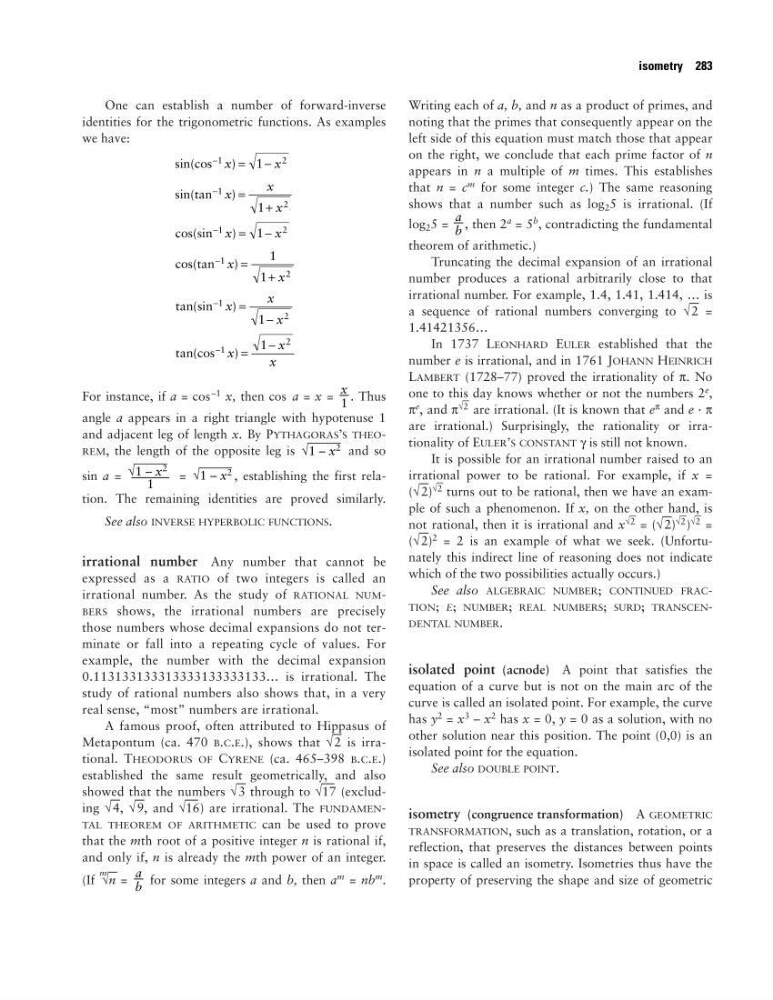
One can establish a number of forward-inverse
identities for the trigonometric functions. As examples
we have:
For instance, if a = cos
–1 x, then cos a = x = . Thus
angle a appears in a right triangle with hypotenuse 1
and adjacent leg of length x. By PYTHAGORAS’S THEOREM, the length of the opposite leg is
and so
sin a =
=
, establishing the first relation. The remaining identities are proved similarly.
See also INVERSE HYPERBOLIC FUNCTIONS.
irrational number Any number that cannot be
expressed as a RATIO of two integers is called an
irrational number. As the study of RATIONAL NUMBERS shows, the irrational numbers are precisely
those numbers whose decimal expansions do not terminate or fall into a repeating cycle of values. For
example, the number with the decimal expansion
0.113133133313333133333133… is irrational. The
study of rational numbers also shows that, in a very
real sense, “most” numbers are irrational.
A famous proof, often attributed to Hippasus of
Metapontum (ca. 470 B.C.E.), shows that √
–
2 is irrational. THEODORUS OF CYRENE (ca. 465–398 B.C.E.)
established the same result geometrically, and also
showed that the numbers √
–
3 through to √
–
17 (excluding √
–
4, √
–
9, and √
–
16) are irrational. The FUNDAMENTAL THEOREM OF ARITHMETIC can be used to prove
that the mth root of a positive integer n is rational if,
and only if, n is already the mth power of an integer.
(If
m
√
–
n =
for some integers a and b, then a
m = nb
m
.
Writing each of a, b, and n as a product of primes, and
noting that the primes that consequently appear on the
left side of this equation must match those that appear
on the right, we conclude that each prime factor of n
appears in n a multiple of m times. This establishes
that n = c
m for some integer c.) The same reasoning
shows that a number such as log 2 5 is irrational. (If
log 2 5 = , then 2
a = 5
b , contradicting the fundamental
theorem of arithmetic.)
Truncating the decimal expansion of an irrational
number produces a rational arbitrarily close to that
irrational number. For example, 1.4, 1.41, 1.414, … is
a sequence of rational numbers converging to √
–
2 =
1.41421356…
In 1737 LEONHARD EULER established that the
number e is irrational, and in 1761 JOHANN HEINRICH
LAMBERT (1728–77) proved the irrationality of π. No
one to this day knows whether or not the numbers 2
e
,
π
e
, and π
√
–
2 are irrational. (It is known that e
π and e · π
are irrational.) Surprisingly, the rationality or irrationality of EULER’S CONSTANT γ is still not known.
It is possible for an irrational number raised to an
irrational power to be rational. For example, if x =
(√
–
2)
√
–
2 turns out to be rational, then we have an example of such a phenomenon. If x, on the other hand, is
not rational, then it is irrational and x
√
–
2 = (√
–
2)
√
–
2 )
√
–
2 =
(√
–
2)
2 = 2 is an example of what we seek. (Unfortunately this indirect line of reasoning does not indicate
which of the two possibilities actually occurs.)
See also ALGEBRAIC NUMBER; CONTINUED FRACTION; E; NUMBER; REAL NUMBERS; SURD; TRANSCENDENTAL NUMBER.
isolated point (acnode) A point that satisfies the
equation of a curve but is not on the main arc of the
curve is called an isolated point. For example, the curve
has y
2 = x
3 – x
2 has x = 0, y = 0 as a solution, with no
other solution near this position. The point (0,0) is an
isolated point for the equation.
See also DOUBLE POINT.
isometry (congruence transformation) A GEOMETRIC
TRANSFORMATION, such as a translation, rotation, or a
reflection, that preserves the distances between points
in space is called an isometry. Isometries thus have the
property of preserving the shape and size of geometric
a
–
b
a
–
b
√1 – x
2
√1 – x
2
–––––
1
√1 – x
2
x
–
1
sin(cos
)
sin(tan
)
cos(sin
)
cos(tan
)
tan(sin
)
tan(cos
)
−
−
−
−
−
−
=
−
=
+
=
−
=
+
=
−
=
−
1
2
1
2
1
2
1
2
1
2
1
2
1
1
1
1
1
1
1
x
x
x
x
x
x
x
x
x
x
x
x
x
x
x
isometry 283
identities for the trigonometric functions. As examples
we have:
For instance, if a = cos
–1 x, then cos a = x = . Thus
angle a appears in a right triangle with hypotenuse 1
and adjacent leg of length x. By PYTHAGORAS’S THEOREM, the length of the opposite leg is
and so
sin a =
=
, establishing the first relation. The remaining identities are proved similarly.
See also INVERSE HYPERBOLIC FUNCTIONS.
irrational number Any number that cannot be
expressed as a RATIO of two integers is called an
irrational number. As the study of RATIONAL NUMBERS shows, the irrational numbers are precisely
those numbers whose decimal expansions do not terminate or fall into a repeating cycle of values. For
example, the number with the decimal expansion
0.113133133313333133333133… is irrational. The
study of rational numbers also shows that, in a very
real sense, “most” numbers are irrational.
A famous proof, often attributed to Hippasus of
Metapontum (ca. 470 B.C.E.), shows that √
–
2 is irrational. THEODORUS OF CYRENE (ca. 465–398 B.C.E.)
established the same result geometrically, and also
showed that the numbers √
–
3 through to √
–
17 (excluding √
–
4, √
–
9, and √
–
16) are irrational. The FUNDAMENTAL THEOREM OF ARITHMETIC can be used to prove
that the mth root of a positive integer n is rational if,
and only if, n is already the mth power of an integer.
(If
m
√
–
n =
for some integers a and b, then a
m = nb
m
.
Writing each of a, b, and n as a product of primes, and
noting that the primes that consequently appear on the
left side of this equation must match those that appear
on the right, we conclude that each prime factor of n
appears in n a multiple of m times. This establishes
that n = c
m for some integer c.) The same reasoning
shows that a number such as log 2 5 is irrational. (If
log 2 5 = , then 2
a = 5
b , contradicting the fundamental
theorem of arithmetic.)
Truncating the decimal expansion of an irrational
number produces a rational arbitrarily close to that
irrational number. For example, 1.4, 1.41, 1.414, … is
a sequence of rational numbers converging to √
–
2 =
1.41421356…
In 1737 LEONHARD EULER established that the
number e is irrational, and in 1761 JOHANN HEINRICH
LAMBERT (1728–77) proved the irrationality of π. No
one to this day knows whether or not the numbers 2
e
,
π
e
, and π
√
–
2 are irrational. (It is known that e
π and e · π
are irrational.) Surprisingly, the rationality or irrationality of EULER’S CONSTANT γ is still not known.
It is possible for an irrational number raised to an
irrational power to be rational. For example, if x =
(√
–
2)
√
–
2 turns out to be rational, then we have an example of such a phenomenon. If x, on the other hand, is
not rational, then it is irrational and x
√
–
2 = (√
–
2)
√
–
2 )
√
–
2 =
(√
–
2)
2 = 2 is an example of what we seek. (Unfortunately this indirect line of reasoning does not indicate
which of the two possibilities actually occurs.)
See also ALGEBRAIC NUMBER; CONTINUED FRACTION; E; NUMBER; REAL NUMBERS; SURD; TRANSCENDENTAL NUMBER.
isolated point (acnode) A point that satisfies the
equation of a curve but is not on the main arc of the
curve is called an isolated point. For example, the curve
has y
2 = x
3 – x
2 has x = 0, y = 0 as a solution, with no
other solution near this position. The point (0,0) is an
isolated point for the equation.
See also DOUBLE POINT.
isometry (congruence transformation) A GEOMETRIC
TRANSFORMATION, such as a translation, rotation, or a
reflection, that preserves the distances between points
in space is called an isometry. Isometries thus have the
property of preserving the shape and size of geometric
a
–
b
a
–
b
√1 – x
2
√1 – x
2
–––––
1
√1 – x
2
x
–
1
sin(cos
)
sin(tan
)
cos(sin
)
cos(tan
)
tan(sin
)
tan(cos
)
−
−
−
−
−
−
=
−
=
+
=
−
=
+
=
−
=
−
1
2
1
2
1
2
1
2
1
2
1
2
1
1
1
1
1
1
1
x
x
x
x
x
x
x
x
x
x
x
x
x
x
x
isometry 283